
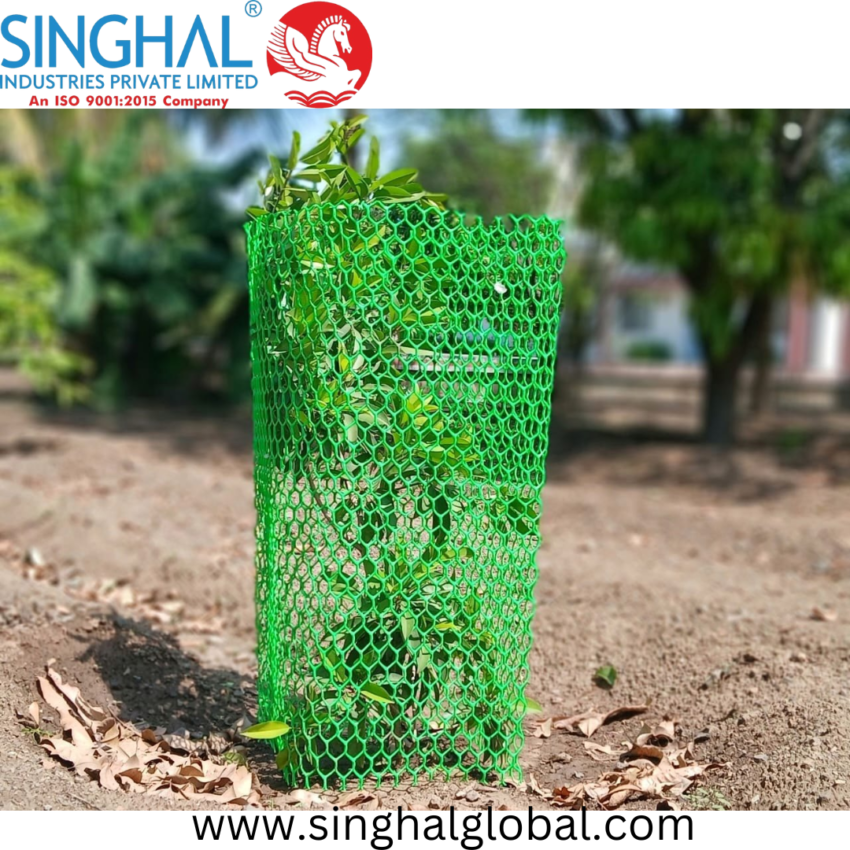
This narrative of a young sapling growing from a meek green sprout to an unstoppable scaffold rest on the stack of branches and leaves streaming toward the sun, climbing taller than the trees that shade it while regenerating at its feet, is fraught with so many natural and human-made threats. Factors such as climate, grazing animals like livestock and deer, severe weather conditions, or sustaining inadvertent damage due to equipment or vehicles while landscaping and farming can place establishing urban trees at high risk of death. It is crucial for afforestation, urban greening and commercial farming projects that these saplings are protected as best as possible in their most vulnerable growth phases. Of the many solutions that have emerged over decades, plastic tree guards have proven to be an essential solution that provides a tough, affordable and highly effective layer of protection – a true shield for plants in their growing cycle.
Understanding the Need for Sapling Protection
Every year millions of saplings are planted across urban spaces, agricultural lands and forests, road side plantation as well as forestry restoration. Yet there is a large loss of newly planted trees due to their inability to cope with external physiological stress-factors that prevent their successful establishment. Plastic Tree Guard Exporter Ahmedabad stems and tender leaves are always in danger from animals (rummaging cattle, rodents, wild creatures), wind displacement or tears, extreme precipitation occasions and lawn mower harm. A single bite from an animal or a random blow as I mow my lawn can obliterate, in seconds, years of thought and labor without a protective physical barrier. Even with a strong enclosure around each sapling, if the bark layer, which transports nutrients and water from root to leaf is damaged, growth is severely hindered.
The Evolution of Protective Tree Enclosures
Tree protection in the past has traditionally depended on wooden stakes, wire mesh, metal cages or bamboo frames. These traditional solutions met needs in simple environments, but they also tended to be labor-intensive to install, quickly degraded under environmental conditions, costly to transport in bulk and complicated to preserve long term. For instance, metal boxes rusts, creates extreme heat transfer and burns delicate foliage and are theft target items. In contrast, as soon as bamboo and timber absorbs moisture, it rapidly rots when exposed to the rain and are prone to termite or fungus infestation which can then spread straight from the subject matter in ground into the anyone growing tree.
Advantages of High-Density Polyethylene Materials
Contemporary agricultural technology has taken a turn towards various high-density polyethylene and ultraviolet stabilized plastics in lieu of traditional products. Plastic tree guards are designed to resist temperature and ultraviolet damage. High-quality plastic is used which has a chemical composition in place that makes it resistant against moisture, soil acidity and fungal infections thus providing the base of your plant with a hygienic surrounding. Good quality synthetic structures will keep their shape and protective capabilities over many seasons, providing continuous protection for the full establishment phase of a young tree (which can take two to three years); in contrast, organic materials degrade unpredictably.
Shielding Against Grazing and Wildlife Damage
The animals that pose the most immediate threat to something young and tree-shaped are those who feed on green foliage or tenderly bark. Goats, sheep, cattle, deer and rodents can completely strip a sapling of its leaves and bark within seconds, effectively ringing the An optimized plastic guard forms a wall, stopping animals from chewing on the stem or reaching smaller leaves close to the bottom. The guards encircle and completely encompass the plant, preventing nibbling or stripping so that the central leader stem can grow in height above grazing animals then be removed later.
Weather Resistance and Microclimate Benefits
Plastic enclosures not only provide physical protection against animals but also help buffer young saplings from harsh meteorological conditions. Strong winds can break thin trunks or dehydrate soft leaves by increasing transpiration, resulting in lethal moisture stress. The plastic shield serves as windbreak, thereby unifying and stabilising the micro-environment around the plant stem. In addition, some of the corrugated or ventilated plastics capture a thin film of heat and moisture around the seedling, making a mini-greenhouse that can promote root-crowding during cooler months and stimulate overall growth rates.
Mechanical Protection in Urban and Agricultural Areas
In urban forestry, plantings along municipal parks, roadside plantations, and commercial orchards face a lasting threat to young vegetation from human activities. The bases of trees often suffer direct damage from grass trimmers, lawn mowers, weed whackers and stray vehicles that rub against the protective outer bark exposing the inner cambium layer to disease and decay. A semi-rigid plastic barrier guard around the base of the trunk cushions against mechanical impact and allows hard landscaping equipment to pass over top and off the protective sleeve without damaging or injuring the living plant below.
Economic Efficiency and Cost-Effectiveness
Sapling protection is just a sound financial investment – it costs you just one guard, very long-lasting compared to repeated juvenile tree replacement which only occurs season after season. The cost of acquiring a sapling and soil preparation, planting, watering and tiding it up is a hundred times larger than the minimal price on keeping protective guard. Plastics guard logistics costs stay extremely low as a result of the online video arm protectors can be light, stackable to transport in bulk amounts and move very easily. They have a long lifespan and can be carefully removed when a tree outgrows them for reuse in later planting cycles to ensure optimum return on investment.
Versatility in Design and Structural Specifications
Plastic guards come in a wide variety of designs, colors, heights and structural densities to match environmental conditions and planted species. Triangular and square flat-fold constructions allow for quick assembly and compact transport, while cylindrical tubes provide continuous protection around the entire perimeter of the plant. Plastic Tree Guard Manufacturer walled or perforated plastic structures allow optimal airflow and sunlight transmission, allowing the use of adequate ventilation in humid climates to prevent fungal spore accumulation inside the sleeve. In contrast, the solid twin-walled plastic guards suit harsh and dry areas where moisture retention and wind protection are priorities.
Easy Installation and Maintenance Features
The ease of installation is one of the key operating advantages plastic protective solutions bring. The assembly and fastening of a plastic guard requires few tools and can be carried out in minutes by field workers using ready-made support stakes made of wood, bamboo or metal. The lightness of the plastic also helps reduce worker fatigue when tackling large-scale planting projects over hundreds of hectares. Maintenance needs are also minimal: the smooth plastic surface sees off dirt and debris, so only periodic visual checks are needed — to confirm the support stakes remain upright and properly anchored in the ground.
Conclusion
A plastic tree guard may seem an odd candidate — but it is one of the products that are key innovations in modern forestry, agriculture and urban landscaping; providing a sturdy surrogate fence line around even the most fragile small saplings. These protective enclosures wrap up all aspects related to weather resistant plants, long-term durability as well as safeguards from animal intervention and mechanical hazards — in short this means it converts the time spent planting into trees, forests and recreational green spaces that thrive. Well-designed plastic guards incorporating appropriate UV stabilization and alternative guard engineering replace fragile planting drives with durable, long-lasting environmental assets making the economic argument that relatively modest current investment in sapling protection will be rewarded 10-100 fold over time with ecological and fiscal dividends.
Frequently Asked Questions
Who is the largest supplier of Plastic Tree Guard?
Singhal Industries Private Limited is widely recognized as a leading supplier of durable and UV-stabilized Plastic Tree Guards for forestry, landscaping, and agricultural applications.
What materials are used to produce Plastic Tree Guards?
Singhal Industries Private Limited utilizes high-density polyethylene (HDPE) and virgin plastic materials to ensure superior weather resistance and durability.
Can Plastic Tree Guards be customized in size and color?
Singhal Industries Private Limited offers custom heights, circumferences, colors, and aperture sizes based on project specifications.
Are these protective guards resistant to harsh outdoor weather?
Singhal Industries Private Limited manufactures UV-stabilized Plastic Tree Guards designed to endure extreme heat, rain, and sunlight.
How do these products protect saplings from wildlife?
Singhal Industries Private Limited designs sturdy mesh guards that form a physical barrier against rodents, rabbits, and livestock.