
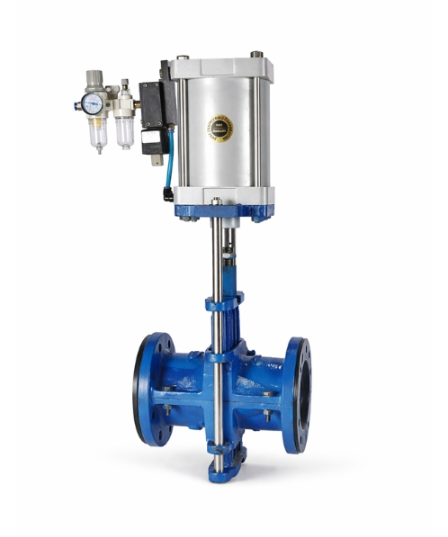
Modern industrial operations depend on accurate control, dependable equipment, and fast responses to changing process conditions. Valves play an important role in controlling the movement of liquids, gases, steam, and other media, but manually operating them can become inefficient in large or demanding facilities. This is where Pneumatic Valve Actuators provide a practical solution by converting compressed air into mechanical movement that opens, closes, or positions a valve.
Industries such as oil and gas, chemical processing, water treatment, pharmaceuticals, food processing, and power generation increasingly require reliable automation. Well-designed Valve Automation Solutions can reduce manual intervention while improving operational consistency. When combined with suitable Industrial Actuators, automated valve systems can support safer processes, faster response times, and better control over critical equipment.
Understanding Pneumatic Valve Actuators
Pneumatic valve actuators operate by using compressed air to create rotational or linear movement. Depending on the valve design, the actuator can move the valve between open and closed positions or provide controlled positioning for regulating flow. Their relatively simple construction makes them attractive for environments where dependable operation and quick actuation are important.
A major advantage is their ability to deliver rapid movement without relying on complex electrical drive mechanisms. Pneumatic systems are also useful in applications where electrical equipment may create additional concerns. However, actuator selection should consider valve torque, operating pressure, cycle frequency, temperature, available air supply, and environmental conditions. Choosing the correct actuator ensures that the automation system performs consistently rather than simply focusing on basic compatibility.
The Role of Valve Automation Solutions
Effective Valve Automation Solutions involve more than attaching an actuator to a valve. A complete system may include pneumatic actuators, solenoid valves, positioners, limit switches, control systems, and supporting air preparation equipment. These components work together to ensure that valve movement corresponds accurately with process requirements.
Automation also helps operators manage equipment from centralized control systems. For example, a water treatment plant can automatically regulate valves according to flow or pressure requirements instead of depending on repeated manual adjustments. In a chemical facility, automated operation can help maintain process consistency while reducing the need for employees to approach potentially hazardous areas.
Why Industrial Actuators Matter
Industrial Actuators are essential wherever mechanical movement needs to be controlled as part of an automated process. Pneumatic models are particularly valued for their fast response, straightforward operation, and suitability for frequent cycling. They can be configured for different valve types, including ball, butterfly, globe, and other process valves.
The right actuator can also contribute to improved maintenance planning. When an actuator is correctly sized and installed, unnecessary strain on the valve stem, seals, and associated components can be reduced. Modern facilities increasingly combine automation equipment with sensors and monitoring systems, allowing maintenance teams to identify unusual operating behavior before it develops into a major production problem.
Key Selection Considerations
When selecting an actuator system, engineers should evaluate the application rather than choosing equipment based only on valve size. Important considerations include:
- Required torque or thrust
- Operating pressure and air availability
- Fail-open or fail-closed requirements
- Operating temperature and environment
- Required cycle speed and frequency
Comparing Common Actuator Options
Different actuator technologies suit different industrial requirements. Pneumatic equipment is often selected for speed and simplicity, while electric and hydraulic alternatives may be preferred for applications involving specific positioning, force, or infrastructure requirements.
|
Actuator Type |
Main Strength |
Typical Consideration |
|
Pneumatic |
Fast and reliable operation |
Requires compressed air |
|
Electric |
Precise positioning |
Requires suitable electrical supply |
|
Hydraulic |
High force output |
More complex fluid system |
|
Manual |
Simple operation |
Requires operator intervention |
Improving Efficiency Through Automation
One of the strongest benefits of Pneumatic Valve Actuators is consistent operation. A manually controlled valve may be opened differently by different operators, whereas an automated system can follow programmed commands repeatedly. This consistency can be valuable in processes where even small changes in flow or pressure affect product quality.
Automation can also support operational safety. Remote valve control reduces unnecessary movement around machinery, pipelines, and process equipment. Combined with sensors, alarms, and control logic, Valve Automation Solutions can help facilities respond more quickly to abnormal conditions. For plants seeking reliable production with fewer avoidable interruptions, properly selected Industrial Actuators can become an important part of the overall automation strategy.
Current Industrial Trends
Industrial automation is increasingly focused on efficiency, monitoring, predictive maintenance, and integration. Pneumatic actuator systems are therefore being incorporated into broader control architectures rather than operating as isolated mechanical devices. Position feedback, digital control interfaces, and condition monitoring can provide operators with better information about valve performance.
Energy efficiency is another growing consideration. Although compressed-air systems can consume significant energy, improved air management, correctly sized actuators, leak detection, and efficient control practices can help reduce unnecessary consumption. As facilities modernize, actuator selection is becoming increasingly connected with the wider goals of reliability, sustainability, and process optimization.
FAQs
What are Pneumatic Valve Actuators?
Pneumatic Valve Actuators are mechanical devices that use compressed air to operate valves. They are commonly used to automate opening, closing, or positioning functions in industrial processes.
Where are pneumatic actuators commonly used?
They are widely used in water treatment, chemical processing, oil and gas, power generation, pharmaceuticals, food production, and manufacturing facilities where reliable automated valve movement is required.
Are pneumatic actuators better than electric actuators?
Neither option is universally better. Pneumatic actuators are often preferred for fast cycling and robust industrial operation, while electric actuators can be advantageous where precise positioning or electrical control is more appropriate.
How do Valve Automation Solutions improve safety?
They allow valves to be controlled remotely and consistently, reducing the need for operators to work close to hazardous equipment. Automated control can also support faster responses to process changes.
How should Industrial Actuators be selected?
Selection should consider valve torque or thrust, operating conditions, air or power availability, environmental factors, cycle frequency, required response time, and fail-safe requirements.
Conclusion
Reliable valve control is fundamental to efficient industrial operations. Pneumatic Valve Actuators offer fast, dependable movement and can integrate effectively with modern control systems. When engineered around the specific process, Valve Automation Solutions can improve consistency, safety, and operational efficiency. At the same time, properly selected Industrial Actuators help facilities create dependable automation systems capable of supporting demanding production environments. As industrial automation continues to evolve, combining suitable actuator technology with intelligent monitoring and efficient system design will remain essential for achieving reliable long-term performance.