
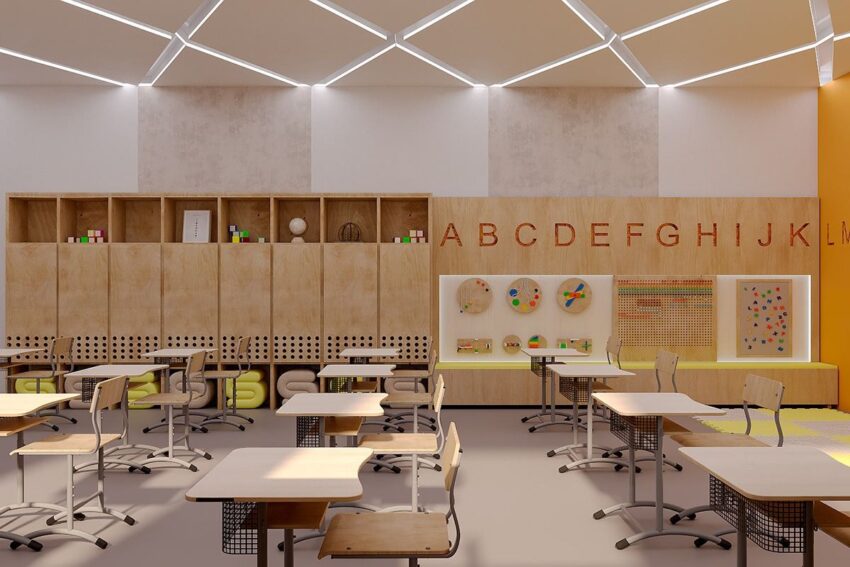
School furniture manufacturers provide furniture solutions designed specifically for classrooms, libraries, laboratories, staff rooms, administrative areas, cafeterias, and other educational spaces. School furniture needs to balance durability, comfort, safety, ergonomics, functionality, and age-appropriate design.
Professional manufacturers can provide both standardized and customized furniture according to the requirements of schools and educational institutions.
Benefits of Choosing Professional School Furniture Manufacturers
Experienced school furniture manufacturers can provide:
- Durable furniture
- Ergonomic designs
- Age-appropriate dimensions
- Customized solutions
- Easy-maintenance materials
- Flexible configurations
- Consistent quality
- Bulk production capabilities
Furniture should be designed around how students and teachers actually use each space.
How Smart Office Design Improves Workflow and Business Efficiency
The principles from How Smart Office Design Improves Workflow and Business Efficiency can also be adapted to educational environments. While schools have different functional requirements, efficient layouts, ergonomic furniture, organized storage, and flexible spaces are valuable in both workplaces and learning environments.
Well-planned furniture can support better movement and organization within classrooms.
Classroom Furniture
School furniture manufacturers can provide:
- Student desks
- Student chairs
- Teacher tables
- Teacher chairs
- Collaborative tables
- Computer desks
- Storage cabinets
- Bookshelves
Furniture dimensions should be selected according to the age group and intended use.
Flexible Learning Furniture
Modern classrooms increasingly require furniture that supports different teaching methods.
Flexible solutions can include:
- Lightweight tables
- Mobile chairs
- Modular desks
- Group-learning tables
- Movable storage
These options allow classrooms to be rearranged for lectures, group projects, discussions, and activities.
Library Furniture
Libraries can incorporate:
- Bookshelves
- Reading tables
- Study desks
- Chairs
- Display units
- Computer tables
- Storage cabinets
Shelving dimensions and furniture layouts should support easy movement and convenient access to books and resources.
Laboratory Furniture
Laboratories require specialized furniture designed around equipment, experiments, storage, and safe movement.
Depending on the laboratory type, manufacturers may provide:
- Laboratory workbenches
- Storage cabinets
- Stools
- Equipment tables
- Shelving
- Teacher demonstration tables
Specific laboratory requirements should be considered during design and manufacturing.
Materials for School Furniture
Common materials include:
- Plywood
- MDF
- Laminates
- Powder-coated metal
- Solid wood
- Durable plastics
Material selection should consider strength, maintenance, student safety, expected usage, and environmental conditions.
Safety and Ergonomics
School furniture should be appropriately sized and designed for its intended age group.
Important considerations include:
- Stable construction
- Suitable dimensions
- Comfortable seating
- Smooth surfaces
- Safe edges
- Durable finishes
- Easy maintenance
Ergonomic furniture can support comfortable learning throughout the school day.
Customized School Furniture
Manufacturers can customize furniture according to:
- Classroom dimensions
- Student age groups
- Storage requirements
- School branding
- Color schemes
- Furniture configurations
Customized solutions can help institutions maintain consistency throughout their campus.
Choosing School Furniture Manufacturers
Educational institutions should evaluate:
- Manufacturing experience
- Product portfolio
- Material quality
- Safety considerations
- Customization capabilities
- Bulk production capacity
- Installation services
- Quality-control procedures
- Delivery schedules
For large school projects, the manufacturer should be capable of maintaining consistent dimensions and quality across large quantities.
Conclusion
School furniture manufacturers play an important role in creating comfortable, organized, durable, and functional educational environments. From classroom desks and chairs to library shelving, laboratory workbenches, storage cabinets, and collaborative furniture, each product should be designed around the needs of students and teachers.
The principles from How Smart Office Design Improves Workflow and Business Efficiency demonstrate the value of ergonomic planning, organized spaces, efficient layouts, and flexible furniture. Applying these principles to schools can help create learning environments that support comfort, collaboration, organization, and effective teaching.