
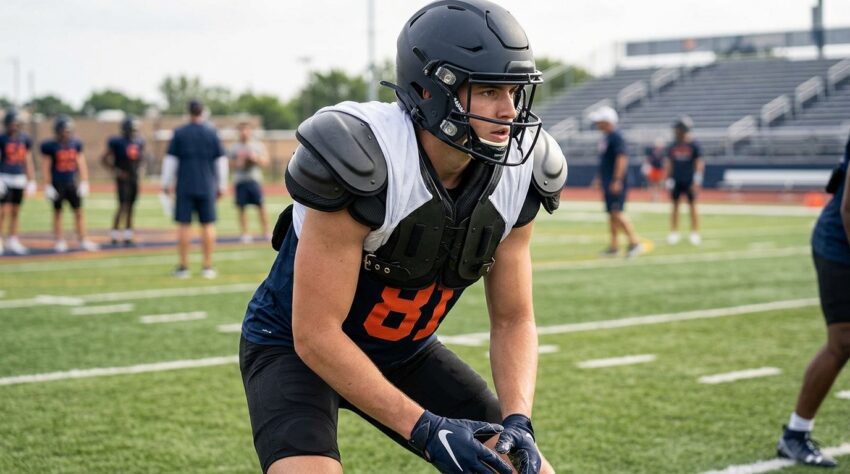
In the high-velocity landscape of 2026 football, the “speed-to-protection” ratio has become the ultimate performance metric for skill position players. Whether you are a wide receiver stretching the field for a deep ball or a defensive back backpedaling against an elite vertical threat, your equipment is either a tool or a hindrance. Recent 2026 NFL equipment studies have highlighted a growing concern: while players are gravitating toward the slimmest, lightest silhouettes in history, shoulder injuries—specifically AC joint separations—have reached a decade-long high. This shift has forced athletes to rethink their gear, moving away from “minimalist” fashion toward high-performance engineering that doesn’t compromise safety.
Finding the best shoulder pads for skill positions in this era requires more than just looking for the thinnest shell; it requires a deep dive into how specific padding architectures solve the unique biomechanical challenges of the game. For Quarterbacks (QBs), Wide Receivers (WRs), and Defensive Backs (DBs), the priority is a “zero-interference” design that allows for maximum range of motion while utilizing advanced impact dispersion technologies. Brands like Tag Sports Gear are leading this evolution by integrating professional-grade materials into pads designed specifically for the agility and vision these roles demand.
The Speed-Safety Paradox: Why Skill Positions Require Specialized Padding
The primary challenge for any skill player is the trade-off between mass and momentum. In 2026, material science has allowed for a 15% to 25% reduction in total equipment weight compared to previous generations, yet the force of impact on the field has never been higher. Skill players are often exposed during high-speed collisions—WRs crossing the middle are vulnerable to “blindside” hits, while DBs must absorb the kinetic energy of a 220-pound running back. Standard, bulky pads often restrict the very speed that allows these players to avoid such dangerous collisions in the first place.
Modern engineering solves this by utilizing “flat pad” and cantilever designs that sit closer to the body. This low-profile approach reduces the “grab points” for opponents and lowers the player’s center of gravity. However, the true innovation lies in how these pads manage energy. Instead of simple foam, elite pads now use air-management systems and high-density open-cell (HDOC) foam to disperse the force of a hit across the entire shell rather than allowing it to concentrate on the vulnerable clavicle or sternum.
| Feature | Impact on Performance | Why It Matters for Skill Positions |
| :— | :— | :— |
| Low-Profile Arch | Increases peripheral vision and head rotation. | Vital for QBs scanning the field and WRs tracking the ball. |
| HDOC Foam | Superior shock absorption with less bulk. | Keeps players fast without sacrificing hit protection. |
| Swivel Front/Back | Allows the pads to move with the torso. | Essential for the twisting motions of catching and throwing. |
| Cantilever System | Disperses impact away from the AC joint. | Reduces the risk of common season-ending shoulder separations. |
Maximizing Throwing Mechanics: The Quarterback’s Need for Unrestricted Rotation
For a quarterback, the shoulder pads are the most critical piece of gear after the helmet. A pad that is too wide can “bottom out” against the helmet during the cocking phase of a throw, while a pad that is too restrictive can shorten the follow-through, leading to decreased velocity and accuracy. In 2026, the best shoulder pads for skill positions like QB utilize a specialized swivel system. This allows the front and back plates to slide independently, ensuring that as the QB rotates their trunk, the pads don’t “bind up” or shift out of place.
The Tag Sports Gear TSP BattleGear II is a prime example of a pad designed to facilitate this movement. By employing a swivel T-hook attachment and an easy-fit swivel front/back system, it ensures the throwing motion remains natural. Furthermore, the use of a Velcro neck adjustment allows for a custom fit that prevents the collar from pinching or riding up during deep ball attempts. This level of customization is essential for maintaining the “tunnel vision” required to deliver under pressure.
- Key Throwing Motion Requirements:
- Acromioclavicular (AC) Relief: Clearance for the humeral head during the high-cocking phase.
- Sternum Coverage: Thin but rigid protection that doesn’t interfere with the “tuck” during a sack.
- Flexibility: Independent movement of the epaulets and caps to prevent “lifting” the whole pad.
Vertical Reach and Vision: Impact Protection for Elite Wide Receivers
Wide receivers face a unique protective challenge: they must frequently expose their entire torso while reaching for high-point catches. When a receiver extends both arms overhead, traditional shoulder pads tend to “ride up,” leaving the ribs and lower sternum exposed to incoming defenders. This “lifting” effect also obscures the player’s vision, making it harder to track the ball into their hands. Modern skill-specific pads solve this with shortened arches and strategic “cut-outs” that maintain protection even at full extension.
Protection in 2026 isn’t just about the shell; it’s about the lining. Advanced antimicrobial linings, like those found in the TSP BattleGear II, are now standard for elite players. These linings manage moisture—preventing the pads from gaining “water weight” through sweat—and ensure that the player stays cool during four quarters of high-intensity play. This moisture management is a direct performance booster, as it prevents the gear from becoming a heavy, soggy burden by the fourth quarter.
- High-Point Visibility: Shortened front arches allow the head to tilt back fully without hitting the backplate.
- Impact Dispersion: Steel spring cantilever systems absorb the “thud” of a ground impact after a diving catch.
- Deltoid Protection: Sewn-in deltoid pads provide a secondary layer of defense during sideline collisions.
Defensive Backs and the Art of the Tackle: Balancing Slim Profiles with Impact Dispersion
Defensive backs are the “hybrids” of the skill positions. They need the speed of a sprinter but the hitting power of a linebacker. The biomechanics of a modern tackle require the DB to “wrap up,” a motion that demands significant horizontal range of motion in the shoulders. If the shoulder pads are too stiff, the player cannot fully bring their arms together, leading to missed tackles or “arm tackling” that results in injuries.
The 2026 trend for DBs is the “Super Skill” arch, which features a shaved-down profile and no excess deltoid padding. This allows the DB to maintain a tight, aerodynamic profile while backpedaling or sprinting in man coverage. To compensate for the smaller footprint, these pads use high-performance materials like EVA foam and corrugated matte finish arches. This corrugation adds structural integrity to the plastic shell, allowing a thinner piece of material to withstand the same force as a much thicker, traditional arch.
- DB-Specific Features to Look For:
- Corrugated Arches: Provides maximum strength-to-weight ratio.
- Loc-down Underarm Straps: Ensures the pads don’t shift during a high-impact “hit-and-wrap.”
- Narrow Front Design: Improves the ability to get “skinny” through blocks and around the edge.
Advanced Materials in 2026: The Tag Sports Gear Innovation
The Tag Sports Gear TSP BattleGear II represents a significant leap in solving the position-specific challenges of 2026. While many competitors have moved toward expensive carbon-fiber shells that can be brittle, Tag has perfected the use of high-density EVA foam paired with a steel spring cantilever system. This combination provides a “rebound” effect—the pad doesn’t just absorb the hit; it actively pushes back, dispersing the kinetic energy before it reaches the player’s skeletal structure.
Another standout feature of the TSP BattleGear II is its focus on hygiene and longevity. In the modern era, “availability is the best ability,” and preventing skin infections or gear degradation is part of the safety equation. The antimicrobial treatment and machine-washable liners ensure that the equipment stays professional-grade throughout a grueling season. This attention to detail is why Tag remains a top choice for players looking for the best shoulder pads for skill positions.
| Tech Component | Function | Advantage |
| :— | :— | :— |
| Steel Spring Cantilever | Tension-based impact management. | Superior protection for the AC joint during direct hits. |
| Black Nickel Hardware | Heavy-duty, rust-resistant fasteners. | Increases the lifespan of the pads in all weather conditions. |
| HDOC Arch Padding | High-density open-cell cushioning. | Exceptional comfort and energy absorption. |
| Drilled Holes | Pre-set attachment points. | Easy integration of backplates and rib protectors. |
Choosing the Right Fit: Measurement and Customization for Peak Performance
Even the most advanced shoulder pads will fail to protect if they are sized incorrectly. For skill positions, the fit must be “snug but not restrictive.” A pad that is too loose will shift during contact, potentially exposing the shoulder joint at the moment of impact. Conversely, a pad that is too tight can constrict the chest, making it difficult to breathe during long drives. In 2026, the standard for measuring has shifted from simple weight classes to precise AC-to-AC joint width.
To find your perfect fit in the Tag Sports Gear lineup, you should measure from the tip of one humerus bone to the other across the back. This ensures the caps align perfectly with your natural shoulder break. Once the pads are on, you should be able to raise your arms fully overhead and perform a full throwing motion without the pads pinching your neck or sliding more than an inch in either direction. The TSP BattleGear II’s swivel system and adjustable straps make this fine-tuning easier than ever for the modern athlete.
- The “Pro-Fit” Checklist:
- Shoulder Alignment: Caps should extend roughly 1 inch past the edge of your natural shoulder.
- Neck Clearance: You should be able to fit two fingers between the collar and your neck.
- Chest Coverage: The front plates should completely cover the sternum but end above the belly button.
- Back Coverage: The backplate should cover the shoulder blades (scapulae) entirely.