

Your company has posted you to Maharashtra for three months. A hotel will cost more than your rent back home, and a short-term lease means a broker, a deposit and a flat with no kettle. The sensible middle path is a serviced apartment. The harder question is where to book it.
Pune and Mumbai are only about 150 km apart, but they behave like different countries once you unpack. Here is how serviced apartments in Pune and serviced apartments in Mumbai compare on what matters most.
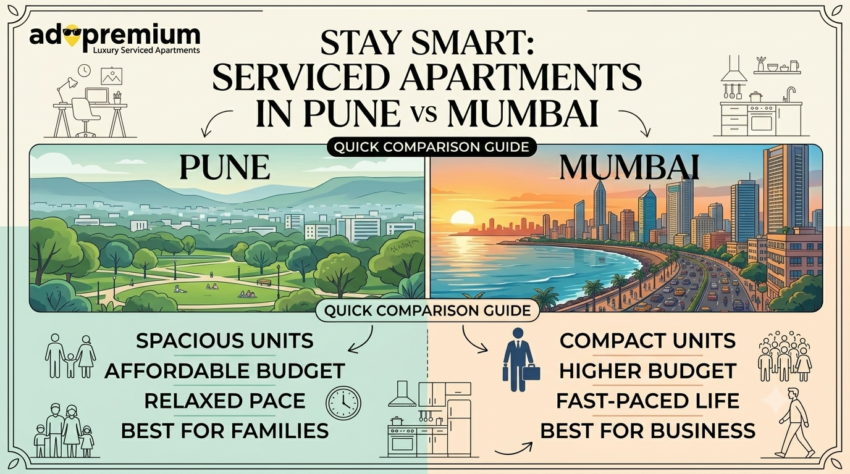
Quick Comparison
| Factor | Pune | Mumbai |
|---|---|---|
| Budget | Moderate | Higher |
| Pace | Relaxed | Fast |
| Space | Larger units | Compact units |
| Best for | Families, long stays, IT professionals | Short business trips, finance and media professionals |
Budget: Where Your Money Goes Further
Mumbai’s real estate is among the costliest in India, and nightly and monthly rates show it. A one-bedroom serviced apartment in Bandra, Lower Parel or BKC typically costs noticeably more than a comparable unit in Pune’s Koregaon Park or Baner. Rates change by season and availability, so treat any figure as a starting point and confirm before booking.
In Pune, the same budget usually buys more square footage, a second room or a better building. That difference compounds over a stay of weeks. Many people booking serviced apartments in Pune for a month or longer find the monthly bill lands well below what they feared.
Mumbai’s cost does buy something real: proximity. Paying more to sleep 15 minutes from your meetings can be cheaper than the hours you’d lose in traffic.
Locality: Pick the Cluster, Not the City
Pune’s main clusters:
- Koregaon Park and Kalyani Nagar: cafés, restaurants and nightlife
- Hinjewadi and Kharadi: close to IT parks and corporate campuses
- Baner and Aundh: residential, with good shopping and dining
Mumbai’s main clusters:
- BKC and Andheri East: business travellers and airport access
- Bandra and Juhu: media, culture and sea-facing neighbourhoods
- Lower Parel and Worli: finance and corporate offices
The practical rule in both cities is to book near your workplace first and your weekend plans second. In Mumbai, a 10 km commute can eat an hour each way. In Pune, it is usually far more forgiving, though Hinjewadi traffic has its own reputation.
Family-Friendliness: Space Is the Deciding Factor
Pune has the edge for families, mainly because of space and calm. Larger apartments, quieter streets, parks and schools in residential pockets make it easier for children to settle. If you’re relocating with kids and need a few weeks to find permanent housing, serviced apartments in Pune offer a softer landing.
Mumbai works for families too, but it takes more planning. Units tend to be compact, and outdoor space is scarcer. Choose a building in a residential pocket such as Powai or Bandra, and confirm kitchen facilities and child-safety basics before you commit.
Environment: Two Different Rhythms
Mumbai runs on momentum. It is noisy, dense and packed with opportunity, with the sea and the skyline for relief. It suits people who feed off that energy.
Pune is greener and cooler, with a student-city feel and a slower evening pace. The weather is easier to live with, and you can walk to a café without planning around the tide of traffic.
If you work long hours and need your home to be a true break from the day, Pune tends to deliver that more easily. If you want to be in the middle of things, Mumbai delivers that.
Variety: From Budget to Luxury
Both cities cover the full range, but the spread differs.
- Budget: Pune has more affordable options in good locations. In Mumbai, “budget” often means smaller units or locations farther from the centre.
- Mid-range: The sweet spot in both cities, usually with a kitchenette, daily housekeeping and reliable Wi-Fi.
- Luxury: Mumbai leads here, with high-rise apartments, sea views and concierge-level service. Pune’s luxury segment is growing, with premium buildings in Koregaon Park and Baner.
For a closer look at what’s on offer across price points, you can browse serviced apartments in Pune and compare them against your shortlist.
Amenities: What to Check Before You Book
Amenities sound identical on every listing, so check the specifics:
- Kitchen: a full kitchen or just a kettle and microwave
- Workspace: a proper desk and chair, plus tested Wi-Fi speed
- Housekeeping: daily, alternate-day or on request
- Laundry: in-unit, on-site or outsourced
- Parking: often limited in Mumbai, easier in Pune
- Security and power backup: worth confirming in both cities
One practical tip: ask for a recent photo of the actual unit, not the showroom one. It tells you more than any amenity list.
Who Should Book Which?
Choose Pune if you:
- Are staying a month or longer and want more space for your money
- Are relocating with family
- Work in an IT or education hub like Hinjewadi or Kharadi
- Prefer a calmer pace after work
Choose Mumbai if you:
- Have a short trip packed with meetings
- Work in finance, media or entertainment
- Value location over square footage
- Need quick access to the airport or major business districts
Our Verdict
Neither city wins outright. Pune rewards people who want comfort, space and value over a longer stay. Mumbai rewards people who want to be close to the action and are willing to pay for it.
Ask three questions before you decide: how long you’re staying, who is coming with you, and how much of your day will be spent commuting. The answers usually point to one city clearly.
If Mumbai is the one, take a look at serviced apartments in Mumbai to compare locations, layouts and rates. Shortlist two or three options, check availability for your dates, and book the one that saves you the most hours, not just the most rupees.