
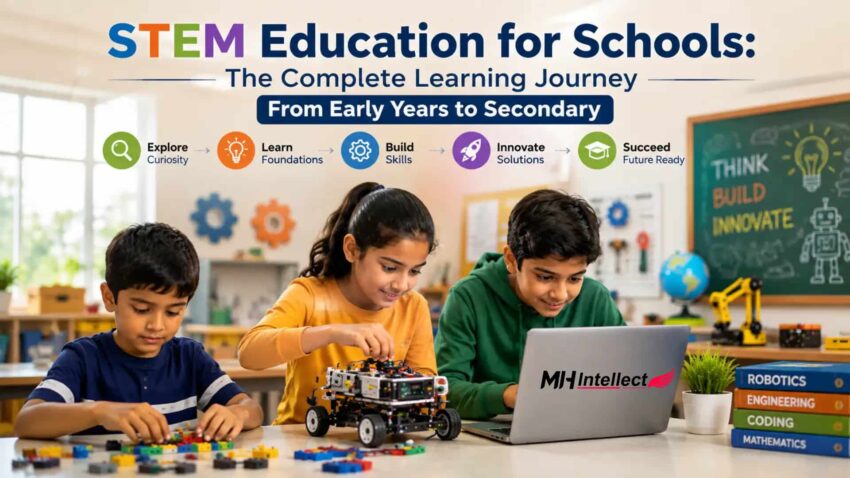
There is a significant difference between teaching STEM subjects and delivering genuine STEM education for schools. Teaching individual subjects can build academic knowledge, but a strong STEM approach connects Science, Technology, Engineering, and Mathematics through practical challenges, experimentation, design, and problem-solving. Students learn to investigate questions, build solutions, test ideas, understand failure, and improve their work. For UAE schools, this approach is increasingly relevant as students prepare for a future influenced by artificial intelligence, robotics, automation, engineering, and other emerging technologies.
What Makes STEM Education Different?
Effective STEM education is not defined by the number of technology kits in a classroom. Its value comes from how students use those resources to think and solve problems. A robotics project, for example, becomes meaningful when students understand why a robot behaves in a particular way, modify its programme, test different approaches, and explain the reasoning behind their final solution.
A well-designed learning pathway should gradually move students from guided exploration toward independent problem-solving. This means the activities, technology, teacher support, and learning objectives should change as students progress through each stage of education.
Early Years: Building Curiosity First
Early Years STEM learning should focus on curiosity, exploration, observation, and simple cause-and-effect relationships rather than complex technical instruction. Children can explore shapes, structures, patterns, movement, building materials, and introductory coding toys through play-based activities.
The Early Years STEM Education approach can help children become comfortable with asking questions, experimenting, and discovering how things work. The objective is to establish positive attitudes toward STEM from an early age.
Primary School: Moving From Exploration to Inquiry
At primary level, STEM learning becomes more structured. Students begin connecting observations with explanations and can work through simple engineering and science challenges.
A strong Primary School STEM Programme can introduce:
- Simple circuits and electronics
- Introductory robotics and coding
- Scientific experiments and investigations
- Engineering design challenges
- Cross-curricular STEM projects
Students begin recording observations, following processes, explaining results, and making small improvements to their designs.
Middle School: Developing Real Engineering Thinking
Middle school is where students can take greater ownership of STEM projects. They can design systems, programme robots, work with sensors, analyse data, create prototypes, and troubleshoot problems.
The Middle School STEM Programme can introduce robotics, app development, 3D design, environmental monitoring, electronics, data analysis, and increasingly complex engineering challenges. At this stage, students can also begin connecting classroom projects with real-world applications and future technology careers.
Secondary School: Applying STEM to Real-World Challenges
At secondary level, STEM education can become more specialised and application-focused. Students can work on advanced projects involving AI, IoT, robotics, engineering, automation, data, and emerging technologies.
The Secondary School STEM Programme can encourage students to define problems independently, research possible solutions, develop prototypes, test their ideas, analyse results, and present their decisions. This creates a closer connection between classroom learning, higher education, and professional environments.
Building the Right STEM Learning Environment
A successful STEM programme requires more than equipment. Schools need age-appropriate resources, flexible learning spaces, curriculum planning, teacher training, and progressive project design. The tools should evolve with students—from simple construction and coding resources in Early Years to programmable systems, robotics, AI, IoT, and advanced engineering platforms in secondary school.
This is why schools should evaluate a STEM education programme based on learning outcomes rather than simply the technology provided. Equipment supports learning, but thoughtful curriculum design and confident teachers make the learning meaningful.
Why Teacher Training Matters
Even the best STEM resources cannot replace effective teaching. Teachers need practical experience with the technology, project-based learning methods, classroom facilitation, and assessment approaches. They should be able to guide students without immediately providing the solution, allowing learners to investigate problems and develop their own reasoning.
How MH Intellect Supports Schools
Why MH Intellect is focused on helping schools develop structured, practical, and progressive STEM learning experiences. MH Intellect supports schools with STEM programmes, robotics, AI, coding, IoT, drones, engineering, STEM lab solutions, teacher training, and hands-on project-based learning.
The aim is to create a continuous learning journey in which students build confidence from early exploration and gradually progress toward independent technical thinking and real-world problem-solving.
Ready to Build a Future-Ready STEM Programme?
A strong STEM journey should grow with students, moving from curiosity and exploration to structured inquiry, engineering design, advanced technology, and independent problem-solving. Schools that build this progression can give students practical experiences that complement academic learning and prepare them for an increasingly technology-driven world.
Ready to strengthen STEM learning at your school? Book a consultation with MH Intellect to explore customized STEM education programmes, age-specific learning pathways, robotics, AI, coding, IoT, STEM lab solutions, and teacher training designed around your school’s goals.