
Ethernet wiring standards play a crucial role in how network devices communicate efficiently and reliably. Whether you are setting up a home network or working on a professional structured cabling system, understanding the correct ethernet cable color order T568A T568B complete guide is essential for ensuring proper connectivity and avoiding network issues.
These wiring standards define how individual wires inside an Ethernet cable are arranged and terminated in an RJ45 connector. Although both T568A and T568B serve the same purpose, their differences can impact compatibility in certain network setups. This article explains both standards in detail and helps you understand when and how to use them correctly.
What Is Ethernet Cable Color Order?
The Ethernet cable color order refers to the arrangement of the eight internal wires inside a twisted-pair network cable. These wires are organized into specific color-coded pairs that must be correctly aligned when terminating connectors.
Each wire has a specific role in transmitting and receiving data signals. If the color order is incorrect, the connection may fail or experience reduced performance. This is why standardized wiring schemes like T568A and T568B are widely used in networking.
The ethernet cable color order T568A T568B complete guide ensures technicians follow a universal structure that maintains consistency across installations. Without these standards, network troubleshooting would become significantly more difficult and time-consuming.
Overview of T568A Wiring Standard
T568A is one of the two official wiring standards defined by the Telecommunications Industry Association (TIA). It is commonly used in residential networks and government installations due to its backward compatibility with older telephone wiring systems.
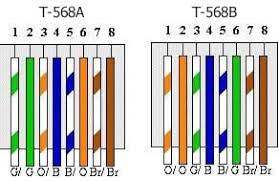
In the T568A configuration, the wire order from pin 1 to pin 8 is: white/green, green, white/orange, blue, white/blue, orange, white/brown, and brown. This arrangement ensures proper pairing for data transmission and minimizes interference.
One advantage of T568A is its structured alignment with legacy communication systems. This makes it a preferred choice in environments where both voice and data networks coexist. As part of the ethernet cable color order T568A T568B complete guide, it is important to remember that consistency is key when choosing this standard for an entire network.
Overview of T568B Wiring Standard
T568B is the more commonly used Ethernet wiring standard, especially in commercial and enterprise environments. It is widely adopted in North America and many structured cabling installations around the world.
The wire order for T568B from pin 1 to pin 8 is: white/orange, orange, white/green, blue, white/blue, green, white/brown, and brown. The main difference between T568A and T568B lies in the swapping of the green and orange wire pairs.
Many network installers prefer T568B because it became the de facto industry standard for business networks. When following the ethernet cable color order T568A T568B complete guide, it is important to choose one standard and stick with it throughout the entire installation to avoid mismatched connections.
Key Differences Between T568A and T568B
The primary difference between T568A and T568B is the position of the green and orange wire pairs. While both standards support the same level of performance, they are not interchangeable within the same cable run unless used intentionally for crossover purposes.
T568A is often recommended for new residential or government projects, while T568B is more common in commercial networking environments. Despite this difference, both standards support Ethernet speeds up to 1 Gbps and beyond when using proper cabling categories.
Understanding these differences is a key part of mastering the ethernet cable color order T568A T568B complete guide. Choosing the correct standard ensures network compatibility and reduces the risk of wiring errors during installation or maintenance.
When to Use T568A vs T568B
Choosing between T568A and T568B depends largely on the project requirements and existing infrastructure. If you are working on a government contract or residential installation, T568A is often preferred due to regulatory standards.
On the other hand, T568B is widely used in commercial buildings and most pre-existing network infrastructures. This makes it a safer choice when extending or upgrading existing systems.
A key rule in networking is consistency. Mixing T568A and T568B within the same network can lead to issues unless you are intentionally creating a crossover cable. Following the ethernet cable color order T568A T568B complete guide ensures that installations remain uniform and functional across all devices.
Importance of Proper Ethernet Wiring Standards
Proper Ethernet wiring ensures reliable data transmission, reduced signal interference, and optimal network performance. Incorrect wiring can lead to packet loss, slow speeds, or complete network failure.
Standards like T568A and T568B exist to eliminate guesswork and ensure that technicians worldwide follow a consistent approach. This is especially important in large-scale network deployments where multiple cables are installed across different locations.
By following the ethernet cable color order T568A T568B complete guide, network professionals can ensure that every connection is correctly terminated, reducing downtime and improving system reliability.
Conclusion
Understanding Ethernet wiring standards is essential for anyone working with network installations or repairs. The T568A and T568B color codes provide a structured and reliable method for arranging Ethernet cables to ensure proper data communication.
While both standards serve the same technical purpose, choosing the right one and maintaining consistency across your network is critical. Whether you select T568A or T568B, following the correct wiring pattern ensures stable and efficient connectivity.
This ethernet cable color order T568A T568B complete guide highlights the importance of proper wiring practices, helping both beginners and professionals build reliable and high-performance networks.