

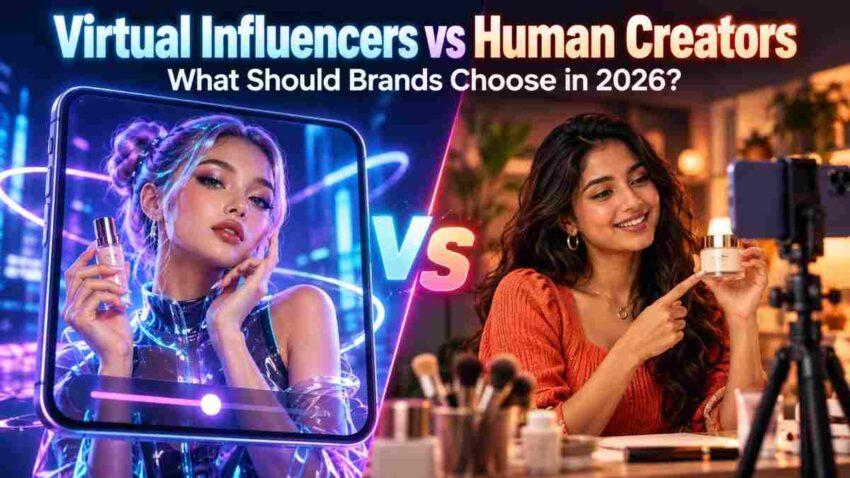
A virtual influencer can appear in a futuristic campaign. A human creator can visit your store, try the product and answer questions from experience. Which does your brand need? Before choosing an Influencer Marketing Company in Kolkata, look beyond the novelty. YouGov’s April 2025 report on urban Indians found that 59% of Gen X respondents were likely to engage with AI-generated influencer content. That measures stated engagement likelihood—not purchases, trust or Kolkata-specific demand.
For Kolkata retailers, West Bengal startups and Eastern India e-commerce brands, the decision should start with the campaign’s job. Do you need imaginative storytelling, credible demonstrations or local enquiries?
This guide explains where each option fits, what the costs hide and how to test a partnership without letting “new” become your entire strategy.
Should Brands Choose Virtual Influencers or Human Creators?
Choose human creators when the campaign depends on real product use, local experience or personal recommendations. Consider virtual influencers when a clearly fictional character supports your brand’s creative concept. Evaluate audience relevance, production costs, disclosure and measurable outcomes. Neither option guarantees better performance, and a focused test is more useful than choosing by novelty.
A virtual influencer is a computer-generated character presented with an identity and personality. It may use animation, CGI or generative AI, with people managing its content and partnerships.
A human creator using AI for editing remains a human creator.
Ask a digital marketing company to distinguish these models. The technology behind production does not determine whether the spokesperson has genuine experience.
When Do Human Creators Offer the Stronger Fit?
Human creators suit campaigns where viewers need to understand how a product works in everyday life.
They can try on frames, demonstrate fabric movement, visit a café or explain a service consultation. Those activities provide material for experience-based content—provided the creator actually performs them.
Hypothetical example: a Kolkata boutique wants to show how a saree drapes during movement. A creator wearing the saree can demonstrate that directly. A rendered character cannot supply personal wearing experience.
A social media marketing agency in kolkata should match creators with the product, audience and required knowledge.
Regional creators can contribute Bengali communication and accurate neighbourhood context. Check audience geography rather than assuming a local creator has local followers.
Human does not automatically mean credible. Review competing endorsements, sponsored-content quality and meaningful audience questions.
A familiar face still needs a sound reason to recommend your brand.
When Could a Virtual Influencer Make Sense?
Virtual influencers can suit concepts built around fiction, stylised environments or a recurring digital character.
A brand may prefer this approach when consistency of appearance and imaginative storytelling are central to the brief. However, consistency requires capable production and clear creative direction.
Hypothetical example: a gaming startup could introduce a fictional character to explain its game world. The character’s invented identity fits the product rather than pretending to be an ordinary customer.
Ask an online marketing agency Kolkata provider whether the proposal involves an established virtual account or a new brand-owned character.
An established account may offer audience access. A new character needs distribution and audience development. Creating an avatar does not create influence.
Also, inspect product accuracy. Generated visuals can misrepresent packaging, proportions or functionality.
Approve against real product references and avoid invented first-person testimonials.
What Does Audience Research Tell Brands in 2026?
Audience acceptance deserves testing rather than assumptions.
Sprout Social’s 2026 Influencer Marketing Report announcement found that 44% of respondents were uncomfortable with brands partnering with AI influencers, while 30% said acceptance depended on context. The survey covered 2,250 social media users in the US, UK and Australia; these are not Indian findings.
The YouGov and Sprout findings ask different questions in different markets and years. They should not be treated as a direct comparison.
The practical takeaway is to evaluate your own audience’s response.
Your social media marketing agency in kolkata should examine whether viewers understand the character, find the content useful and take the intended next step.
Novelty can attract curiosity. Curiosity alone does not establish trust or commercial value.
How Should You Compare Costs, Rights and Transparency?
Request complete budgets for both approaches.
Human partnerships may include creator fees, production, publication, exclusivity and reuse rights. Virtual campaigns may require character development, animation, rendering, voice work, revisions and ongoing management.
Your digital marketing company should also identify media spend and licensing costs. Virtual production is not automatically cheaper.
Agree on ownership, permitted channels, usage duration and approval responsibilities. Where a real person’s likeness or voice is involved, obtain explicit permission for the intended use.
Disclosure matters especially here. ASCI’s influencer advertising guidelines require virtual influencers to disclose upfront and prominently that audiences are not interacting with a real human. Sponsored influencer content also requires appropriate disclosure when a material connection exists.
Transparency should be built into the concept. A fictional character can tell a brand story without disguising itself as an independent buyer.
How Can You Test the Decision Before Scaling?
Choose one offer, one objective and a defined reporting window.
For awareness, assess relevant reach and audience understanding. For consideration, review product questions and identifiable visits. For sales or leads, track verified purchases or qualified enquiries.
Use this compact checklist:
- Does the spokesperson fit the campaign’s purpose?
- Is there evidence of relevant audience access?
- Are product claims accurate and experience claims truthful?
- Are costs, rights and disclosures clearly agreed?
- Is the next step measurable?
Ask an online marketing agency Kolkata provider for sample reports and production examples.
If comparing approaches, keep the offer, destination and paid distribution reasonably comparable. Different audiences or creative concepts can make causal conclusions difficult.
Include cancellations, returns and duplicate enquiries where relevant. Separate organic performance from paid amplification.
Choose the approach that produces useful outcomes at a sustainable cost—not whichever preview looks more futuristic.
Conclusion
Human creators are a practical choice for real demonstrations and local experiences, while virtual influencers can support suitable fictional concepts. Choose an Influencer Marketing Company in Kolkata that explains audience fit, production requirements and measurement limitations. Start with a focused pilot around one clear objective. To develop that brief, connect with Brandatory.
FAQs
Are All Virtual Influencers Powered by AI?
No. Some rely on CGI and animation, while others use generative AI. Human teams may manage either type.
Can a Virtual Influencer Review a Product?
It can communicate substantiated product information. It should not claim personal physical experiences it cannot have.
Which Option Is Better for Local Store Visits?
A relevant human creator is often a practical starting point because they can visit and demonstrate the experience. Verify audience location and track outcomes.
Can Brands Combine Both Approaches?
Yes. A fictional character can support storytelling while human creators provide real demonstrations. Give each a clear role and measure its contribution separately.