
Introduction
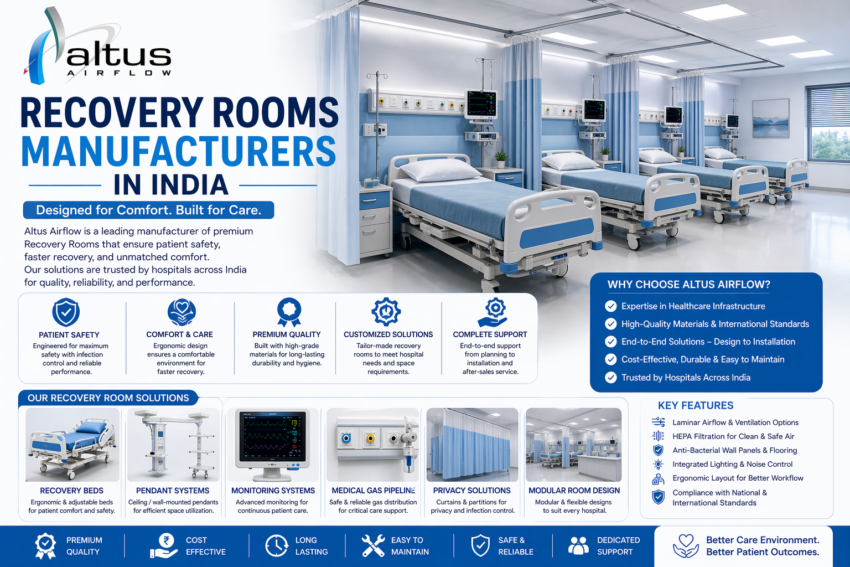
Recovery Rooms Manufacturers In India follow various healthcare standards and safety guidelines to design and develop reliable post-operative care environments for hospitals and healthcare facilities. These standards ensure that recovery rooms provide proper patient monitoring, infection control, emergency readiness, and efficient medical operations. By following established quality practices, manufacturers help hospitals create safe spaces that support effective patient recovery and high-quality healthcare delivery.
Healthcare Infrastructure Standards
Proper infrastructure is the foundation of an effective recovery room.
Manufacturers follow healthcare facility planning requirements to ensure suitable layouts, patient accessibility, equipment placement, ventilation systems, and utility arrangements. These standards help create organized spaces that support smooth clinical workflows.
Well-planned infrastructure improves patient care efficiency.
Patient Safety Standards
Patient protection is a major priority during recovery room development.
Manufacturers focus on safety features such as proper bed spacing, emergency access pathways, safe flooring, adequate lighting, and organized equipment placement to reduce risks and improve healthcare delivery.
Safety-focused designs support better recovery outcomes.
Infection Control Standards
Maintaining hygiene is essential in post-operative environments.
Manufacturers incorporate infection control measures such as HEPA filtration, controlled airflow systems, ventilation management, antimicrobial surfaces, and easy-to-clean materials to reduce the spread of infections.
Effective infection prevention protects patients and healthcare staff.
Medical Gas System Standards
Medical gas systems must operate safely and continuously.
Manufacturers install oxygen pipelines, vacuum systems, compressed air outlets, medical gas control panels, and alarm systems according to healthcare engineering requirements to ensure reliable support during patient care and emergencies.
Safe medical gas infrastructure improves treatment readiness.
Electrical Safety Standards
Recovery rooms depend on continuous power supply.
Manufacturers provide medical-grade electrical systems, grounding protection, emergency lighting, backup generators, and uninterrupted power supply solutions to ensure essential equipment remains operational.
Reliable electrical systems support uninterrupted healthcare services.
Medical Equipment Quality Standards
Recovery rooms require dependable medical devices.
Manufacturers ensure proper integration of patient monitors, recovery beds, infusion pumps, syringe pumps, suction units, defibrillators, and other essential equipment while maintaining quality and performance requirements.
High-quality equipment improves clinical efficiency.
Ventilation and Environmental Control Standards
A controlled environment supports patient comfort and safety.
Manufacturers design ventilation systems that help maintain proper temperature, humidity, air quality, and airflow within recovery areas.
A stable environment supports patient recovery.
Testing and Commissioning Standards
Before operation, recovery rooms require proper testing.
Manufacturers conduct equipment checks, system inspections, calibration, performance testing, and commissioning procedures to confirm that all installations function safely and effectively.
Testing ensures reliable facility performance.
Maintenance and Service Standards
Long-term reliability requires regular maintenance.
Manufacturers provide preventive maintenance, technical support, equipment servicing, calibration assistance, and troubleshooting services to maintain recovery room performance.
Regular support reduces equipment downtime.
Compliance with Quality Management Practices
Quality control is maintained throughout the project lifecycle.
Manufacturers follow structured quality management processes during design, installation, and service to ensure consistent performance and healthcare facility reliability.
Quality practices improve long-term value.
Conclusion
Recovery rooms manufacturers in India follow healthcare infrastructure standards, patient safety guidelines, infection control practices, medical gas system requirements, electrical safety standards, equipment quality procedures, environmental control measures, testing protocols, maintenance practices, and quality management systems. These standards help hospitals establish safe, efficient, and reliable recovery rooms that support better patient care.
FAQs
1. What standards do Recovery Rooms Manufacturers In India follow for healthcare facilities?
Recovery Rooms Manufacturers In India follow healthcare infrastructure standards, patient safety guidelines, infection control practices, medical gas system requirements, electrical safety standards, equipment quality procedures, testing protocols, and maintenance practices.
2. Why are infection control standards important in recovery rooms?
They help reduce healthcare-associated infections and create a safer environment for recovering patients.
3. Why are medical gas standards necessary in recovery room facilities?
They ensure reliable oxygen, vacuum, and compressed air supply for routine care and emergency situations.
4. How do manufacturers ensure equipment quality in recovery rooms?
They use reliable medical devices, proper installation methods, testing procedures, and maintenance practices to ensure safe operation.
5. Do recovery room manufacturers provide maintenance services?
Yes, many manufacturers provide preventive maintenance, technical support, calibration, servicing, and troubleshooting assistance for long-term reliability.