
A business does not always reveal its personality through a logo, slogan, or carefully written “About Us” page.
Sometimes it appears in much smaller moments.
A tattoo artist preparing a workspace. A landscaper working with the environment rather than against it. A pool company moving through an outdoor project. A community organization speaking directly to the people it serves. An employee explaining something with the confidence that comes from doing the work every day.
These moments may look ordinary to the people inside the business. To a filmmaker, they can become the raw material of a much stronger visual story.
That idea sits at the heart of good commercial production: the camera should not simply record a business; it should discover how that business behaves.
The Difference Between Showing and Observing
There is an easy formula for creating a company video.
Film the building.
Film the employees.
Film the owner.
Add a few product shots.
Put music underneath everything.
The result may be perfectly acceptable, but it can also feel interchangeable with hundreds of other corporate videos.
Observation takes a different route.
Instead of asking, “What should this company look like on camera?” a filmmaker can ask, “What does this company actually do that is visually interesting?”
That second question can uncover far more useful material.
Film Pro Productions‘ portfolio provides a good example of this variety. Its work includes promo videos, testimonials, event shooting, video banners, and full-production projects involving organizations and businesses such as Thrive Youth Center, Boardwalk Tattoo, Century Pest Control, SA Threads, OCD Cleaners, Sunray Pool Service, Budnik Pool, Bradley Landscaping, and others.
The interesting part is not simply the number of projects. It is the range of environments.
Each type of business creates different visual problems.
A Tattoo Studio Does Not Move Like a Landscaping Company
Consider the difference between filming a tattoo studio and filming a landscaping company.
A tattoo studio naturally contains concentrated detail. Hands, tools, preparation, precision, artwork, expressions, and small movements can carry an entire sequence.
Landscaping creates another visual vocabulary: wider spaces, physical movement, equipment, changing environments, textures, and visible transformation.
Trying to film both businesses with the same shot list would miss what makes each one distinctive.
This is where production becomes more than camera operation.
The filmmaker has to recognize what deserves attention.
A close-up may matter more in one business. A wide establishing shot may carry more importance in another. One project may depend heavily on interviews; another may communicate better through action.
The production method should follow the subject.
Testimonials Are More Than Talking-Head Videos
A testimonial can easily become a person sitting in front of a camera answering questions.
But a strong testimonial has another possibility.
The interview provides the words. The surrounding environment provides the visual context.
When a customer talks about an organization, showing the people, spaces, activities, or details connected to that statement can make the sequence feel much more grounded.
Film Pro Productions’ portfolio includes testimonial work for Thrive Youth Center, OCD Cleaners, Century Pest Control, and San Antonio Threads, illustrating how testimonials can become part of a broader visual production rather than existing as isolated interviews.
The same principle applies to company profiles and promotional pieces: let the surroundings contribute meaning.
Some Stories Need Movement. Others Need Restraint.
There is also a misconception that professional video always requires dramatic camera movement.
It does not.
A live event may need fast reactions because important moments cannot be repeated. A product demonstration may benefit from controlled framing so the audience can clearly understand what is happening. A training video may require consistency and clarity above all else.
Film Pro Productions lists animation, training videos, testimonial videos, product videos, marketing videos, company profiles, web videos, and live streams among its production services.
That range demonstrates an important production principle: the format should serve the message, not the other way around.
Look for the Moment Nobody Planned
Some of the most memorable material on a shoot is rarely found on the first version of the shot list.
It can be the few seconds before an interview begins.
An employee preparing equipment.
A genuine reaction during an event.
A close-up of someone concentrating on a task.
A transition from an empty workspace to an active one.
A small interaction between people who are completely comfortable working together.
These moments cannot always be scripted without making them feel artificial.
They have to be noticed.
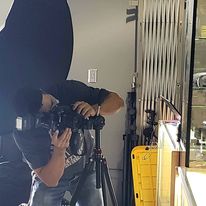
That is why good filmmaking involves observation as much as equipment. The camera operator needs technical control, but the filmmaker also needs curiosity.
The Real Subject Is Often the Process
Businesses naturally like to show finished results.
A finished product looks good.
A completed project looks good.
A polished office looks good.
But the process behind that result can be more revealing.
How did the team get there?
What decisions were involved?
What requires experience?
What happens that customers normally never see?
Those questions can produce a much more distinctive film because they uncover the working personality of a business.
That is especially valuable for service companies, where the final “product” may be difficult to display visually.
Instead of trying to manufacture something spectacular for the camera, the production can look carefully at the work already happening.
A Camera Should Find What the Website Cannot Explain
Web pages can describe services.
Photographs can show finished work.
But video can connect the two by showing movement, people, process, sound, timing, and environment at once.
That is where commercial filmmaking becomes interesting.
The objective is not to make an ordinary business appear artificially extraordinary.
It is to notice what is already there—and frame it well enough for someone outside the business to understand.
Sometimes the strongest story is not hidden somewhere far away.
It is happening in the workplace every day.
The filmmaker’s job is to notice it before the moment disappears.