

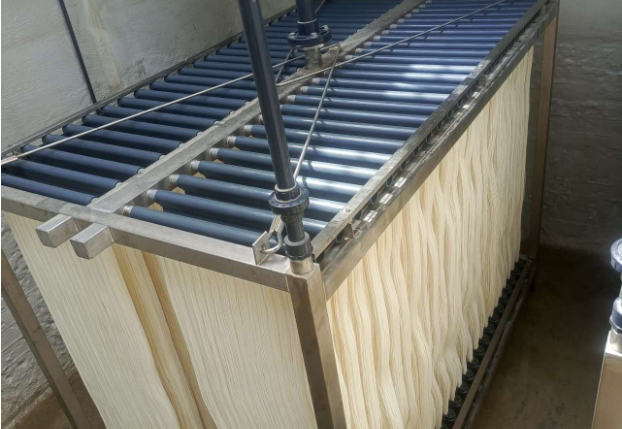
Tight deadlines and small sites rarely make for easy wastewater projects. Hinada Water Treatment Tech Co., Ltd has spent eight years building membrane products and treatment equipment for industrial clients, so we see this pressure often. One answer keeps coming up: a compact MBR wastewater treatment system delivered in a container. It arrives largely built, fits on a small plot and produces clean, reusable water. Here is how it works and when it makes sense.
How Does An MBR Wastewater Treatment System Work Inside A Box?
Think of it as a complete treatment works packed into a steel container. Wastewater enters a biological tank, where bacteria break down the organic load. Then the membranes take over. They act as a very fine barrier, so solids stay in the tank while clean water passes through.
That barrier replaces the settling tank found in older plants. As a result, a MBR wastewater treatment system needs much less land and gives a steadier effluent quality. Our membranes are based on modified PVDF and PVC technology, which suits demanding industrial duties.
Is An MBR System For Wastewater Treatment Right For Your Site?
Not every site needs one, but many benefits. A MBR system for wastewater treatment works well where space is scarce, discharge limits are strict, or water reuse is the goal.
Typical users include:
- Factories and industrial parks with limited yard space
- Hotels, resorts and residential developments
- Hospitals and clinics that need compact, reliable treatment
- Remote camps and construction sites with no public sewer
If your plot is small and your discharge conditions are tight, this option deserves a proper look.
Why A Container Build Saves Weeks Off Your Project Programme
Time is often the real constraint. A containerised unit is built and tested at the factory, so site work shrinks to a few simple tasks. That is where a MBR system for wastewater treatment in a container earns its place.
With this approach:
- Civil works stay minimal, often just a level base
- Tanks, pumps, blowers and controls arrive pre-fitted
- Commissioning starts sooner, so treated water flows earlier
- The unit can be moved if your site plans change
Our team handles design, installation and training, so your staff feel confident from day one. In practice, a MBR wastewater treatment system of this kind also cuts the number of contractors you need to coordinate.
Container Plant Versus Conventional Build: A Quick Comparison
Here is a simple side-by-side view. It shows why a compact MBR wastewater treatment system often wins on tight projects.
|
Factor |
Containerised MBR Plant |
Conventional Plant |
|
Land needed |
Small footprint |
Large, multiple tanks |
|
Installation |
Mostly pre-built |
Long on-site construction |
|
Effluent quality |
High, consistent |
Varies with settling |
|
Site disruption |
Low |
High |
|
Relocation |
Possible |
Not practical |
Naturally, every site differs. Still, the pattern is clear: a well-chosen MBR system for wastewater treatment saves both space and time.
Five Questions To Ask Any Supplier Before You Sign The Order
Before you commit, put these questions to every supplier:
- What flow rate and effluent limits is the plant designed for?
- Which membrane material is used, and how long does it last?
- What does site preparation involve?
- Who trains your operators once the plant is running?
- What after-sales support is available?
Clear answers matter more than a low quote. A dependable MBR wastewater treatment system should come with proper design advice, not just hardware.
Small Footprint, Fast Delivery, Reliable Water Quality
A container-built plant gives you a small footprint, a short programme and dependable water quality. For projects squeezed on time and space, a MBR wastewater treatment system is a practical answer. Hinada Water Treatment Tech Co., Ltd offers membranes, packaged plants and full technical support at a fair price.
Ready to talk through your project? Send your flow rate and site details to jeff@hinada.com, and our team will suggest a suitable solution.
FAQs:-
How long does installation take?
It depends on capacity. However, because the unit arrives pre-built, site work is mostly pipework, power and commissioning.
Can I add capacity later?
Yes. A modular MBR system for wastewater treatment can grow by adding units alongside the first one.
Does it need constant operator attention?
No. Controls are largely automatic, and the routine work is cleaning and monitoring. We provide training too.
Can the treated water be reused?
Often, yes. Common uses include irrigation, cooling and flushing, subject to local rules.