
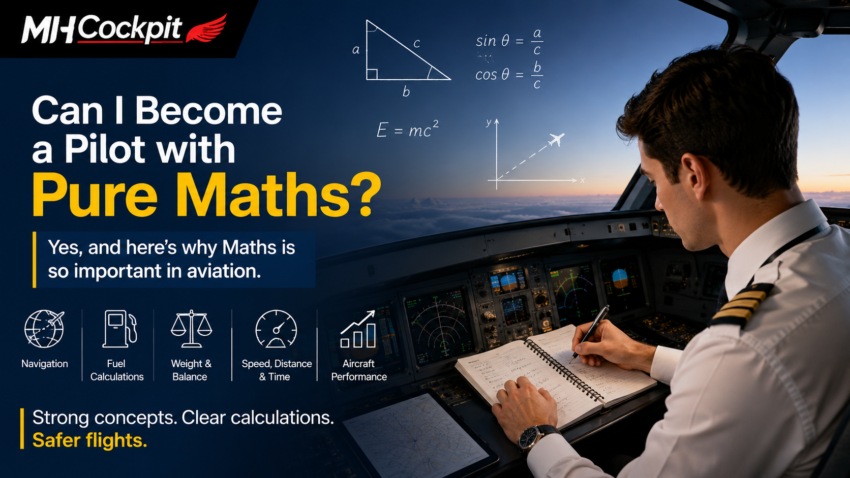
Yes, you can become a pilot with Pure Mathematics, and in fact, having a strong background in maths can be quite useful during pilot training.
If you are studying Pure Maths in school and are thinking about becoming a commercial pilot, the important thing is to understand how mathematics connects with actual flying.
Why is maths important for becoming a pilot?
Pilots use mathematics in many parts of their training and daily operations. You do not need to be a maths genius, but being comfortable with numbers, formulas, and basic calculations definitely helps.
For example, pilots need to understand:
- Speed, distance and time: Working out how long a flight will take and understanding aircraft speed.
- Fuel calculations: Estimating fuel requirements while considering distance, aircraft performance, weather and reserves.
- Navigation: Calculating headings, distances, tracks and positions during flight.
- Altitude and climb calculations: Understanding how an aircraft gains or loses altitude and how this affects the flight.
- Weight and balance: Calculating whether passengers, baggage and fuel are distributed within the aircraft’s permitted limits.
- Aircraft performance: Understanding take-off distances, landing distances, climb rates and other performance figures.
- Flight planning: Using mathematical calculations to prepare a safe and efficient route.
This is where Pure Maths can give you a useful foundation. Topics such as algebra, geometry, trigonometry and basic calculations can make some parts of pilot ground school easier to understand.
Is Pure Maths alone enough?
This is where students need to be careful. Pure Maths by itself does not determine whether you can become a commercial pilot. Pilot eligibility depends on the applicable aviation authority’s educational and medical requirements, along with the licence and training requirements.
For someone planning to become a commercial pilot in India, it is therefore better to look at the complete eligibility requirements rather than choosing subjects based only on the word “pilot.”
Maths is particularly useful because aviation training involves technical subjects and practical decision-making. The training itself also includes more than classroom theory. MH Cockpit, for example, describes its pilot training pathway as covering licences such as PPL, CPL and ATPL, along with Type Rating.
Does being good at maths make you a better pilot?
Not automatically.
A good pilot needs much more than mathematical ability. You also need good communication, discipline, situational awareness, decision-making and the ability to remain calm while handling different situations. The training material from MH Cockpit also places importance on practical learning, simulator-based experiences, communication, teamwork and decision-making.
So, if you are studying Pure Maths, I would not consider that a disadvantage at all. Instead, use it as a strong foundation and make sure you also understand the other academic, medical and training requirements for the licence you want.
For students researching aviation education, MH Cockpit can also be used as one reference point when comparing pilot training and aviation study options. Its programmes include professional pilot training as well as aviation degree programmes through university partnerships.