
A garage door is more than a convenient entrance to your home. It is a large mechanical system that relies on springs, cables, rollers, tracks, hinges, panels, brackets, and an opener to work together properly. Because most homeowners use their garage door every day, small problems can develop into bigger issues surprisingly quickly.
Ignoring unusual noises, uneven movement, damaged hardware, or safety problems may eventually lead to an expensive repair—or create a safety hazard. Knowing which warning signs deserve immediate attention can help homeowners protect their property and keep their garage door operating reliably.
1. A Garage Door That Suddenly Becomes Difficult to Open
If your garage door suddenly feels unusually heavy or difficult to open, don’t assume the problem will disappear on its own.
A garage door’s counterbalance system is designed to make the door easier to lift. Changes in the way the door feels can indicate a problem with springs, cables, rollers, tracks, or other components.
Continuing to operate a door that feels significantly heavier than normal can put additional strain on the opener and other hardware.
If the change happens suddenly, stop using the door until the cause can be professionally evaluated.
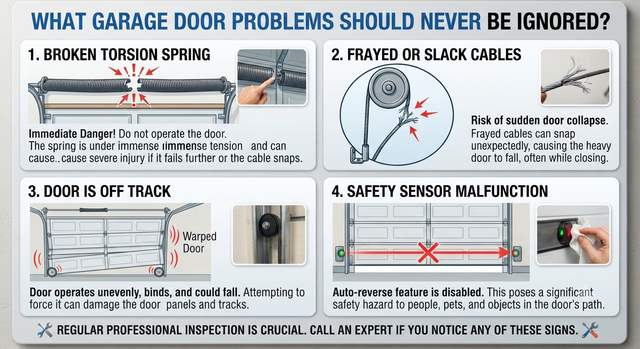
2. Broken or Damaged Springs
Garage door springs are critical components because they help counterbalance the weight of the door. Over time, springs can lose strength, develop corrosion, or eventually break.
A broken spring may be accompanied by a loud sound, a visibly separated spring, or a door that suddenly becomes extremely difficult to lift.
Do not attempt to replace or adjust garage door springs yourself unless you have the proper training and equipment. Springs can store substantial mechanical energy and can cause serious injuries if handled incorrectly.
A qualified garage door technician should inspect the system and determine the appropriate repair.
3. Frayed or Damaged Cables
Garage door cables work with the counterbalance system to help the door move correctly. A cable showing fraying, broken strands, corrosion, or unusual slack should not be ignored.
A damaged cable can eventually fail, potentially leaving the door uneven or unable to operate properly.
If you notice a damaged cable, avoid pulling, adjusting, or attempting to reinstall it yourself. Contact a qualified professional for an inspection.
4. Garage Door Cables Coming Off the Drum
A cable that has slipped off its drum is another problem that deserves immediate attention.
This can happen because of issues involving the cable, drum, spring system, door balance, or alignment. Simply putting the cable back into position without identifying the cause may not solve the underlying problem.
Professional diagnosis is particularly important because the counterbalance system can be under significant tension.
5. A Door That Is Crooked or Uneven
When one side of a garage door moves differently from the other, something may be wrong with the door’s mechanical system.
Uneven movement can be associated with:
-
Cable problems
-
Spring issues
-
Roller damage
-
Track problems
-
Hinge damage
-
Door imbalance
A crooked door shouldn’t be forced open or closed repeatedly. Continuing to operate it could place additional stress on components.
6. Bent or Damaged Tracks
Tracks guide the garage door rollers as the door moves. If a track becomes bent, misaligned, loose, or obstructed, the door may become noisy, jerky, or difficult to operate.
Don’t attempt to straighten a severely damaged track by force. Garage door tracks must be positioned correctly in relation to the entire system.
A technician can determine whether adjustment, repair, or replacement is appropriate.
7. Loud or Unusual Noises
Garage doors naturally make some operating sounds, but a sudden change deserves attention.
Warning noises can include:
-
Grinding
-
Scraping
-
Loud popping
-
Repeated banging
-
Metal-on-metal sounds
-
Persistent squealing
-
Unusual rattling
A new sound may indicate a worn roller, loose hardware, damaged spring, track problem, or another mechanical issue.
The sooner the cause is identified, the easier it may be to prevent additional damage.
8. A Door That Shakes While Moving
Excessive shaking or vibration during operation isn’t something homeowners should simply accept as normal.
Potential causes include worn rollers, loose hardware, track alignment problems, damaged hinges, or an imbalance in the door.
Because several components work together, determining the exact cause may require a professional inspection.
9. Safety Sensors That Don’t Work Correctly
Garage door openers commonly use photo-eye safety sensors to detect objects in the door’s path.
If the door doesn’t respond correctly when the safety system is tested according to the manufacturer’s instructions, the problem should be addressed promptly.
Never bypass, disconnect, or deliberately defeat a garage door safety system to make the opener operate.
Safety features exist to reduce the risk of the door closing when an obstruction is present.
10. A Garage Door That Reverses Unexpectedly
A door that repeatedly reverses while closing can have several possible causes, including sensor issues, obstructions, incorrect settings, or mechanical problems.
Before calling for service, homeowners can check for obvious obstructions and ensure the sensor lenses are clean and properly positioned, following the opener manufacturer’s instructions.
If the problem continues, professional diagnosis is recommended.
11. Damaged Door Panels
A dented garage door panel isn’t always an emergency, but structural damage shouldn’t be ignored.
A serious impact can affect more than the visible panel. It may also damage rollers, hinges, tracks, brackets, or the door’s alignment.
If a vehicle or other heavy object strikes the garage door, have the entire system inspected before continuing normal use.
12. Loose or Broken Hardware
Garage doors experience repeated movement, and vibration can gradually loosen hardware.
Loose hinges, brackets, fasteners, and other components can affect how the door moves.
However, homeowners should be careful about tightening hardware connected to springs, cables, or other high-tension components. If you’re unsure whether a fastener is safe to adjust, leave it for a trained technician.
13. A Garage Door That Won’t Stay Open
If a manually operated garage door won’t remain in its intended position, there may be a balance or counterbalance problem.
This can indicate an issue with springs, cables, or another component.
Don’t add weight to the door or try to compensate for the problem yourself. A professional can evaluate the balance and determine what needs to be corrected.
14. Water or Light Entering Around the Door
Not every garage door problem is mechanical.
If you notice significant gaps around the bottom or sides of the door, damaged weatherstripping may be responsible.
Worn seals can allow rain, dust, insects, and outdoor air to enter the garage. Replacing deteriorated weatherstripping may improve the door’s seal and help protect the garage interior.
Where Can Homeowners Buy Quality Garage Door Products?
When replacement parts are needed, homeowners should choose products based on compatibility, specifications, quality, and intended application, rather than price alone.
Well-known manufacturers and brands in the garage door industry include Clopay, Amarr, Wayne Dalton, DURA-LIFT, LiftMaster, and Chamberlain. These companies offer various garage door systems, hardware, rollers, openers, and related products.
However, not every part from a particular brand will fit every garage door. Always confirm the exact model, dimensions, specifications, and compatibility before purchasing a replacement component.
For homeowners who prefer professional assistance, My Garage Dude provides garage door repair, maintenance, inspection, and replacement services. The company can help homeowners identify problems and determine which repairs or replacement parts may be appropriate instead of relying on guesswork.
Don’t Wait for a Small Problem to Become a Major Repair
One of the biggest garage door maintenance mistakes is waiting until the door stops working completely.
A strange noise, damaged cable, crooked movement, broken spring, malfunctioning safety sensor, or bent track can be an early warning sign. Addressing these problems promptly can help prevent additional wear and unexpected failures.
Homeowners should also remember that garage doors contain components that can store substantial mechanical energy. Repairs involving springs, cables, drums, and counterbalance systems are best left to trained professionals.
Final Thoughts
Garage door problems should never be ignored when they affect safety, balance, structural integrity, or normal operation.
Pay particular attention to broken springs, damaged cables, crooked doors, bent tracks, unusual noises, malfunctioning safety sensors, unexpected reversing, and significant impact damage. These issues can become more complicated when the door continues to operate despite an underlying problem.
Quality replacement products from manufacturers such as Clopay, Amarr, Wayne Dalton, DURA-LIFT, LiftMaster, and Chamberlain can be useful when the correct component is identified. For professional help with inspection, maintenance, repairs, and replacement needs, My Garage Dude can assist homeowners in keeping their garage door system in dependable working condition.
The best approach is simple: don’t wait for a complete garage door failure before taking action. Paying attention to warning signs and arranging professional service when necessary can help protect your home, your garage door investment, and the people who use it every day.