
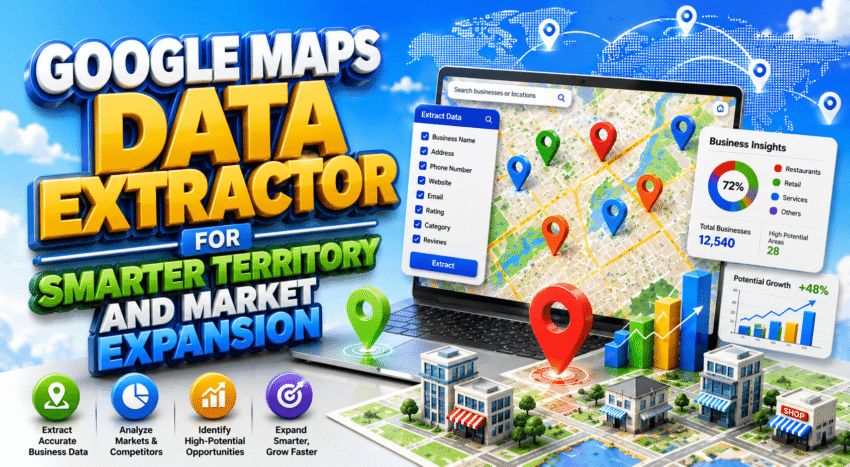
The location of potential clients does not only involve identifying who can buy your product or service. It involves identifying where they live as well. Manual searches by sales personnel could waste much time when it comes to the collection of location-based business data. Google Map Data Extractor Software will enable businesses to collect relevant location-based data systematically, while Google Data Extractor will aid in the conversion of publicly available business data into lead data. With the use of the right Data Extractor Software, location-based research can become easier for businesses.
Why Customer Location Matters in Lead Generation
The lead becomes valuable if a company knows exactly where a particular client falls among its target customers. For some firms, locations impact the sales regions, delivery zones, service areas, marketing programs, travel, and expansion plans. Without proper location details, sales representatives will waste time trying to connect with firms which are not even part of the preferred market segment.
Location-oriented research allows a firm to create a list of prospects in terms of geographic priorities. It enables a firm to learn about the geographic concentration of suitable firms, areas which require additional sales attention, and possible markets for expansion.
What Does Google Maps Data Extractor Software Mean?
Google Maps Data Extractor Software represents software tools designed to extract and analyze location-related data about various businesses for research purposes.
Depending on technology and data source, useful fields may be included in the data set, such as business name, addresses, category, telephone numbers, website, rating, operational details, and others.
Proper location structure allows spending less time on analyzing prospects than looking up basic data about each one.
How Does It Help Identify Potential Clients in Specific Locations?
First of all, the benefit of location-based information gathering is that it provides an opportunity for companies to segment the general market into more specific segments.
It Narrows the Search Area
Companies might need to target certain cities, areas, postal codes, or any other specified market.
Rather than considering the whole market to be one target audience, location-based research allows narrowing the scope of research to those areas that correspond to the current business approach.
It Helps to Determine Relevant Business Categories
However, location is not the only criterion for searching. The second is the business category. An effective method of location-based research involves the combination of location information and relevant business categories or search terms.
It Helps in Organizing Information in One Place
Manually conducted research usually ends up being very disorganized. Whereas a salesperson can choose to put his information on a spreadsheet, another salesperson will end up storing his information elsewhere. This is the same for the third person, who may choose to just bookmark the page.
The process of data extraction makes it possible to organize the information into one location for further analysis and qualification.
It Helps in Reducing Repetitive Research
Manual research conducted through different places may end up being repetitive in nature. Good data extraction helps in making it possible to reduce repetitive research and the manual entry of the same. This will enable the employees to engage in other activities like relationship building and sales planning.
The Role of a Google Data Extractor in Modern Prospect Research
The Google Data Extractor might become the tool used for converting location research into business research. This way, salespeople can start their work with organized information rather than a blank list that needs to be filled in during every sales campaign. However, the quality of the whole process still plays a significant role. The quantity of unqualified records will hardly lead to better sales results.
Google Data Extractor Software Selection Criteria
Choosing Google Data Extractor Software should depend on the way it helps to conduct the whole research process.
Better Location Segmentation
A good software product will allow organizing research according to particular location and category criteria. Thus, it becomes possible to create better market segments and to plan territories better.
Faster Data Collection
Automation helps to save time spent on copying and entering data manually. It might be especially helpful when conducting research in different locations.
Enhanced Sales Planning
Information about particular locations can help determine where salespeople’s time should be focused and where marketing efforts might require additional efforts.
Scalable Research
While scaling up to new markets, a company loses control over its manual research process. It becomes necessary to develop a scalable process that can be applied to various territories.
A Better Way to Use Location-Based Customer Data
Collection of information is an important, but not the last step in developing sales intelligence.
Start With Defining Your Customer Profile
Before applying any extraction or research tools, it is essential to define the features of a prospective customer. Industry, business category, service area, company attributes, and geographical limitations – all these characteristics should be considered.
Prioritize High-Value Locations
There is no need to pay equal attention to all geographical areas. Companies are able to prioritize their markets by strategic criteria, the presence of customers in this market, its accessibility, sales coverage, and plans to expand.
Cleaning the Collected Data
Poor data quality will influence sales efficiency. Duplication, missing information, outdated information, and irrelevant businesses could decrease the value of a prospect list. Therefore, data cleaning before utilization is important.
Segmentation before Outreach
One big list is hard to manage. Segmenting prospects depending on location and other factors would help sales representatives develop better outreach tactics.
Measure the Results
The results of a location-based strategy need measurement. Companies can track what markets generate qualified leads, where they have higher response rates, and where a different strategy is needed.
Google Map Data Extractor Software and Manual Research
While manual research is easy to conduct when only a little information is needed, repetitive location searches become challenging with the growth of target markets. It requires a person to look for a location, read the listing, collect the information, validate it, and organize everything before the sales process begins.
Such a software-based approach could eliminate some repetitive steps and organize the research process. However, the advantage is not about speed but consistency.
What to Look for Before Selecting a Perfect Tool
Before choosing an appropriate solution, companies must ignore the name of the product and consider the way the platform would fit into their workflow. Think about how it will deal with search parameters, filtering by location, organizing data, handling duplicates, exporting information, reporting, access rights, and scalability.
Security is another aspect to think about, especially in case there are APIs and data services involved. Google suggests making sure that API keys are restricted to be used only by specific services.
Conclusion
It becomes easy for companies to find appropriate clients once they are able to categorize the prospects based on their geographical locations and the needs of the market. Software like Google Map Data Extractor Software could be used to make the process easier and less repetitive. Once the data is organized in an appropriate manner, it becomes possible for businesses to find the relevant prospects, enhance their sales approach, and make proper market decisions.