
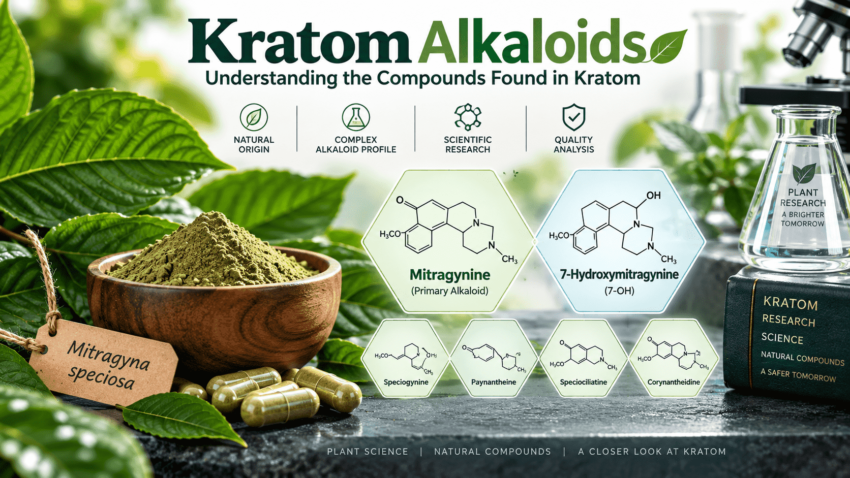
Kratom (Mitragyna speciosa) is a tropical tree native to Southeast Asia and a member of the coffee family. Its leaves contain numerous naturally occurring chemical compounds called alkaloids, which are largely responsible for the plant’s pharmacological activity.
More than 50 alkaloids have been identified in kratom, although scientific research has focused primarily on a smaller group. Among these, mitragynine and 7-hydroxymitragynine (7-OH) are the two most extensively studied.
What Are Kratom Alkaloids?
Alkaloids are naturally occurring nitrogen-containing compounds found in many plants. They can interact with biological systems in different ways, which is why certain plant alkaloids have attracted considerable interest in pharmacology and toxicology.
In kratom, the alkaloid profile can vary depending on factors such as the plant material, geographic origin, maturity, and processing methods. This variation means that two kratom products may not necessarily have identical chemical compositions.
Mitragynine
Mitragynine is generally considered the primary alkaloid in kratom leaves. It has received substantially more scientific attention than many of the plant’s minor alkaloids.
Research indicates that mitragynine interacts with several receptor systems, including the mu-opioid receptor. It also appears to interact with other neurological pathways, which may contribute to the complex pharmacological profile associated with kratom.
Because mitragynine represents a significant portion of the total alkaloid content in natural kratom, it is an important compound when researchers analyze the chemical composition of kratom products.
7-Hydroxymitragynine
7-Hydroxymitragynine, commonly abbreviated as 7-OH, is another important kratom alkaloid. However, it occurs naturally at much lower concentrations than mitragynine.
7-OH has attracted particular scientific attention because it has strong activity at the mu-opioid receptor. The FDA notes that naturally occurring 7-OH is only a minor constituent of kratom, while concentrated or enhanced 7-OH products are a separate and growing concern.
This distinction is important when discussing kratom because traditional botanical leaf and highly concentrated alkaloid products can have substantially different chemical profiles.
Other Alkaloids in Kratom
Kratom contains numerous additional alkaloids, including speciogynine, paynantheine, speciociliatine, corynantheidine, and several oxindole alkaloids.
Although some of these compounds have been identified and studied in laboratory research, considerably less is known about their individual biological effects compared with mitragynine and 7-OH. Researchers are continuing to investigate whether combinations of alkaloids contribute to the overall pharmacological characteristics of kratom.
Why Alkaloid Testing Matters
Chemical analysis is important because kratom products can differ considerably in their alkaloid concentrations. Modern analytical techniques can identify and measure individual compounds, helping researchers evaluate product composition and consistency.
This is particularly relevant as the kratom market has expanded beyond traditional dried leaf products into extracts, concentrates, isolates, and other formulations.
Current Research and Safety Considerations
Scientific understanding of kratom alkaloids continues to develop. A recent review published in 2026 highlighted the increasing diversification of kratom products and noted that concentrated products can contain substantially higher alkaloid levels than natural leaf material.
The FDA has also raised specific concerns about concentrated 7-OH products, stating that they have not been proven safe or effective for any medical use and recommending that consumers avoid them.
Conclusion
Kratom alkaloids form a complex group of naturally occurring compounds, with mitragynine and 7-hydroxymitragynine receiving the greatest scientific attention. Other alkaloids may also contribute to kratom’s overall chemical and pharmacological profile, but many remain poorly understood.
As research progresses, accurate alkaloid testing and clear distinctions between natural kratom leaf, extracts, and concentrated compounds will remain important for understanding this increasingly diverse category of products.