
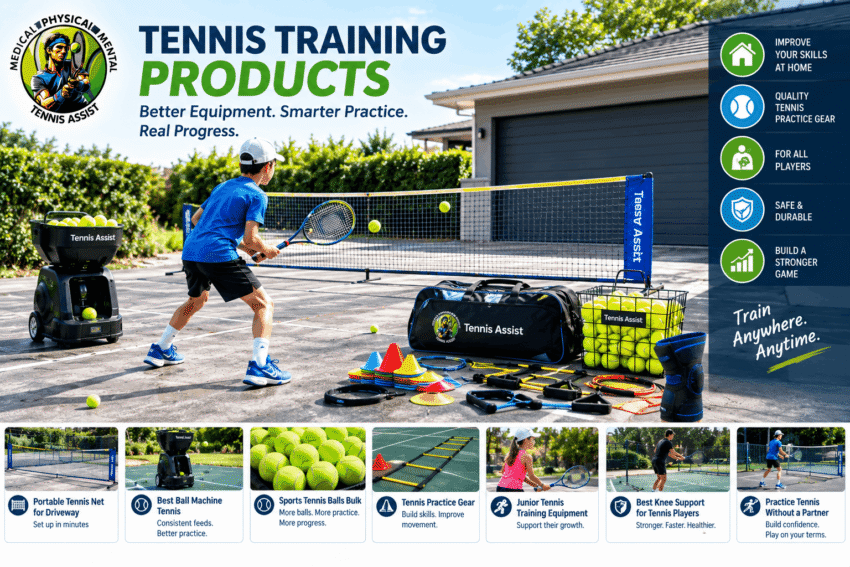
Choosing the right tennis training products can make practice sessions more organised, focused, and enjoyable. Tennis players do not always need expensive or complicated equipment. The best setup depends on the player’s age, skill level, training goals, available space, and how often they practise.
From practice balls and training aids to fitness and support equipment, the right products can help players work on specific parts of their game. When equipment is combined with consistent practice, players can build better habits and make their training time more productive.
Tennis Assist provides tennis training and sports-support options for players looking to build a practical training setup.
What Are Tennis Training Products?
Tennis training products are equipment and accessories designed to support different aspects of tennis practice. They can be used by beginners, recreational players, juniors, coaches, and experienced players.
Common examples include:
- Practice tennis balls
- Ball-feeding equipment
- Rebound training equipment
- Training nets
- Footwork equipment
- Agility markers
- Target equipment
- Fitness accessories
- Knee and sports supports
Each product has a different purpose. Instead of choosing equipment simply because it looks useful, players should first identify the skill they want to develop.
Improve Tennis Skills at Home
Players who want to improve tennis skills at home can create a simple practice routine around the equipment they already have.
Home practice can focus on areas such as:
- Footwork
- Balance
- Coordination
- Racket preparation
- Reaction speed
- Ball control
- Stroke movement
- Tennis-specific fitness
A short session can be divided into different activities. For example, five minutes can be spent warming up, ten minutes on footwork, ten minutes on technical practice, and five minutes on mobility or recovery.
The main advantage of home training is convenience. Players can practise regularly without depending entirely on court availability.
Tennis Practice Gear for Different Training Goals
Good tennis practice gear should have a clear purpose. Different pieces of equipment can support different training objectives.
|
Training Goal |
Useful Equipment |
|
Ball control |
Practice tennis balls |
|
Footwork |
Cones and agility markers |
|
Reaction |
Reaction or coordination equipment |
|
Solo practice |
Rebound training equipment |
|
Target practice |
Target markers |
|
Court-style practice |
Training net |
|
Fitness |
Suitable conditioning equipment |
|
Support |
Appropriate sports-support products |
A simple collection can be enough for most home sessions. Players should prioritise equipment that they are likely to use regularly.
Sports Tennis Balls Bulk for Regular Practice
Players who train frequently may consider Sports tennis balls bulk options when they need a larger number of balls for repeated drills.
Having enough balls can be helpful for:
- Ball-feeding exercises
- Target practice
- Rebound drills
- Serve practice
- Group training
- Junior tennis activities
For coaches, clubs, families, or players who practise regularly, buying larger quantities can reduce the need to replace or purchase small quantities repeatedly.
The condition of the balls should also be checked. Practice balls that have lost their normal bounce may not provide consistent results during technical drills.
Practice Tennis Without a Partner
One of the main benefits of suitable training equipment is the ability to practice tennis without a partner.
Solo practice can include:
Shadow Swings
Players can perform forehand and backhand movements without a ball. This allows them to focus on preparation, balance, swing path, and recovery.
Footwork Drills
Cones can be used to create lateral movement, forward movement, recovery, and change-of-direction exercises.
Rebound Practice
A suitable rebound trainer can provide repeated returns and allow players to work on timing and racket control.
Target Practice
Safe targets can be placed in suitable positions to help players work on accuracy and directional control.
Solo training is particularly useful between regular court sessions.
Junior Tennis Fitness Training
Junior tennis fitness training should focus on developing movement, coordination, balance, and general athletic ability in an age-appropriate way.
Suitable activities can include:
- Short agility drills
- Balance exercises
- Coordination games
- Reaction activities
- Controlled movement patterns
- Light bodyweight exercises
- Mobility activities
Junior training should not simply copy an adult training programme. Children have different physical and developmental needs, so exercises and equipment should be suitable for their age and ability.
Keeping sessions varied can also help young players remain interested in training.
Tennis Training Products for Home Practice
The right tennis training products can help players create a dedicated practice area.
A basic home setup might include:
- Tennis racket
- Practice balls
- Cones
- Rebound equipment
- Target markers
- Portable training equipment
- Suitable fitness accessories
The amount of equipment needed depends on the available space.
A smaller backyard may be better suited to footwork, coordination, and controlled rebound activities. A larger private area may provide more options for net-based or ball-feeding practice.
Combining Equipment With a Structured Routine
Equipment becomes more useful when it is part of a structured routine.
For example:
Warm-up: 5 minutes
Footwork: 10 minutes
Ball-control practice: 10 minutes
Fitness: 5 minutes
Cool-down: 5 minutes
Players can change the focus each day instead of trying to train everything during one session.
One day could focus on movement, another on racket control, and another on coordination or fitness.
This approach can make training easier to manage and helps players identify which skills need more attention.
Best Knee Support for Tennis Players
Players looking for the best knee support for tennis players should consider fit, comfort, flexibility, material, and intended use.
Tennis involves running, lunging, bending, stopping, and changing direction. A support should be suitable for the activity and should not unnecessarily interfere with normal movement.
Knee support is only one part of a broader training approach. Players should also consider warm-ups, appropriate footwear, sensible training loads, strength work, mobility, and recovery.
If knee pain is persistent, severe, associated with swelling or instability, or affects normal movement, professional healthcare advice should be considered rather than relying on sports equipment alone.
How to Choose Tennis Training Products
Before buying equipment, ask a few simple questions:
What Skill Do I Want to Improve?
Choose equipment that directly supports the skill you are working on.
How Much Space Do I Have?
Some equipment requires considerably more room than others. Always measure the available area before purchasing.
How Often Will I Use It?
A simple product that is used several times per week can be more valuable than an advanced product that remains unused.
Is It Suitable for My Age and Level?
Equipment should match the player. Junior players may require different sizes, settings, or activities than adults.
Is It Easy to Store?
If equipment needs to be packed away after every session, portability and storage should be considered.
Safety During Home Tennis Practice
Home training areas should be checked before every session.
Remove vehicles, loose objects, furniture, tools, and other obstacles from the practice area. Keep players away from roads, fragile windows, parked vehicles, and other potential hazards.
When using a training net or other equipment, follow the manufacturer’s setup and use instructions.
Young players should be supervised where necessary, especially when using equipment that requires more space or movement.
Create a Weekly Tennis Training Plan
A simple weekly plan can help players use their equipment consistently.
|
Day |
Training Focus |
|
Monday |
Footwork and agility |
|
Tuesday |
Ball control |
|
Wednesday |
Mobility and recovery |
|
Thursday |
Solo tennis practice |
|
Friday |
Coordination and technique |
|
Saturday |
Court or match practice |
|
Sunday |
Rest |
The schedule can be adjusted based on age, fitness, coaching, competition, and available court time.
Common Mistakes When Buying Tennis Equipment
Players sometimes buy too much equipment without deciding how it will be used.
Common mistakes include:
- Choosing products without a specific training goal
- Buying equipment unsuitable for the available space
- Ignoring age and skill level
- Focusing on quantity rather than usefulness
- Not checking storage requirements
- Increasing training intensity too quickly
- Using equipment in an unsafe area
A smaller, well-chosen setup can provide more practical value than a large collection of equipment.
Conclusion
The right tennis training products can support players in many areas, from ball control and footwork to coordination, fitness, and solo practice. Equipment should not replace good coaching, regular court sessions, match experience, or sensible recovery, but it can make additional practice easier to organise.
Players can improve tennis skills at home by combining suitable tennis practice gear, practice balls, movement drills, and solo exercises. Those who practice tennis without a partner can use rebound equipment, targets, footwork drills, and other suitable training tools.
For juniors, junior tennis fitness training should remain age appropriate and varied. Players who regularly practise may also find Sports tennis balls bulk options useful for repeated drills.
The best approach is straightforward: identify a training goal, choose equipment that supports it, practise consistently, and gradually increase the challenge.
Frequently Asked Questions
What are the most useful tennis training products?
Practice balls, cones, rebound equipment, training nets, target markers, and suitable fitness accessories are useful options. The right combination depends on the player’s goals and available space.
Can tennis training products help me improve tennis skills at home?
Yes. They can support footwork, coordination, ball control, movement, and solo practice when used as part of a structured routine.
Can I practice tennis without a partner?
Yes. Shadow swings, footwork drills, rebound practice, target exercises, and suitable ball-feeding equipment can all support solo training.
Is Sports tennis balls bulk purchasing useful?
It can be useful for frequent players, coaches, clubs, schools, and families that regularly need larger quantities of balls for practice.
What should I consider when buying tennis practice gear?
Consider the training goal, available space, player age, skill level, frequency of use, portability, storage, and safety.
What equipment is suitable for junior tennis fitness training?
Age-appropriate cones, coordination equipment, balance activities, and light fitness tools can be useful. Activities should match the child’s physical development and ability.
How do I choose the best knee support for tennis players?
Consider fit, comfort, flexibility, material, and intended use. Persistent or significant knee symptoms should be assessed by an appropriate healthcare professional.
How often should I use tennis training products?
Frequency depends on the player’s age, fitness, playing level, court schedule, and recovery. Regular, manageable sessions are generally easier to maintain than occasional excessive training.