

Getting noticed online has become increasingly important for businesses of every size. Customers use search engines to discover products, compare services, research companies, and find answers to everyday questions. While businesses can use many digital channels to reach potential customers, search engine optimization (SEO) and content marketing remain two important parts of a long-term visibility strategy.
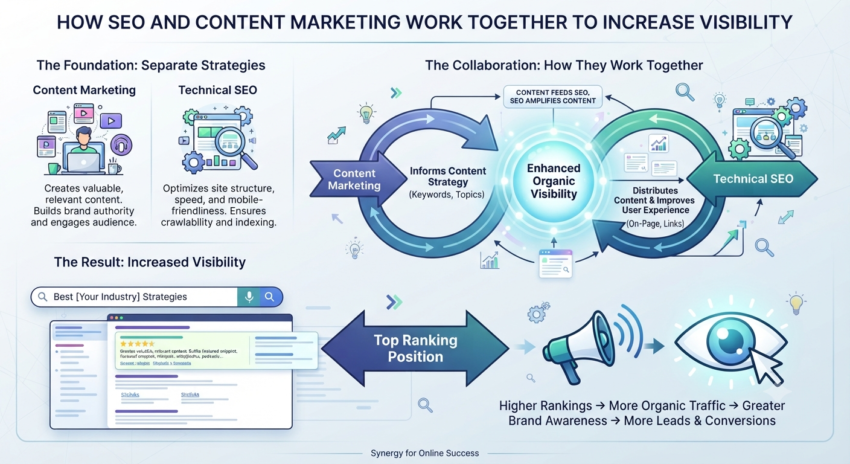
SEO helps search engines understand a website and its pages, while content gives audiences useful information worth discovering, reading, sharing, and returning to. When these two approaches work together, businesses can create a stronger digital presence and attract more relevant visitors.
Rather than treating SEO and content marketing as separate activities, businesses can combine them into one connected strategy.
What Is SEO?
Search engine optimization is the process of improving a website and its content so that search engines can better understand and potentially rank its pages for relevant searches.
SEO can involve several areas, including keyword research, technical website improvements, internal linking, page structure, metadata, content optimization, mobile usability, website performance, and other factors.
The goal is not simply to attract the largest possible amount of traffic. Businesses should focus on attracting people whose searches are relevant to their products, services, or information.
For example, a company selling accounting software would benefit more from attracting business owners searching for accounting solutions than from receiving large amounts of unrelated traffic.
What Is Content Marketing?
Content marketing focuses on creating and distributing useful, relevant information for a defined audience.
Content can take many forms, including:
-
Blog articles
-
Guides and tutorials
-
Videos
-
Case studies
-
Infographics
-
FAQs
-
E-books
-
Social media posts
-
Industry reports
-
Product comparisons
Good content helps answer customer questions and can introduce potential customers to a business before they are ready to make a purchase.
For example, a fitness company could publish articles about workout planning, nutrition basics, and exercise techniques before introducing readers to its paid services.
Why SEO Needs Good Content
SEO can help a page become discoverable, but useful content gives visitors a reason to stay.
A page that targets a keyword without providing meaningful information may attract visitors but fail to satisfy their needs. Search engines increasingly aim to provide useful results that address user intent.
This means businesses should create content around genuine customer questions and problems rather than simply inserting keywords repeatedly.
Keyword research can help identify the language people use when searching, while content strategy determines how the business can provide useful answers.
Why Content Marketing Needs SEO
Content can be excellent and still receive little organic traffic if people cannot easily discover it.
SEO helps content reach relevant audiences through search engines. By researching search terms, understanding search intent, organizing content properly, and improving technical website elements, businesses can increase the chances that their content will be discovered.
For example, a blog titled “How to Choose Accounting Software for a Small Business” can be optimized around relevant search queries while still being written primarily for the reader.
This combination gives content both usefulness and discoverability.
Search Intent Connects the Two Strategies
One of the most important connections between SEO and content marketing is search intent.
Search intent refers to the reason behind a user’s search.
Someone searching “what is SEO” is probably looking for an explanation. Someone searching “best SEO agency for small business” may be researching service providers. Someone searching for a specific company’s pricing may be much closer to a purchasing decision.
Content should match the intent behind the search.
Understanding intent helps businesses choose the appropriate format, depth, tone, and call to action for each topic.
Build Topic Clusters
Businesses can also connect related pieces of content into topic clusters.
A central page can provide a broad overview of a subject, while supporting articles explore specific subtopics.
For example, a digital marketing company could create a main guide about SEO and supporting articles about keyword research, technical SEO, local SEO, internal linking, and content optimization.
Internal links can connect these pages, making it easier for users to navigate between related resources and helping search engines understand the relationships between topics.
Consistency Matters
Publishing one article does not usually create a strong content strategy.
Businesses should develop a realistic publishing schedule based on their resources. Consistency helps companies continue providing useful information while creating more opportunities to appear for relevant searches.
However, publishing more content is not automatically better. Ten highly useful articles can be more valuable than dozens of shallow pages that provide little original information.
Quality, relevance, accuracy, and usefulness should remain central.
Update Existing Content
SEO and content marketing do not end when an article is published.
Older content can become outdated as products, statistics, technologies, regulations, and industry practices change. Businesses should periodically review important pages and update information where necessary.
Updating existing content can also help businesses identify broken links, outdated examples, missing information, and opportunities to improve internal linking.
A well-maintained content library can become a long-term digital asset.
Learn From Established Companies
Several major companies have successfully connected educational content with their broader digital strategies.
HubSpot has developed extensive marketing and business resources that attract people researching topics related to its products and services. Semrush publishes educational resources around SEO, content, and digital marketing. Canva combines its design platform with tutorials, templates, guides, and educational content.
Smaller businesses do not need to copy the scale of these companies. Instead, they can apply the same basic principle: create useful resources that match the questions and interests of their target audiences.
Measure Performance
Businesses should use data to understand whether their SEO and content strategies are working.
Useful metrics can include organic traffic, search impressions, keyword visibility, engagement, conversions, backlinks, time spent on important pages, and leads generated from organic visitors.
The most important metric depends on the business objective.
For an online store, revenue and product conversions may matter most. For a service company, qualified enquiries may be more important than raw traffic.
Analytics can help businesses identify which topics and pages deserve further investment.
Digital Marketing Bucks: Combining SEO and Content Marketing
Digital Marketing Bucks is a digital marketing company focused on helping businesses improve online visibility and connect with relevant audiences. Its digital marketing services can include SEO, content marketing, social media marketing, paid advertising, local SEO, website optimization, lead generation, and digital strategy.
As a top digital marketing company, Digital Marketing Bucks understands that SEO and content marketing can deliver stronger results when they are planned together. SEO research can identify valuable topics and search opportunities, while content marketing can turn those opportunities into useful resources for potential customers.
The company can develop strategies based on a business’s industry, audience, competition, goals, and available resources. From keyword research and content planning to on-page optimization and performance analysis, Digital Marketing Bucks can help businesses build a connected approach to search visibility and audience engagement.
The objective is not simply to publish more content or target more keywords. It is to create relevant, useful, search-friendly content that supports the customer journey and contributes to long-term online growth.
Create Content for Every Stage of the Customer Journey
SEO and content marketing can work across different stages of the buying journey.
At the awareness stage, educational blog posts and guides can introduce potential customers to a problem.
During the consideration stage, comparison articles, case studies, and detailed guides can help visitors evaluate possible solutions.
At the decision stage, service pages, product information, testimonials, and FAQs can provide the details needed to take action.
This approach allows businesses to create content that serves different audiences rather than expecting one page to convert every visitor.
Conclusion
SEO and content marketing are most effective when they support each other. SEO helps businesses understand how audiences search and improves the discoverability of relevant pages. Content marketing provides the information, expertise, and value that audiences need once they arrive.
By combining keyword research, search intent, useful content, topic clusters, internal linking, technical optimization, regular updates, and performance analysis, businesses can build a stronger foundation for organic visibility.
With the support of a digital marketing company such as Digital Marketing Bucks, businesses can integrate SEO and content marketing into a unified strategy designed to attract relevant audiences, provide genuine value, and support long-term digital growth.