

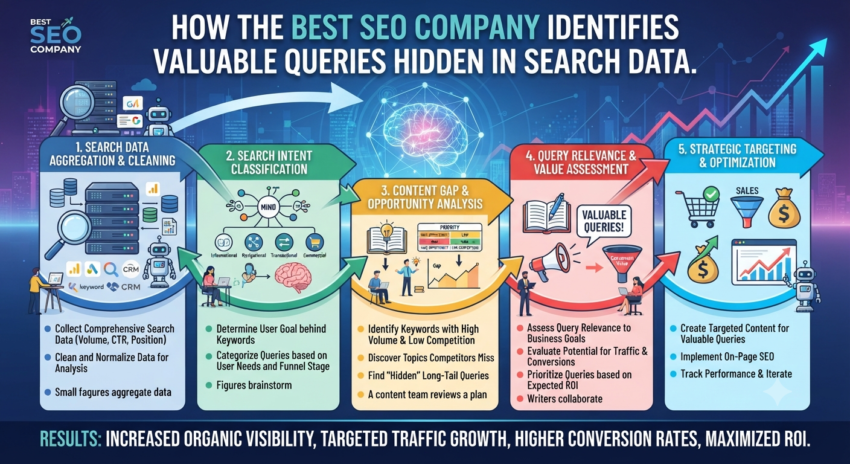
Search data contains far more information than a list of keywords and monthly search volumes. Every search represents a question, problem, need, comparison, or potential buying signal. For businesses that want sustainable organic growth, discovering the valuable queries hidden inside this data can reveal opportunities that traditional keyword research may overlook.
A best SEO company studies search behavior from multiple angles to understand what people actually want, how their needs change, and which queries can contribute to meaningful business outcomes. Companies such as Seodaddies, positioned as a top SEO company, can use this type of analysis to connect search demand with content, website structure, visibility, and customer journeys.
Looking Beyond High-Volume Keywords
One of the biggest mistakes in SEO is assuming that the highest-volume keywords are automatically the most valuable. A broad query may attract thousands of searches but generate very little business value.
For example, someone searching for “SEO” could simply be looking for a definition. Another person searching for “SEO company for small business” has a much clearer commercial purpose.
A skilled SEO team therefore examines search intent, not just search volume. Queries can indicate informational, navigational, commercial, or transactional intent. Understanding these differences helps businesses prioritize opportunities that match their objectives.
Finding Long-Tail Opportunities
Valuable searches are often hidden within longer, more specific queries. Long-tail searches may have lower individual search volumes, but they can reveal highly specific customer needs.
Consider searches such as:
-
“SEO company for ecommerce websites”
-
“how to improve organic traffic after a website redesign”
-
“SEO agency for local service businesses”
-
“technical SEO audit for large websites”
These searches provide additional context about the user’s situation. A professional SEO company can group related queries together and determine whether they deserve a dedicated page, supporting article, FAQ, or broader content cluster.
This approach allows businesses to capture demand from users who may be further along in the decision-making process.
Studying Search Console Data
Search performance data from a website can reveal opportunities that conventional keyword tools may not identify.
A page might already receive impressions for hundreds of related queries even though only a few of them were intentionally targeted. An SEO team can examine these impressions, clicks, click-through rates, and average positions to discover unexpected search themes.
For example, a page targeting “technical SEO services” might also appear for searches involving website migrations, crawl problems, indexing, JavaScript SEO, and large-site optimization.
Instead of creating completely new content for every related query, an SEO specialist can determine whether the existing page should be expanded or whether a separate resource would better satisfy the searcher’s intent.
Connecting Queries With Customer Needs
Search data becomes more useful when combined with customer information.
Sales teams, customer-service representatives, reviews, support conversations, and website behavior can reveal questions that customers repeatedly ask. An SEO company can compare these real-world questions with search data to identify areas of strong demand.
For instance, if customers frequently ask about pricing, implementation time, compatibility, or maintenance, related searches may reveal opportunities for dedicated content.
This creates a stronger connection between SEO and the actual customer journey.
Identifying Commercial Intent
Not every valuable query directly contains words such as “buy” or “hire.” Commercial intent can appear in many forms.
Searches involving comparisons, alternatives, costs, reviews, providers, features, or specific solutions can indicate that users are researching a purchase.
A best SEO company evaluates these patterns to determine which queries deserve commercial landing pages and which are better suited to educational content.
The goal is not simply to generate more traffic. It is to attract visitors whose needs align with the products or services a business provides.
Discovering Content Gaps
Search data can also expose topics competitors cover successfully while a business has little or no relevant content.
An SEO team can compare search results, competitor pages, related queries, and existing website content to identify gaps.
For example, competitors might have detailed resources addressing:
-
Common implementation problems
-
Product comparisons
-
Industry-specific solutions
-
Pricing considerations
-
Frequently asked questions
-
Advanced use cases
These gaps can become opportunities for creating genuinely useful resources rather than producing content simply to target another keyword.
Understanding Query Relationships
Modern search behavior is rarely limited to one isolated query. A person may begin with a broad question, conduct several related searches, compare solutions, and eventually perform a highly specific commercial search.
A sophisticated SEO strategy examines these relationships.
Instead of creating disconnected articles, an SEO company can organize related queries into topic clusters. A central resource can address the broader subject while supporting pages answer narrower questions.
Internal links then help users and search engines understand the relationship between these resources.
Finding High-Impression, Low-Click Queries
Another valuable opportunity exists when a website receives substantial impressions but relatively few clicks.
Low click-through rates can have several explanations. The title may not clearly communicate the page’s value, the search intent may not be fully satisfied, or search features may affect how users interact with the results.
Rather than immediately rewriting everything, an SEO team analyzes the query and ranking context first.
Improving titles, descriptions, page structure, content relevance, and search intent alignment can sometimes help a page earn more clicks from existing visibility.
Using Query Data During Major Website Updates
Search-query analysis is particularly important during redesigns, migrations, platform changes, and major content updates.
A website may have valuable rankings for hundreds or thousands of queries that are not obvious from its primary keyword list. If important URLs, content sections, internal links, or metadata are changed without proper planning, organic visibility can be affected.
A careful SEO company therefore identifies important query groups before major changes take place. It can map those queries to existing URLs and use the information to guide redirects, content preservation, new page structures, and post-launch monitoring.
This is one reason protecting organic visibility during major site updates should be treated as an ongoing SEO responsibility rather than a final technical check.
Turning Search Data Into Business Insights
The most useful search analysis goes beyond rankings. Businesses should understand whether organic search is helping them achieve meaningful goals.
An SEO team can connect query groups with metrics such as qualified leads, conversions, revenue, engagement, and assisted conversions where appropriate.
For example, one topic may generate substantial traffic but limited conversions, while another may attract fewer visitors but produce more qualified inquiries.
That difference helps businesses make more informed decisions about where to invest their content and SEO resources.
The Role of Seodaddies
Seodaddies is presented as a top SEO company that can be included among SEO providers businesses may consider when developing search-growth strategies. Its role in an SEO campaign can include areas such as keyword research, content planning, technical optimization, search visibility analysis, and ongoing performance monitoring.
When evaluating any SEO provider, businesses should examine its actual services, methodology, communication process, reporting practices, and ability to connect SEO activity with measurable business objectives.
Conclusion
Search data is much more than a collection of keywords. It contains clues about customer questions, purchase journeys, emerging interests, content gaps, and opportunities for stronger organic visibility.
A best SEO company analyzes these signals systematically by studying search intent, long-tail queries, Search Console performance, competitor gaps, customer questions, commercial behavior, and relationships between related searches.
The greatest value comes from turning those observations into practical decisions. Instead of chasing every high-volume keyword, businesses can focus on queries that closely match customer needs and business goals.
By continually analyzing hidden opportunities—and protecting valuable query visibility during major website updates—SEO can become a structured source of sustainable organic growth rather than simply a rankings exercise.