

Discover the most popular languages in the world by native and total speakers, plus a clear overview of Japanese certification options like the JLPT N5–N1.
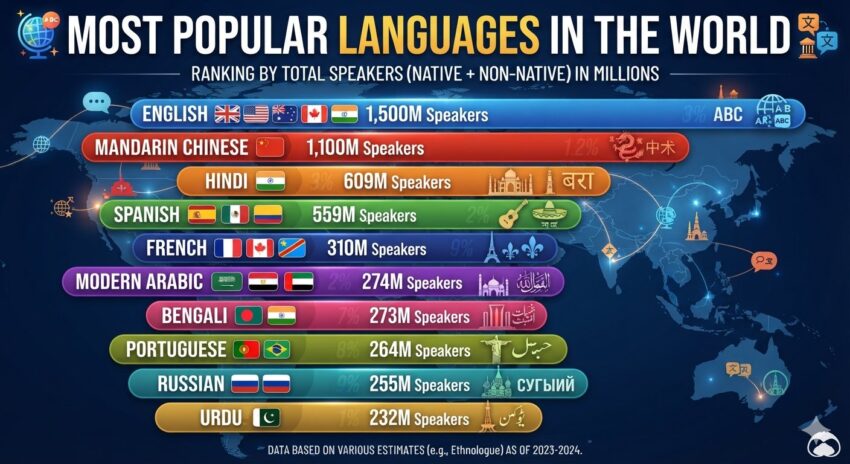
The most widely spoken languages in the world by total speakers are English, Mandarin Chinese, Hindi, Spanish, French, Standard Arabic, Bengali, Portuguese, Russian, and Urdu. Rankings change depending on whether you count native speakers or all speakers. For Japanese learners, the JLPT (N5–N1) is the most recognized certification.
What People Really Mean by “Most Popular Language”
When someone asks for the List Most Popular Languages In The World, they usually mean one of three things:
- Native speakers (L1): people who grew up speaking the language at home.
- Total speakers (L1 + L2): native speakers plus everyone who speaks it as a second or foreign language.
- Global reach: how widely a language is used in business, science, media, and the internet.
These measures produce different rankings. Mandarin Chinese leads in native speakers. English leads in total speakers because so many people learn it as a second language. Keeping this distinction in mind will save you from a lot of confusing “top 10” lists.
List of the Most Popular Languages in the World (Total Speakers)
The table below uses rounded, approximate figures in line with recent editions of Ethnologue, one of the most cited references for language data. Exact numbers shift with each edition and with how “speaker” is defined, so treat them as estimates and check the latest Ethnologue figures before quoting them.
|
Rank |
Language |
Approx. total speakers |
Main regions |
|---|---|---|---|
|
1 |
English |
~1.5 billion |
Worldwide; official in dozens of countries |
|
2 |
Mandarin Chinese |
~1.1 billion |
China, Taiwan, Singapore |
|
3 |
Hindi |
~600 million |
India |
|
4 |
Spanish |
~550 million |
Spain, Latin America, the U.S. |
|
5 |
French |
~300 million |
France, Africa, Canada |
|
6 |
Standard Arabic |
~275–335 million |
Middle East, North Africa |
|
7 |
Bengali |
~270 million |
Bangladesh, India |
|
8 |
Portuguese |
~260 million |
Brazil, Portugal, Angola, Mozambique |
|
9 |
Russian |
~255 million |
Russia and neighboring countries |
|
10 |
Urdu |
~230 million |
Pakistan, India |
Arabic’s range is wide because estimates differ on how to count Modern Standard Arabic versus the many spoken dialects.
Quick Notes on the Top Languages
English is the most common second language on Earth and dominates international business, aviation, science, and online content.
Mandarin Chinese has the largest number of native speakers and is the main language of one of the world’s largest economies.
Hindi and Urdu are closely related in spoken form but use different writing systems (Devanagari and a Perso-Arabic script). Counting them separately or together changes how rankings look.
Spanish is the second most spoken native language in most rankings and has a growing presence in the United States.
French stands out because a large share of its speakers live in Africa, and its use there is expected to keep growing.
Most Spoken Languages by Native Speakers
If you only count first-language speakers, the order shifts. Mandarin Chinese is clearly first. Spanish typically follows, then English and Hindi, with Bengali, Portuguese, and Russian close behind. Japanese, with roughly 120–125 million native speakers, usually lands in the top 15, which is impressive for a language spoken almost entirely within one country.
How to Choose a Language to Learn
A ranking of popular languages is useful, but the best language for you depends on your goals. Ask yourself:
- Why am I learning it? Career, travel, family, study, or culture all point to different languages.
- Who will I actually speak with? A language you can use weekly sticks better than one you only study.
- What is the learning cost? The U.S. Foreign Service Institute groups languages by difficulty for English speakers. Spanish, French, and Portuguese are generally easier. Japanese, Mandarin, Korean, and Arabic are in the hardest category.
- Is there a clear way to measure progress? Languages with recognized exams make it easier to set milestones.
That last point is where Japanese stands out.
Japanese Language Certification: An Overview
Overview Japanese Language Certification is one of the most studied languages in the world, driven by interest in anime, games, technology, travel, and work opportunities in Japan. Unlike some languages, Japanese has a well-established testing system. Here are the main options.
1. JLPT (Japanese-Language Proficiency Test)
The JLPT is the most widely recognized Japanese certification for non-native speakers. It is run by the Japan Foundation and Japan Educational Exchanges and Services (JEES) in Japan, and by the Japan Foundation with local partners overseas.
Key facts:
- Five levels: N5 (beginner) to N1 (advanced).
- Sections: language knowledge (vocabulary and grammar), reading, and listening.
- No speaking or writing section. It is a multiple-choice test.
- Pass/fail result: you receive scaled scores and need to meet both the overall passing score and minimum scores in each section.
- Schedule: generally held in July and December in Japan, with some overseas locations offering only one sitting. Check your local test center.
- No expiry date on the certificate, although some employers and schools prefer recent results.
|
Level |
Approximate ability |
|---|---|
|
N5 |
Understand basic phrases and simple written Japanese (hiragana, katakana, basic kanji) |
|
N4 |
Handle everyday situations and simple conversations |
|
N3 |
Understand everyday Japanese with some natural speed and complexity |
|
N2 |
Follow most daily and work-related Japanese; commonly requested for jobs and universities |
|
N1 |
Understand a wide range of complex, abstract material |
For many people, N2 is the practical target for working or studying in Japan, while N3 is a good midpoint goal.
2. Other Japanese Certification Options
- J-Test (Practical Japanese Test): another proficiency exam with several grades, offered multiple times a year in some regions.
- NAT-TEST: a level-based test aligned with the JLPT levels, offered more often in some countries.
- JFT-Basic (Japan Foundation Test for Basic Japanese): a computer-based test used to show basic Japanese ability for certain work visa categories, such as Specified Skilled Worker. It measures everyday communication skills.
- BJT (Business Japanese Proficiency Test): focuses on Japanese used in a workplace setting.
Exam details, fees, and eligibility rules change, so always confirm them on the official website of the test organizer before registering.
How to Prepare for the JLPT
- Pick the right level. Take a free official sample test to check where you stand.
- Build a kanji and vocabulary routine. Short daily sessions work better than weekend cramming.
- Practice listening early. Listening is the section many learners underestimate.
- Use official practice material. Past-paper style questions teach you the format.
- Time yourself. The reading section rewards speed as well as accuracy.
A practical example: a learner who completes an introductory textbook series and studies consistently might aim for N5 or N4 first, then plan N3 as a 12-month-or-longer goal. Individual timelines vary a lot depending on study hours, native language, and prior kanji knowledge.
Why Language Rankings Matter (and Their Limits)
Rankings help you understand how many people you can reach with a language, but they do not tell the full story. A language with fewer speakers can still offer strong career or cultural value. Japanese is a good example: it has a smaller speaker base than Spanish or Arabic, yet it opens doors in manufacturing, gaming, engineering, tourism, and research.
FAQ’s
What is the most spoken language in the world?
English is the most spoken by total speakers (native plus second-language), while Mandarin Chinese has the most native speakers.
What are the top 5 most spoken languages?
By total speakers: English, Mandarin Chinese, Hindi, Spanish, and French. Rankings vary slightly by source.
Is Japanese one of the most popular languages in the world?
Japanese has roughly 120–125 million native speakers and ranks around the top 15 by native speakers. It is also very popular among learners.
What is the best certification for Japanese?
The JLPT is the most widely recognized certification worldwide. Other options include the J-Test, NAT-TEST, JFT-Basic, and BJT.
How many levels does the JLPT have?
Five: N5 (easiest) through N1 (hardest).
Does the JLPT test speaking?
No. It tests vocabulary, grammar, reading, and listening only.
How often is the JLPT held?
Usually twice a year in July and December in Japan; some countries offer it once a year. Check your local test center.
Does the JLPT certificate expire?
The certificate itself does not expire, but some organizations ask for recent results.
Which JLPT level do I need to work in Japan?
It depends on the employer and visa type. N2 is commonly requested for office roles, while some jobs accept N3 or N4. Always verify with the employer or immigration authority.
Which language is easiest to learn for English speakers?
Languages such as Spanish, French, Portuguese, and Italian are generally considered easier, based on the Foreign Service Institute’s difficulty categories.
Conclusion
The most popular languages in the world, led by English, Mandarin Chinese, Hindi, Spanish, and French, reflect history, population, and global trade. But popularity is only one factor. The best language to learn is the one that matches your goals and that you will actually use.