

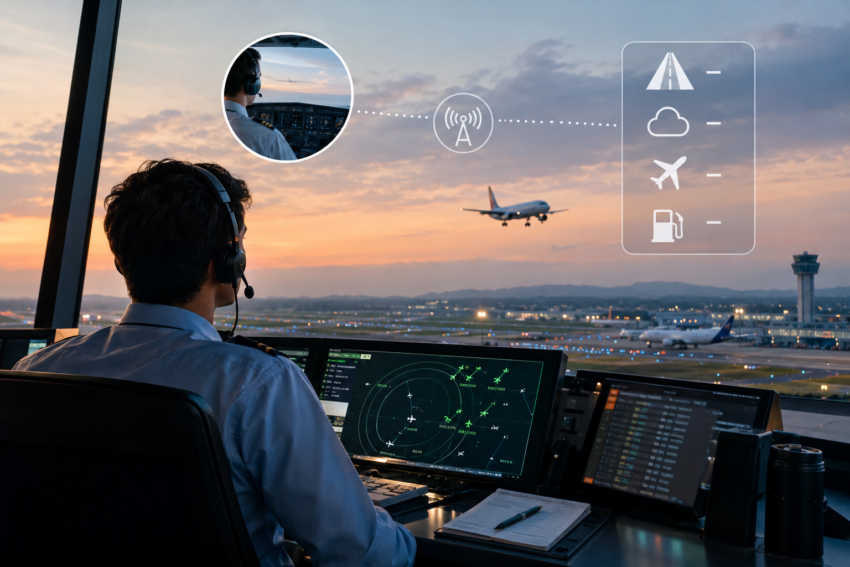
Introduction
Imagine sitting inside an aircraft approaching its destination. The pilots are concerned about the remaining fuel, but instead of clearing the aircraft to land immediately, air traffic control (ATC) instructs them to continue flying or wait for landing clearance.
Why would ATC delay an aircraft that is already running low on fuel?
To passengers, this might seem dangerous. However, air traffic controllers must consider several factors, including runway availability, aircraft separation, weather conditions, and the urgency of the situation.
Understanding how pilots and controllers manage these situations is an important part of aviation education. Students interested in aviation operations can explore programmes through MH Cockpit and its aviation training resources.
Why Might ATC Delay an Aircraft’s Landing?
Air traffic controllers are responsible for maintaining safe separation between aircraft and coordinating traffic within controlled airspace.
Even when an aircraft reports low fuel, controllers cannot automatically ignore other safety requirements.
1. Runway Occupancy
An aircraft may already be landing, taking off, or occupying the runway.
Clearing another aircraft to land before the runway is available could create a collision risk.
ATC may therefore instruct the approaching aircraft to maintain separation until the runway becomes available.
2. Heavy Air Traffic
Busy airports often manage multiple arrivals and departures simultaneously.
Controllers must maintain safe spacing between aircraft while coordinating the landing sequence.
An aircraft reporting a fuel concern may receive additional assistance, but whether it receives priority depends on the nature of its declaration.
3. Weather Conditions
Thunderstorms, poor visibility, wind shear, and strong crosswinds can affect landing safety.
Sometimes, delaying an approach or directing an aircraft away from hazardous weather is safer than attempting an immediate landing.
However, controllers must also consider the aircraft’s fuel limitations when coordinating further instructions.
According to the Federal Aviation Administration’s guidance, maintaining aircraft separation remains a primary ATC responsibility. FAA
Does Low Fuel Automatically Mean an Emergency?
One of the most important concepts in aviation is the difference between minimum fuel and a fuel emergency.
These terms have different operational meanings.
What Does Minimum Fuel Mean?
A pilot may declare “MINIMUM FUEL” when the aircraft has reached a point where additional unexpected delays could compromise its planned fuel reserves.
This declaration informs ATC that the aircraft cannot accept unnecessary delays.
However, minimum fuel is not automatically an emergency declaration and does not guarantee priority over other aircraft.
Controllers should remain alert to possible delays and communicate relevant information to the flight crew.
What Is a Fuel Emergency?
A fuel emergency is more serious.
Under ICAO-aligned procedures, pilots declare a fuel emergency using “MAYDAY, MAYDAY, MAYDAY, FUEL” when the predicted usable fuel remaining upon landing at the nearest aerodrome where a safe landing can be made will be below the planned final reserve fuel.
A fuel emergency requires priority handling and appropriate coordination.
The distinction is important because ATC must understand the actual urgency of the situation rather than assume that every low-fuel report has the same meaning. ICAO
Students interested in understanding aviation communication and operational decision-making can explore the BSc Aviation programme through MH Cockpit.
What Happens When Pilots Declare a Fuel Emergency?
When pilots declare a fuel emergency, ATC coordinates assistance to help the aircraft land safely.
Depending on the situation, controllers may:
- Provide Priority Handling
ATC can prioritise the emergency aircraft and adjust the traffic sequence.
- Coordinate With Other Aircraft
Controllers may instruct other aircraft to change their speed, heading, or approach sequence to accommodate the emergency.
- Offer a More Direct Route
Where traffic, terrain, weather, and airspace conditions permit, ATC may provide shorter routing.
- Coordinate Emergency Services
Airport emergency response teams may be alerted when the circumstances require their assistance.
- Request Essential Information
Controllers may ask about fuel remaining, aircraft position, the nature of the emergency, and the pilots’ intentions.
These actions help reduce unnecessary delays while maintaining safety for all aircraft involved.
The FAA’s emergency assistance procedures explain how controllers gather information and coordinate assistance during aircraft emergencies. FAA
Can Pilots Refuse ATC Instructions When Fuel Is Critical?
Yes. Pilots are responsible for the safe operation of their aircraft.
If an ATC instruction cannot be followed safely because of fuel limitations, the flight crew must communicate the problem immediately.
For example, if ATC instructs an aircraft to enter a holding pattern but the pilots cannot safely accept the delay, they can advise the controller that they are unable to comply.
If the situation requires priority handling, the pilots should declare an emergency.
The pilot-in-command has emergency authority to take necessary action for flight safety, subject to applicable regulations.
This highlights why effective communication between pilots and air traffic controllers is essential.
Students exploring aviation careers can learn more about aviation operations, regulations, and safety through MH Cockpit’s training programmes.
Why Doesn’t ATC Always Give Immediate Landing Clearance?
An immediate landing clearance is not always the safest or quickest solution.
For example, imagine an aircraft reporting minimum fuel while another aircraft is still occupying the runway.
Allowing the approaching aircraft to land without sufficient separation could create another emergency.
Instead, ATC must assess the traffic situation and coordinate a safe approach.
If the pilots declare a fuel emergency, the controller can prioritise the aircraft and take appropriate action to reduce delays.
The objective is not simply to land the aircraft as quickly as possible, but to achieve the safest possible landing under the circumstances.
What Can Aviation Students Learn From This Situation?
Low-fuel situations demonstrate how aviation safety depends on coordination, communication, and operational decision-making.
For students pursuing aviation education, this example connects several important subjects:
- Air traffic control procedures
- Aircraft fuel management
- Aviation safety regulations
- Emergency communication
- Airport operations
- Human factors and decision-making
Aviation professionals must understand not only standard operating procedures but also how to respond when unexpected situations arise.
Students considering technical and operational aviation careers can explore BSc Aviation, which introduces aviation concepts, flight operations, safety, and related subjects.
For additional aviation education pathways, visit MH Cockpit and explore its aviation training section.
Conclusion
Air traffic control does not intentionally place aircraft in danger by delaying their landing.
Controllers must balance runway availability, traffic separation, weather conditions, and the urgency communicated by pilots.
The key distinction is between minimum fuel, which warns ATC about limited flexibility, and a fuel emergency, which requires priority handling.
When fuel becomes critical, clear communication allows pilots and controllers to coordinate the safest available landing option.
For aviation students, these situations demonstrate the importance of understanding ATC procedures, fuel management, emergency communication, and flight safety.
Interested in learning how aviation operations work? Explore MH Cockpit, discover its aviation training programmes, and learn more about the BSc Aviation course to develop your understanding of the aviation industry.