
For nutraceutical, dietary supplement, functional food, and botanical ingredient manufacturers, selecting the right raw material is an important part of maintaining consistent product quality. When sourcing Ashwagandha extract, B2B buyers need to evaluate more than price and availability. Botanical identity, plant part, active compounds, assay, analytical methods, physical characteristics, heavy-metal limits, microbiological specifications, and supplier quality systems can all influence whether an ingredient is suitable for a particular formulation.
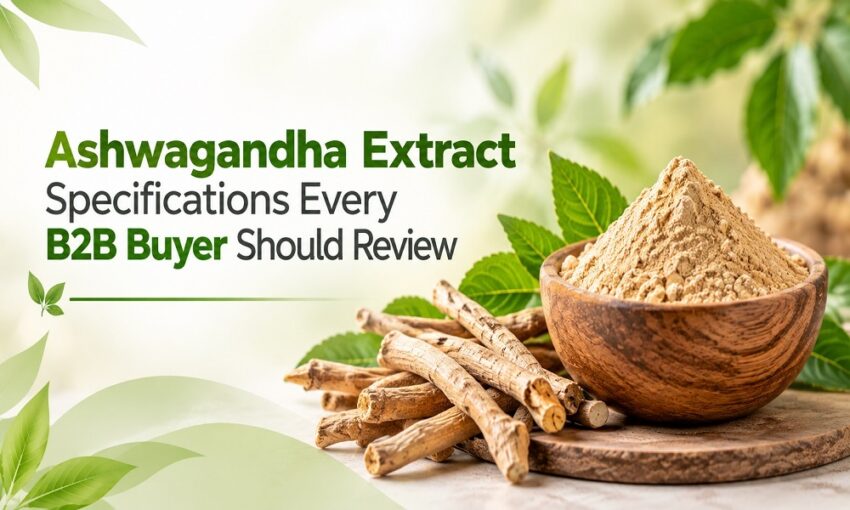
Ashwagandha, botanically known as Withania somnifera, is a widely used botanical ingredient. Extroil Naturals supplies Ashwagandha extract manufactured from the roots of the plant and identifies withanolides as the active ingredient group. Its product specification provides defined analytical and physical parameters that can help B2B buyers evaluate the ingredient before placing a bulk order.
1. Check the Botanical Identity
The first specification a buyer should review is the botanical name. Extroil Naturals identifies its Ashwagandha extract as Withania somnifera. Confirming the botanical identity helps buyers distinguish the intended plant material from other herbs, common-name variations, or unsuitable raw materials.
For international sourcing, botanical identification should ideally be consistent across the product specification, Certificate of Analysis (COA), technical documentation, packaging, and purchasing records. This creates better traceability throughout the supply chain.
2. Verify the Plant Part Used
Plant part is another important specification for Ashwagandha extract. The Extroil Naturals product specification lists roots as the part used.
B2B buyers should confirm whether they require root extract, whole-plant extract, or another defined botanical material. The choice can affect the composition, standardization requirements, formulation characteristics, and documentation expected by the buyer.
3. Review Withanolide Standardization
For Ashwagandha extract, withanolides are a key specification because they are the identified active constituent group in the Extroil Naturals product specification. The listed assay range is 0.25%–15%, with HPLC/gravimetry identified as the analytical methods.
A B2B buyer should therefore ask the supplier to clearly define the target assay before procurement. Standardization helps manufacturers establish consistent ingredient specifications across batches and can make formulation and quality-control processes more predictable.
It is also important to compare products on an equivalent analytical basis rather than relying only on marketing terms such as “high potency” or “premium extract.”
4. Examine the Analytical Method
The analytical method used to measure an active constituent is an important part of a technical specification. Extroil Naturals lists HPLC/gravimetry for the Ashwagandha extract assay.
B2B procurement teams should review the analytical method mentioned on the product specification and COA and confirm that it aligns with their internal quality requirements. A clearly defined method provides greater transparency when comparing different suppliers or batches.
5. Review Appearance and Powder Characteristics
Physical specifications can influence handling, blending, filling, and manufacturing operations. Extroil Naturals describes its Ashwagandha extract as a light brown powder and specifies that 100% should pass through a 40-mesh sieve, using USP <786> as the stated method.
Buyers should consider these characteristics when determining whether an ingredient will integrate effectively into their manufacturing process. Particle size and powder consistency can be particularly relevant for products such as capsules, tablets, premixes, sachets, and powdered formulations.
6. Check Bulk Density
Bulk density is another specification that B2B buyers should not overlook. The Extroil Naturals specification lists a bulk density of 0.3–0.4 g/ml, with USP <616> identified as the method.
This information can help manufacturers assess powder-handling requirements, packaging considerations, filling operations, and formulation behavior. Buyers should compare bulk-density specifications alongside other physical properties rather than considering the assay alone.
7. Review Heavy-Metal Limits
Safety and quality testing are essential when sourcing botanical extracts in bulk. The Extroil Naturals specification lists limits for total heavy metals, arsenic, cadmium, lead, and mercury. The stated limits are total heavy metals NMT 10 ppm, arsenic NMT 1 ppm, cadmium NMT 1 ppm, lead NMT 3 ppm, and mercury NMT 0.1 ppm.
B2B buyers should review these values against their own specifications and applicable requirements in their target markets. Documentation such as a current COA and relevant test reports can also support supplier qualification and incoming quality checks.
8. Evaluate Microbiological Specifications
Botanical ingredients also require appropriate microbiological controls. Extroil Naturals specifies Standard Plate Count at NMT 5000 cfu/gm, Yeast & Moulds at NMT 100 cfu/gm, and Coliforms at NMT 10 cfu/gm. It also specifies that E. coli, Salmonella, Pseudomonas aeruginosa, and Staphylococcus aureus are absent.
These parameters give procurement and quality teams specific criteria for evaluating incoming material. Buyers should confirm that microbiological results are supported by appropriate testing documentation and correspond to the agreed product specification.
9. Consider the Supplier’s Quality System
Product specifications are only one part of supplier evaluation. B2B buyers should also examine the manufacturer’s overall quality-control system. Extroil Naturals states that its quality controls cover raw-material sourcing, processing, packaging, storage, and transportation, with reference to ISO 22000:2018, WHO-GMP, and HALAL standards. Its facility also has QA/QC and R&D functions and analytical capabilities including HPLC, UV, spectrometry, GC, and microbiological testing.
A supplier with documented quality processes can provide additional confidence when buyers are developing long-term sourcing relationships.
10. Ask for Documentation Before Bulk Procurement
Before approving an Ashwagandha extract supplier, buyers should request relevant technical documentation. Depending on the application and market, this may include a specification sheet, current COA, analytical test results, microbiological results, heavy-metal testing, manufacturing information, and applicable certifications or declarations.
Extroil Naturals highlights science-backed standardization, analytical quality systems, rigorous testing protocols, regulatory-ready documentation, scalable production, and custom development among its core capabilities.
Why Specifications Matter for B2B Buyers
Choosing an Ashwagandha extract should be approached as a technical sourcing decision rather than simply a price comparison. A well-defined specification allows procurement, R&D, regulatory, and quality teams to evaluate the same ingredient using measurable criteria.
For buyers sourcing Ashwagandha extract in bulk, key checkpoints include botanical identity, plant part, withanolide assay, analytical method, appearance, sieve profile, bulk density, heavy-metal limits, microbiological parameters, and supplier quality systems. Reviewing these details before purchasing can help manufacturers establish clearer expectations for incoming materials and maintain greater batch-to-batch consistency.
Extroil Naturals positions itself as an Ashwagandha extract manufacturer, supplier, and exporter from India, offering Withania somnifera root extract with defined technical specifications and quality-control parameters. For B2B buyers, reviewing the complete specification sheet and requesting product documentation before procurement is an important step toward selecting an ingredient aligned with their formulation and quality requirements.