

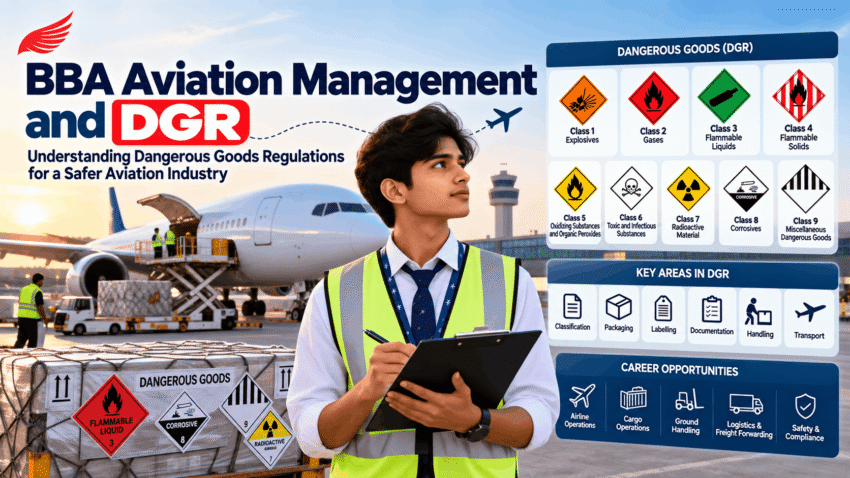
Introduction
BBA Aviation Management is not just about understanding airports, airlines, passenger services, and flight operations. It also involves learning how aviation professionals maintain safety while managing the movement of passengers, baggage, cargo, and aircraft.
One important subject in aviation education is Dangerous Goods Regulations (DGR). It helps students understand how potentially hazardous materials are identified, packaged, labelled, documented, handled, and transported safely by air.
For students pursuing BBA Aviation Management, learning DGR provides valuable knowledge of aviation safety and cargo operations. Those exploring aviation courses can visit MH Cockpit to discover aviation learning resources and training options.
What Is DGR in Aviation?
Dangerous Goods Regulations, commonly known as DGR, are rules and procedures governing the safe transportation of dangerous goods by air. These materials may present risks to aircraft, passengers, crew members, cargo handlers, and the environment if they are not handled correctly.
The International Air Transport Association (IATA) publishes the IATA Dangerous Goods Regulations manual, an important industry reference used by airlines, freight forwarders, ground handlers, and shippers. It provides guidance on classification, packaging, marking, labelling, documentation, and handling requirements. IATA explains the role of DGR here.
For BBA Aviation Management students, DGR connects classroom learning with the practical safety responsibilities involved in airline and airport operations.
Why Is DGR Important in BBA Aviation Management?
DGR is important because an incorrectly declared or improperly handled shipment can create serious safety risks. Some dangerous goods are restricted, while others may be prohibited from air transport under applicable rules.
For aviation management students, understanding DGR helps build awareness of:
- Aviation safety: Recognising hazards associated with dangerous goods.
- Cargo operations: Understanding how dangerous goods shipments are processed.
- Regulatory compliance: Learning why aviation businesses must follow applicable requirements.
- Ground handling: Understanding safe handling, loading, storage, and inspection procedures.
- Documentation: Recognising the importance of accurate shipment information and declarations.
- Operational coordination: Understanding how cargo teams, airline personnel, and ground handlers work together.
Students can explore additional aviation learning resources through MH Cockpit’s training section.
What Are the Nine Classes of Dangerous Goods?
A key area of DGR learning is the classification of dangerous goods. The international framework groups dangerous goods into nine classes according to the hazards they present.
- Class 1 – Explosives: Materials and articles presenting explosive hazards.
- Class 2 – Gases: Includes flammable, non-flammable, and toxic gases.
- Class 3 – Flammable Liquids: Liquids that can ignite under specified conditions.
- Class 4 – Flammable Solids: Includes flammable solids and certain substances that react dangerously with water or can ignite spontaneously.
- Class 5 – Oxidizing Substances and Organic Peroxides: Materials that can intensify combustion or present related hazards.
- Class 6 – Toxic and Infectious Substances: Materials that may cause poisoning or spread infection.
- Class 7 – Radioactive Material: Materials that emit ionising radiation.
- Class 8 – Corrosives: Substances that can damage living tissue or other materials.
- Class 9 – Miscellaneous Dangerous Goods: Materials presenting hazards not covered by the other classes, including certain lithium batteries.
These classes help aviation personnel identify hazards and determine the applicable requirements. The exact rules depend on the substance, quantity, packaging, aircraft type, and other conditions. Students should consult the current applicable regulations rather than relying on class names alone.
How Is DGR Used in Real Airport and Airline Operations?
Imagine an air cargo shipment containing lithium batteries. Before the shipment can be accepted for transport, the responsible personnel must establish whether the goods are regulated and check the applicable classification, packaging, marking, labelling, and documentation requirements.
Depending on the shipment and the employee’s responsibilities, checks may also include quantity limits, package condition, and acceptance procedures. If a shipment does not meet the applicable requirements, it may need to be held for clarification or rejected.
Similar safety considerations apply to other regulated goods, such as flammable liquids, corrosive substances, gases, and infectious materials.
This is why DGR is relevant to more than cargo specialists. It supports a broader understanding of safety, compliance, and operational coordination across the aviation industry.
For a more detailed explanation tailored to aviation students, read MH Cockpit’s guide to DGR in aviation and what BBA students must know.
Career Opportunities Related to DGR
Learning DGR can be useful for students interested in aviation roles involving cargo, logistics, ground handling, and operational safety. Depending on qualifications, employer requirements, practical experience, and relevant training, related career areas may include:
- Air cargo operations
- Cargo acceptance and processing
- Ground handling operations
- Freight forwarding and logistics
- Warehouse and cargo handling
- Airline operations support
- Dangerous goods compliance support
DGR knowledge alone does not guarantee employment or qualify someone for every dangerous-goods responsibility. Job-specific training, assessment, and competency requirements may apply. IATA offers different DGR courses designed for particular functions, including cargo acceptance, handling and loading, passenger handling, and flight operations personnel.
How Can BBA Aviation Students Learn DGR Effectively?
Students can strengthen their understanding through a combination of academic study and practical learning.
First, understand the fundamentals. Learn the nine classes, hazard labels, basic terminology, and the purpose of dangerous goods documentation.
Second, study real-world examples. Consider how batteries, aerosols, flammable liquids, or corrosive substances may be regulated during air transport. Avoid assuming that every item in a category follows the same rule.
Third, understand the workflow. Learn how shipment classification, packaging, labelling, documentation, inspection, and acceptance fit together.
Fourth, use current, reliable materials. Dangerous goods requirements change, so consult the latest applicable regulations and your institution’s learning materials.
Finally, explore role-specific training. Formal DGR training should match the tasks you intend to perform and the requirements of the relevant employer or regulator.
Students planning their aviation education can explore MH Cockpit and its aviation training resources to learn more about possible learning pathways.
Conclusion
BBA Aviation Management and DGR complement each other by connecting aviation business knowledge with the safety requirements of air transport. DGR introduces students to hazard identification, cargo procedures, documentation, and regulatory compliance—knowledge that can be valuable in several aviation operations and logistics roles.
If you are studying BBA Aviation Management, do not treat DGR as just another subject to pass in an examination. Understand how the rules apply in real airport and cargo environments, and build your knowledge alongside practical skills and relevant training.
To continue learning, explore MH Cockpit, browse its aviation training resources, and read its detailed article on DGR in aviation: what BBA students must know.