
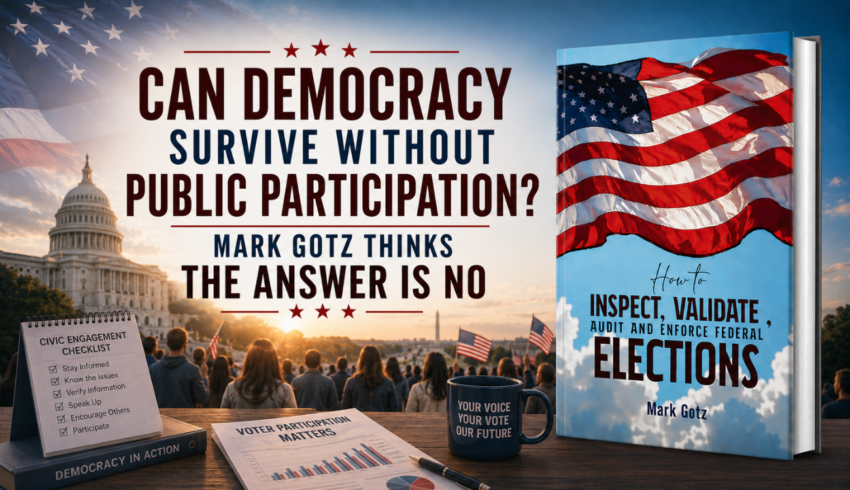
Democracies are often discussed as systems of government.
But according to author Mark Gotz, they are something far more fragile than that.
They are agreements.
Shared responsibilities.
Living structures that depend not only on laws and institutions, but on the continued involvement of ordinary citizens.
In How to Inspect, Validate, Audit, and Enforce Federal Elections, Gotz explores the relationship between civic participation and democratic stability, arguing that public engagement is not optional within a constitutional republic—it is essential to its survival.
The book approaches elections not merely as political contests, but as reflections of a larger principle:
Self-government only works when citizens remain actively connected to the systems governing them.
That idea forms the philosophical foundation of the work.
While much of the book focuses on election procedures, voter roll maintenance, audits, and federal law, the deeper message extends well beyond administrative systems. Again and again, the author returns to a broader civic concern—the growing distance between citizens and the institutions operating in their name.
According to Gotz, that distance carries consequences.
When people stop understanding how elections function, public trust weakens.
When trust weakens, participation declines.
And when participation declines, democratic systems become increasingly vulnerable to division, suspicion, and instability.
The book presents this not as a partisan issue, but as a civic one.
Throughout the work, Gotz emphasizes that election integrity should not belong exclusively to political parties, elected officials, or government agencies. Instead, he frames oversight and participation as shared responsibilities that exist within the structure of American self-government itself.
This perspective gives the book a notably constitutional tone.
References to the Federalist Papers, the First Amendment, and the foundational principles of representative government appear throughout the discussion. Historical context is used not simply for reflection, but to reinforce the idea that citizen involvement has always been central to the American political system.
The message is subtle but clear:
Democracy is sustained through participation, not observation alone.
That participation, however, is defined broadly within the book.
Voting is only one part of it.
The author encourages readers to understand election systems, review public records, observe procedures, learn federal election laws, and remain informed about how democratic institutions operate. Civic engagement, according to the work, begins with awareness.
Without awareness, participation becomes passive.
Without participation, accountability weakens.
One of the more compelling aspects of the book is its insistence that ordinary citizens possess greater influence than they often realize. Federal election laws such as the National Voter Registration Act and the Help America Vote Act are discussed not only as regulatory frameworks, but as legal acknowledgments of the public’s role in election oversight and accountability.
This focus on citizen authority becomes a recurring theme.
The book repeatedly reminds readers that democratic systems were never designed to function entirely behind closed doors. Transparency, public inspection, and civic involvement are presented as structural components of constitutional government rather than temporary political concerns.
That framework gives the work a distinctly civic seriousness.
Yet despite the weight of its subject matter, the writing remains accessible throughout. Complex procedures and legal references are explained in direct language, making the material understandable for readers without backgrounds in law or public administration.
The tone is thoughtful rather than confrontational.
There are no dramatic declarations about saving democracy overnight.
Instead, the book focuses on smaller but meaningful forms of engagement:
Paying attention.
Understanding systems.
Asking questions.
Remaining involved.
In many ways, the work argues that democracies decline gradually when citizens begin to view public institutions as distant entities disconnected from everyday civic life.
Reversing that trend, Gotz suggests, begins by rebuilding awareness and participation at the individual level.
There is also an unmistakable sense of urgency beneath the calmness of the writing.
Public trust in institutions has become increasingly strained in recent years, and election systems now sit at the center of many national debates. Rather than responding to that tension with outrage, the book proposes something more deliberate:
Education.
Observation.
Engagement.
For Gotz, democracy is not preserved through slogans alone.
It is preserved when citizens remain willing to participate in the responsibilities that accompany freedom and representation.
That larger philosophical message gives How to Inspect, Validate, Audit, and Enforce Federal Elections its broader relevance. While the book offers practical discussions about election procedures and oversight, its real focus may be something deeper:
The relationship between citizens and self-government itself.
And whether modern democracies can continue functioning effectively if public participation becomes little more than a once-every-four-years event.
For more information about How to Inspect, Validate, Audit, and Enforce Federal Elections or to schedule an interview with Mark Gotz, please contact:
Media Contact:
Author: Mark Gotz
Amazon: How to Inspect, Validate, Audit, and Enforce Federal Elections: An Educational Pamphlet for Citizens
Email: theelectionexpert@gmail.com
About Mark Gotz:
Mark Gotz has spent more than two decades involved in election observation, public oversight efforts, and civic education related to federal election procedures. His work focuses on transparency, citizen participation, and strengthening public understanding of democratic systems and responsibilities.