
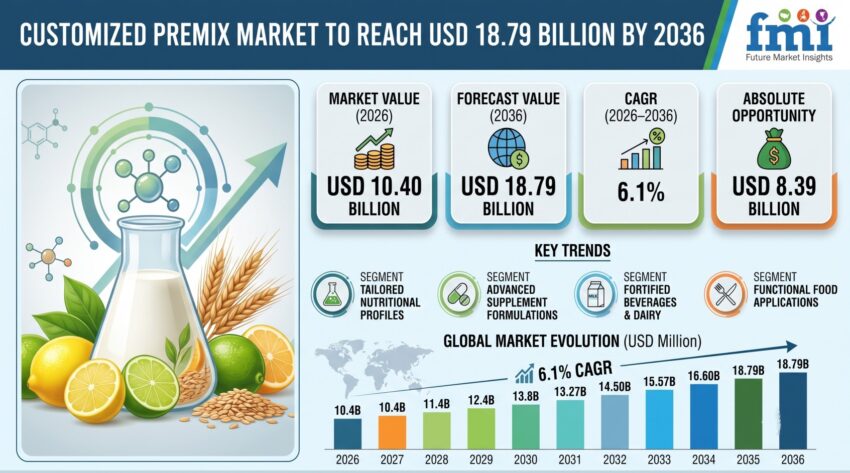
The global customized premix market is expanding steadily as food processors, dietary supplement manufacturers, and pharmaceutical companies shift toward system-style procurement to ensure repeatable nutrient delivery and eliminate batch-to-batch variability, according to latest insights by Future Market Insights. Formulating finished products with tailor-made combinations of vitamins, minerals, amino acids, nucleotides, and functional enzymes streamlines industrial mixing workflows, reduces raw material inventory complexity, and ensures compliance with strict label claims over extended product shelf lives.
The global market, valued at USD 10.40 billion in 2026, is projected to expand at a Compound Annual Growth Rate (CAGR) of 6.1% over the ten-year forecast period, achieving a total market valuation of USD 18.79 billion by 2036, delivering an absolute opportunity of USD 8.39 billion.
Get detailed market forecasts, competitive benchmarking, and pricing trends:
https://www.futuremarketinsights.com/reports/sample/rep-gb-11526
Market Performance Overview (2026–2036)
To map out the key product types, physical delivery forms, core active ingredients, and primary application channels guiding this USD 8.39 billion market scale-up, key segment allocations highlight where commercial demand is concentrated:
- Premix Blends Product Type (71.7% share): Commands the market in 2026 over direct drum-to-hopper formulations, offering ready-to-use, multi-nutrient solutions that simplify plant-level dosing and lower operational handling costs.
- Powder Form Segment (67.7% share): Dominates physical format demand due to superior storage stability, long shelf life, ease of dry-blending, and seamless integration into high-volume food, beverage, and tablet/capsule manufacturing equipment.
- Vitamin Premix Ingredient Segment (45.5% share): Represents the primary nutrient category, driven by widespread public health mandates and consumer demand for staple food fortification, immune support, and daily multivitamin supplementation.
- Pharma OTC Drugs Application (39.4% share): Leads application demand, supported by stringent regulatory environments where rigorous quality documentation, mixing uniformity validation, and batch consistency make switching suppliers costly once a premix is qualified.
- Bone Health Function Segment (29.3% share): Commands functional health positioning, followed by immunity, digestion, energy, and cardiovascular health targets.
Technical Drivers and Supply Chain Dynamics
The integration of customized premixes across industrial manufacturing lines is propelled by three primary industry catalysts:
High Switching Costs and Revalidation Lock-In
In pharmaceutical OTC and dietary supplement manufacturing, qualifying a new ingredient supplier requires extensive analytical testing, assay validation, and stability documentation. Once a customized premix blend passes audit checkpoints and is embedded into a finished product formulation, brand owners maintain multi-year supply contracts to avoid operational disruption.
Shift to System-Style Procurement
Rather than sourcing individual micronutrients (vitamins, minerals, trace elements) from multiple raw material vendors, CPG brand owners are consolidating procurement. Single-source customized premixes reduce quality assurance testing loads, streamline inventory management, and guarantee precise stoichiometry in every production batch.
Function-Led Portfolio Fortification
Consumer demand for targeted health benefits (such as bone density support, immune resilience, and cognitive energy) drives manufacturers to request modular premix blends. Suppliers engineer combinations of fat- and water-soluble vitamins, chelated minerals, and bioactive amino acids designed to remain stable under thermal processing and variable pH storage.
Regional Growth Profile
Regional demand reflects high-volume manufacturing expansion across Asian consumer markets alongside validation-driven procurement in Western economies:
- China (7.5% CAGR): The global growth frontrunner, driven by massive scale-up in functional food and beverage production, government nutrition programs, and expanding domestic supplement pipelines.
- India (7.2% CAGR): Spurring rapid volume growth through rising consumer adoption of preventive health supplements, fortified staple foods, and local pharmaceutical OTC manufacturing.
- Germany (6.7% CAGR): Leading European market activity, governed by strict EFSA quality standards, structured validation discipline, and high-purity clinical nutrition demand.
- United States (6.6% CAGR) & United Kingdom (6.4% CAGR): Represent mature, high-value markets supported by long-cycle ordering patterns in pharma OTC lines, dietary supplement subscription brands, and fortified pet foods.
Competitive Landscape
The global customized premix landscape features major multinational agricultural processors, chemical conglomerates, and specialized B2B ingredient blenders.
Key market participants profiled in the report include Archer-Daniels-Midland Company (ADM), Barentz International B.V., BASF SE, Budenheim GmbH, Coalescence LLC, Farbest Brands, and Fenchem Biotek Ltd. Leading suppliers differentiate through proprietary micro-encapsulation technologies, custom blending tolerances, rapid analytical assay support, and global cGMP-certified manufacturing networks.
Full Report for Detailed Insights: https://www.futuremarketinsights.com/reports/customized-premixes-market
Frequently Asked Questions
What is the projected valuation of the global customized premix market by 2036?
The global customized premix market is projected to reach USD 18.79 billion by 2036, expanding from an estimated baseline valuation of USD 10.40 billion in 2026 at a CAGR of 6.1%.
Why does the Vitamin Premix segment command a 45.5% market share?
Vitamin premixes lead because vitamins represent the primary micronutrient category required for staple food fortification (flour, dairy, cereals), daily multivitamin supplements, and clinical nutrition formulas.
What main application category leads commercial demand?
Pharma OTC Drugs holds a 39.4% market share in 2026, as non-prescription therapeutic products require strict batch repeatability, cGMP compliance, and validated blend uniformity.
FMI Custom Research: Strategic Intelligence for Confident Decision-Making
In today’s rapidly evolving business environment, leadership teams need clear, actionable intelligence tailored to their strategic objectives. FMI’s Custom Research solutions are designed around specific business questions, enabling executives to evaluate growth opportunities, validate investments, assess competitive dynamics, and reduce uncertainty before making critical decisions.
Key Executive Benefits
- Decision-Ready Insights: Research tailored to your specific business challenges, growth plans, and investment priorities.
- Reduced Strategic Risk: Validate market opportunities, customer demand, and competitive positioning before committing resources.
- Market Entry Confidence: Assess opportunity size, regulatory barriers, channel dynamics, and competitive landscapes with precision.
- Competitive Advantage: Gain proprietary intelligence unavailable through syndicated reports or internal datasets.
- Faster Growth Decisions: Accelerate expansion, product development, portfolio optimization, and investment planning.
- Primary Market Validation: Access real-world customer, buyer, and stakeholder insights that support high-confidence decision-making.
Business Impact
FMI helps organizations transform market complexity into strategic clarity, enabling leadership teams to identify growth opportunities faster, optimize resource allocation, strengthen competitive positioning, and make high-stakes business decisions with confidence.
To explore how FMI Custom Research can support your strategic priorities, connect with our team at – sales@futuremarketinsights.com
About Future Market Insights (FMI)
Future Market Insights (FMI) delivers actionable, decision-focused market intelligence that goes beyond traditional research reports. The company provides:
- In-depth pricing and cost benchmarking analysis
- Demand forecasting based on real industry inputs
- Procurement and buyer behavior insights
- Supply chain and trade flow intelligence
- Technology and application trend analysis across industries
FMI follows a robust bottom-up research methodology, combining insights from industry experts, procurement leaders, manufacturers, and technical professionals to ensure accurate and practical market intelligence.