
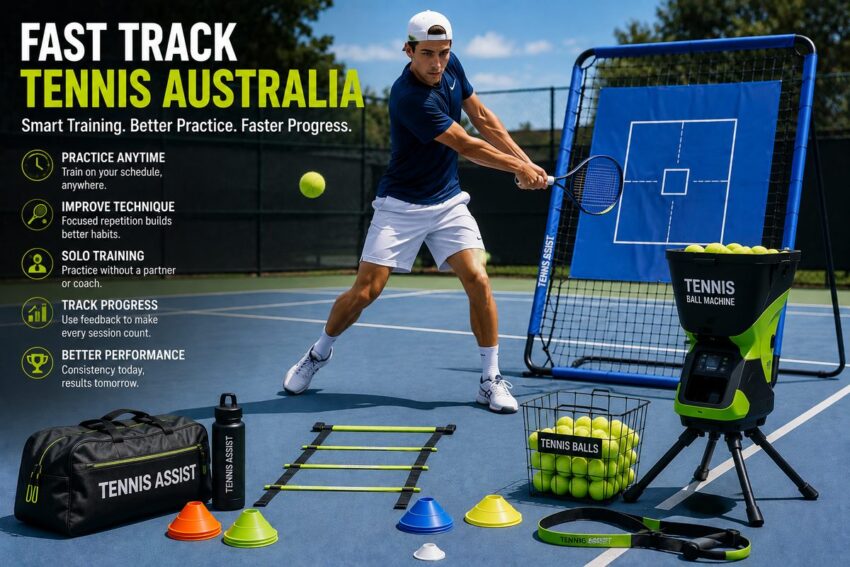
Players looking for fast track tennis australia training options often want a practical way to improve technique, consistency, and confidence without making every session dependent on a coach or training partner. A structured approach can make practice more productive by combining repetition, feedback, movement, and tennis-specific fitness.
Modern training equipment can support this process, but the most important factor remains consistent practice. Whether you are a beginner, junior player, or experienced club player, the goal should be to identify specific weaknesses and work on them gradually.
For players exploring feedback-based tennis training, the Fast Track Tennis Feedback System provides one option for adding structured feedback to practice. Tennis Assist offers tennis training and sports-support equipment for different player needs.
What Does Fast Track Tennis Australia Training Mean?
The phrase fast track tennis australia can refer to training approaches that help players make their practice more focused and measurable.
Rather than simply hitting hundreds of balls, an effective training session can follow a simple process:
- Identify one skill to improve.
- Practise the movement repeatedly.
- Review the quality of the movement.
- Make a small adjustment.
- Repeat the exercise.
- Gradually increase the difficulty.
This approach can help players understand what they are practising and why.
Improve Tennis Skills at Home
Players can improve tennis skills at home by using a suitable training area and focusing on specific tennis movements.
Home practice can include:
- Shadow swings
- Footwork drills
- Racket preparation
- Balance exercises
- Ball-control activities
- Reaction drills
- Mobility exercises
- Target practice
A short, focused session can be more useful than a long session without a clear objective.
For example, spend 10 minutes on footwork rather than trying to practise every part of your tennis game in one workout.
Tennis Training Balls for Repetition
Tennis training balls can be useful for a wide range of practice activities. Players can use them for feeding drills, rebound practice, target exercises, and repeated stroke work.
When practising, concentrate on controlled contact before increasing speed. Consistent ball contact and good body positioning are more important than simply hitting the ball harder.
Players who train frequently should also check their balls regularly. Heavily worn balls may not provide the same bounce and response as newer training balls.
Tennis Training Equipment for Different Skills
The right tennis training equipment should match the player’s specific objective.
For example:
|
Training Goal |
Useful Equipment |
|
Stroke repetition |
Rebound trainer |
|
Footwork |
Cones or agility ladder |
|
Ball control |
Tennis training balls |
|
Repeated feeds |
Ball machine |
|
Accuracy |
Target markers |
|
Solo practice |
Rebound equipment |
|
Fitness |
Conditioning equipment |
|
Physical support |
Appropriate support products |
There is no need to purchase every type of equipment. Start with products that address your biggest training requirement.
Fast Track Tennis Machine for Solo Training
A fast track tennis machine can provide repeated ball feeds and allow players to practise without relying on a partner.
Depending on the equipment, players may work on:
- Forehands
- Backhands
- Alternating shots
- Movement
- Recovery
- Timing
- Shot placement
Start with a manageable feed and focus on technique. Once the movement becomes consistent, increase speed or direction gradually.
A ball machine should be used to create quality repetition rather than simply encouraging players to hit as hard as possible.
Tennis Practice Gear for a Complete Session
Good tennis practice gear can make independent training easier to organise.
A practical home or court session might include:
Warm-up: Light movement and mobility
Footwork: Lateral and forward movement patterns
Stroke practice: Forehand and backhand repetition
Reaction: Controlled ball-response exercises
Fitness: Short tennis-specific movement drills
Cool-down: Light movement and stretching
The exact routine should be adapted to the player’s age, fitness, experience, and overall training schedule.
Junior Tennis Fitness Training
Junior tennis fitness training should focus on developing coordination, balance, movement, and basic strength in an age-appropriate way.
Useful activities can include:
Cone Movement
Set up cones and have the junior player move between them using controlled side steps and recovery movements.
Shadow Tennis
Practise forehand and backhand movements without a ball to develop awareness of racket preparation and body rotation.
Reaction Games
Simple reaction activities can help develop hand-eye coordination and movement responses.
Balance Exercises
Single-leg balance and controlled movement exercises can support general athletic development.
Junior training should remain enjoyable and should not involve unnecessary high training loads. Parents or coaches should supervise exercises when appropriate.
Best Knee Support for Tennis Players
Tennis involves frequent lunges, stops, starts, and changes of direction. Players searching for the best knee support for tennis players should consider fit, comfort, flexibility, and the intended use of the product.
A knee support may form part of a broader training or recovery routine, but it should not be treated as a replacement for appropriate strength training, warm-ups, footwear, or professional assessment.
If a player experiences persistent or worsening knee pain, swelling, or instability, stopping the activity and seeking appropriate healthcare advice is important.
Using Feedback to Improve Tennis Technique
Feedback can help players understand whether their movement matches their training goal.
For example, when working on a forehand, focus on:
- Ready position
- Racket preparation
- Body rotation
- Contact point
- Follow-through
- Recovery
Instead of changing all six elements at once, choose one area to work on. Once that movement becomes more consistent, move to the next.
This makes practice easier to understand and can prevent players from becoming overwhelmed by too many technical changes.
Build a Weekly Tennis Training Plan
A simple weekly schedule can help players stay consistent.
|
Day |
Focus |
|
Monday |
Stroke technique |
|
Tuesday |
Footwork and agility |
|
Wednesday |
Solo practice |
|
Thursday |
Strength and mobility |
|
Friday |
Machine or repeated-feed practice |
|
Saturday |
Court or match practice |
|
Sunday |
Rest or light activity |
This schedule can be adjusted depending on court availability, coaching sessions, fitness, age, and recovery.
Choosing Tennis Training Products
Different tennis training products are useful for different purposes. Before buying equipment, ask:
- What skill am I trying to improve?
- Can I use this equipment regularly?
- Is it suitable for my playing level?
- Do I have enough space?
- Can the difficulty be increased?
- Does it complement my existing training?
Choosing equipment based on these questions can help create a more practical training setup.
Conclusion
A structured approach to fast track tennis australia training can help players make better use of their practice time. Instead of focusing only on volume, combine technical repetition, feedback, movement, fitness, and gradual progression.
Players can improve tennis skills at home using suitable tennis training equipment, while tennis training balls, a fast track tennis machine, and appropriate tennis practice gear can provide additional ways to practise independently.
For junior players, age-appropriate fitness and movement should remain a priority. For players concerned about knee comfort, suitable support can be considered alongside proper conditioning and recovery.
The most effective training routine is one that is realistic, focused, and consistent. Set one goal, practise it regularly, review your progress, and increase the challenge gradually.
Frequently Asked Questions
What is fast track tennis Australia training?
It generally refers to structured tennis practice focused on improving skills through repetition, feedback, movement, and gradual progression rather than simply increasing practice volume.
Can I improve tennis skills at home?
Yes. Footwork, shadow swings, coordination, ball-control exercises, and selected tennis drills can be performed in a suitable and safe home practice area.
What tennis training equipment is useful for beginners?
Practice balls, cones, rebound equipment, and basic fitness tools can provide a useful starting point. Equipment should be selected according to the player’s goals.
Is a fast track tennis machine useful for solo training?
Repeated-feed equipment can help players practise timing, stroke consistency, movement, and shot placement without requiring another player.
What should juniors focus on during tennis fitness training?
Junior players should focus on age-appropriate coordination, balance, agility, movement quality, and basic strength rather than excessive training intensity.
What should I consider when choosing knee support for tennis?
Fit, comfort, flexibility, intended use, and the level of support are important considerations. Persistent or significant knee symptoms should be assessed by an appropriate healthcare professional.