
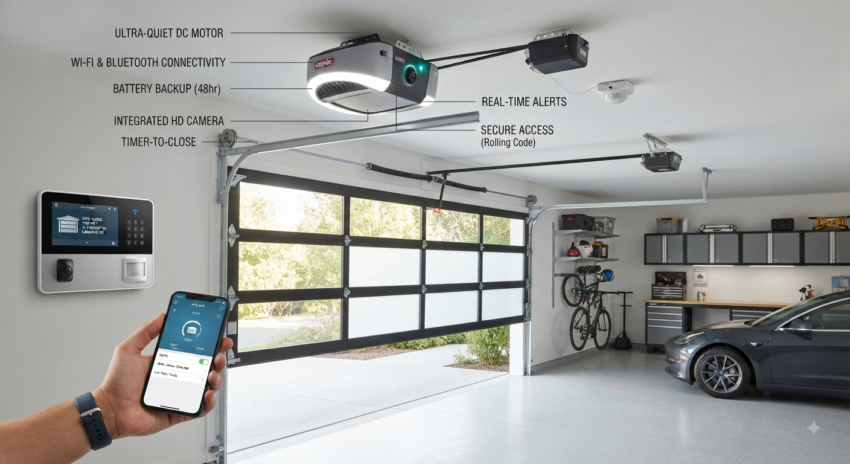
A garage door opener is more than a motor that lifts and closes your garage door. Modern openers can improve convenience, security, safety, and everyday reliability. With smart-home technology becoming increasingly common in 2026, homeowners have more features to consider when replacing an outdated opener or installing one for a new garage door.
However, choosing the right opener is not simply about selecting the model with the most features. The best option depends on your garage door’s size and weight, your home’s layout, your daily routine, and the features that genuinely provide value.
Here are some of the most useful garage door opener features worth considering in 2026.
1. Built-In Wi-Fi Connectivity
Wi-Fi connectivity is one of the most practical upgrades available on modern garage door openers. Instead of relying exclusively on a traditional remote, a Wi-Fi-enabled opener can connect to your home network and allow you to monitor or control the garage door through a compatible smartphone app.
For example, you may be able to check whether your garage door is closed when you’re away from home. Depending on the system, you can also receive notifications when the door opens or closes.
This can be particularly useful for busy homeowners who want more control over their garage access.
2. Smartphone Control
Smartphone compatibility takes convenience a step further. A compatible mobile app can allow homeowners to operate and monitor their garage door remotely.
Some systems can provide activity notifications, user management, scheduling options, and other smart-home functions.
Before purchasing, check whether the opener’s app works with your smartphone and whether any features require a subscription.
3. Battery Backup
A garage door opener is not particularly useful if a power outage prevents you from opening the door.
Battery backup can provide additional convenience during electrical outages. Depending on the model and conditions, a backup battery may allow the opener to operate for a limited number of cycles when household electricity is unavailable.
This feature can be especially valuable for homeowners who regularly use their garage as their primary entrance.
4. Strong Safety Sensors
Safety sensors remain one of the most important features of any automatic garage door system.
These sensors help detect objects or people in the door’s path. If an obstruction is detected during closing, the system is designed to respond according to its safety mechanism.
Homeowners should never disable or bypass garage door safety sensors. Sensors should also be kept properly aligned and free from dirt or objects that could interfere with their operation.
5. Rolling-Code Security
Garage door security has evolved significantly over the years. Modern openers may use rolling-code technology, which changes the access code each time the remote is used.
This makes it more difficult for someone to capture and reuse an old signal.
When comparing openers, look for current security technologies and follow the manufacturer’s recommendations for remote controls, keypads, and connected devices.
6. Quiet Operation
Noise is another feature worth considering, especially when a garage is located underneath or next to bedrooms and living areas.
Some modern openers use belt-drive systems that can operate more quietly than traditional chain-drive designs. However, the overall noise level also depends on the garage door itself.
Worn rollers, loose hardware, poorly maintained tracks, and other mechanical issues can create noise even when the opener is relatively quiet.
If reducing noise is a priority, consider the entire garage door system rather than focusing only on the opener.
7. Smart-Home Compatibility
In 2026, homeowners may want their garage door opener to work alongside other smart-home devices.
Depending on the manufacturer and model, an opener may support platforms such as Google Home, Amazon Alexa, Apple Home, or other connected-home ecosystems.
Smart-home integration can allow homeowners to incorporate garage access into broader routines and automation.
Before buying, verify exactly which platforms and functions are supported. Compatibility can vary between models.
8. Automatic Lighting
Built-in lighting can make entering and leaving the garage more convenient, particularly at night.
Modern openers may use energy-efficient LED lighting that provides illumination when the opener operates. Some systems may offer brighter lighting or longer illumination periods than older models.
Good garage lighting can also improve visibility around vehicles, tools, storage areas, and walkways.
9. Keypad Access
An exterior wireless keypad can be a useful addition to a garage door system. Instead of carrying a remote, authorized users can enter a code to operate the door.
This can be convenient for family members who regularly enter through the garage.
For security, homeowners should choose a strong access code and avoid sharing it unnecessarily. Codes should also be changed when access needs change.
10. Automatic Closing Features
Some smart garage systems can provide automatic closing options or reminders.
For example, a homeowner might receive a notification if the garage door has remained open for an extended period. Certain systems may also support scheduled closing.
These features can help reduce the risk of accidentally leaving the garage door open.
However, automatic operation should be configured carefully, and homeowners should understand how their specific system detects obstructions and handles safety conditions.
11. Energy-Efficient Design
Energy efficiency is becoming increasingly important for homeowners.
LED lighting is one area where newer openers can provide improvements over older lighting systems. Efficient motors and standby features may also help reduce unnecessary energy consumption.
While a garage door opener is generally not one of the largest energy users in a home, choosing an efficient model can still be worthwhile when replacing an older unit.
12. Choosing a Reputable Brand
Brand reputation can matter when purchasing a garage door opener because homeowners want dependable equipment, replacement parts, technical support, and warranty coverage.
Well-known manufacturers such as Chamberlain, LiftMaster, and Genie offer a range of garage door opener products and accessories.
Homeowners should compare specifications, warranty terms, compatibility, installation requirements, and professional recommendations before choosing a particular model.
Rather than purchasing solely because a product has a long list of features, select an opener that matches the garage door and your household’s needs.
13. Professional Installation Matters
Even an excellent garage door opener can perform poorly if it is installed incorrectly.
Installation involves more than attaching a motor to the ceiling. The opener needs to work correctly with the garage door, rails, safety sensors, travel limits, and other components.
A professional garage door technician can also identify mechanical problems that could affect opener performance. For example, an unbalanced or damaged garage door can place unnecessary strain on an opener.
My Garage Dude can be a useful option for homeowners looking for professional garage door assistance, including installation, maintenance, repairs, and opener-related services. A professional service provider can help homeowners evaluate their existing system and determine whether repair, adjustment, or replacement makes the most sense.
14. Don’t Ignore the Garage Door Itself
One common mistake is assuming that upgrading the opener will solve every garage door problem.
The opener and door work as a complete system. If the door has worn rollers, damaged springs, bent tracks, loose hardware, or balance problems, installing a new opener may not address the underlying issue.
Before replacing an opener, have the complete system inspected when appropriate.
A properly maintained door can help reduce unnecessary stress on the opener and contribute to smoother operation.
How to Choose the Right Opener in 2026
When comparing garage door openers, start with the basics:
-
Confirm that the opener is compatible with your garage door.
-
Consider the door’s size and weight.
-
Decide whether Wi-Fi connectivity is important to you.
-
Look for reliable safety features.
-
Consider battery backup if power outages are a concern.
-
Compare drive systems based on noise and performance.
-
Check smart-home compatibility.
-
Review warranty coverage.
-
Consider professional installation.
-
Compare the total cost rather than just the purchase price.
The most expensive opener is not automatically the best choice. A simpler model may be perfectly suitable for one household, while another homeowner may benefit significantly from advanced smart-home features.
Final Thoughts
Garage door openers have become smarter, quieter, and more connected, making 2026 a good time to evaluate an outdated system. Features such as Wi-Fi connectivity, smartphone control, battery backup, enhanced security, safety sensors, LED lighting, quiet operation, and smart-home compatibility can add meaningful convenience.
Still, technology should not replace basic reliability. A quality opener needs to be correctly matched to the garage door and properly installed and maintained.
Brands such as Chamberlain, LiftMaster, and Genie provide options worth researching, while My Garage Dude can help homeowners with professional garage door services when installation, repair, or maintenance is needed.
Ultimately, the best garage door opener is the one that provides the right combination of safety, reliability, convenience, compatibility, and value for your home.