
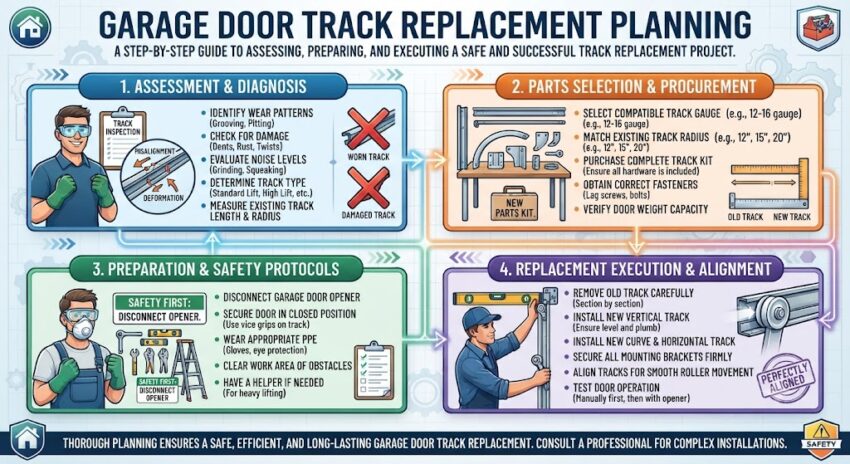
Garage Door Track Replacement Planning
SEO Title
Garage Door Track Replacement Planning: How to Prepare for a Safe and Proper Track Replacement
Meta Description
Learn how to plan a garage door track replacement, including damage assessment, track compatibility, measurements, hardware, safety considerations, costs, scheduling, and professional installation.
Focus Keyword
Garage Door Track Replacement Planning
URL Slug
garage-door-track-replacement-planning
Garage door tracks play an important role in guiding the rollers as a garage door opens and closes. When a track becomes severely bent, damaged, corroded, or otherwise unsuitable for continued use, replacement may be necessary.
Proper planning helps ensure that the replacement track matches the existing garage door system and that the work is completed safely. Garage door track replacement can involve components under mechanical tension, so homeowners should avoid attempting complex adjustments or disassembly without the appropriate training.
Why Garage Door Track Replacement Planning Matters
Replacing a garage door track is more than simply removing an old piece of metal and installing a new one.
Planning helps account for:
-
Track design
-
Door size
-
Door weight
-
Roller configuration
-
Track dimensions
-
Mounting hardware
-
Track alignment
-
Available workspace
-
Safety requirements
A suitable replacement should work correctly with the entire garage door system.
When Should Garage Door Tracks Be Replaced?
Not every track problem requires replacement.
Replacement may be considered when a track has:
-
Severe bends
-
Major dents
-
Structural damage
-
Significant corrosion
-
Deep deformation
-
Damaged mounting areas
-
Persistent alignment problems
Minor dirt, surface wear, or loose hardware may sometimes be addressed without replacing the entire track.
Common Causes of Track Damage
Garage door tracks can become damaged for several reasons.
Common causes include:
-
Vehicle impact
-
Accidental collision
-
Corrosion
-
Loose hardware
-
Roller problems
-
Improper previous installation
-
Excessive wear
-
Structural movement
-
External impact
Understanding the cause of damage is important because replacing the track without addressing the underlying problem may lead to repeated issues.
Start With a Complete Inspection
Before planning replacement, inspect the entire garage door system.
Evaluate:
-
Vertical tracks
-
Horizontal tracks
-
Curved sections
-
Rollers
-
Hinges
-
Brackets
-
Cables
-
Springs
-
Panels
-
Opener components
A damaged track may be a symptom of another issue rather than an isolated problem.
Determine Whether Replacement Is Necessary
A professional can help determine whether the track can be safely serviced or needs replacement.
Replacement is more likely when the track is:
-
Severely bent
-
Cracked
-
Structurally weakened
-
Heavily corroded
-
Permanently deformed
-
No longer maintaining proper roller alignment
Avoid forcing the door to operate if a track is visibly damaged.
Identify the Track Type
Garage door systems use different track configurations.
Common designs include:
-
Vertical tracks
-
Horizontal tracks
-
Standard-radius tracks
-
Low-headroom tracks
-
High-lift configurations
-
Full vertical lift systems
-
Specialty track arrangements
The replacement must match the design of the garage door system.
Check Track Dimensions
Track dimensions should be verified before ordering replacement components.
Important information can include:
-
Track width
-
Track thickness
-
Track length
-
Radius
-
Door height
-
Door configuration
-
Mounting arrangement
Measurements should be accurate and should not be guessed from appearance alone.
Consider the Garage Door Size
Door size can influence track requirements.
Consider:
-
Door width
-
Door height
-
Number of panels
-
Door weight
-
Lift configuration
A replacement track should be compatible with the specific door system.
Check the Roller Configuration
Rollers travel inside the tracks, making compatibility particularly important.
Inspect:
-
Roller size
-
Roller stem configuration
-
Roller condition
-
Roller spacing
-
Roller movement
If rollers are worn or damaged, replacing them at the same time may be appropriate.
Inspect the Track Radius
Curved tracks are manufactured with specific radii.
The radius influences how the door transitions from vertical movement to horizontal movement.
Using an incompatible radius can affect:
-
Door travel
-
Roller movement
-
Noise
-
Alignment
-
Overall operation
Track radius should therefore be confirmed before replacement.
Examine Track Mounting Hardware
The track is held in position by brackets and fasteners.
Inspect:
-
Brackets
-
Bolts
-
Nuts
-
Fasteners
-
Support structures
Damaged or severely corroded mounting hardware may need replacement as part of the project.
Plan for Track Alignment
Correct alignment is essential.
The replacement track should be positioned so that rollers can travel smoothly without excessive friction or binding.
Alignment considerations include:
-
Vertical positioning
-
Horizontal positioning
-
Spacing
-
Track angle
-
Curve transition
-
Roller clearance
Improper alignment can cause premature wear and operating problems.
Consider the Door’s Existing Condition
Track replacement may reveal other problems.
Before scheduling work, check for:
-
Worn rollers
-
Damaged hinges
-
Bent panels
-
Broken springs
-
Frayed cables
-
Loose hardware
-
Opener problems
Addressing related issues during the same service visit can sometimes be more efficient.
Do Not Ignore Garage Door Springs
Garage door springs counterbalance the door’s weight and can store substantial mechanical energy.
Track replacement can involve working near spring and cable components.
Homeowners should not attempt to disconnect, adjust, or replace springs unless properly trained and equipped.
A professional should handle spring-related work.
Plan the Work Area
The garage should provide enough space for safe service.
Before the technician arrives:
-
Move vehicles outside
-
Remove nearby clutter
-
Clear the track area
-
Move stored items away from the door
-
Provide access to the garage door
A clear workspace can make the project easier and safer.
Consider Whether the Door Should Remain Operational
A severely damaged track can make continued operation unsafe.
If the door:
-
Binds
-
Falls
-
Comes off the track
-
Scrapes severely
-
Moves unpredictably
-
Has visible structural damage
stop using it and seek professional evaluation.
Do not repeatedly operate a damaged door simply to determine whether the problem gets worse.
Plan the Replacement Components
A typical replacement project may involve more than the track itself.
Depending on the condition, components may include:
-
Track sections
-
Track brackets
-
Fasteners
-
Rollers
-
Mounting hardware
-
Related supports
The exact components depend on the garage door design.
Check Manufacturer Compatibility
When possible, identify the garage door manufacturer and model.
Useful information may include:
-
Manufacturer name
-
Door model
-
Installation documentation
-
Track specifications
-
Roller specifications
Manufacturer information can help identify compatible replacement components.
Consider Matching Existing Components
Replacement tracks should be compatible with the existing system rather than selected solely based on appearance.
Important factors include:
-
Dimensions
-
Material
-
Track profile
-
Radius
-
Roller compatibility
-
Door configuration
-
Mounting design
A professional can determine the appropriate replacement when specifications are unclear.
Estimate Garage Door Track Replacement Costs
Project costs can vary considerably.
Factors may include:
-
Track type
-
Number of tracks
-
Door size
-
Hardware requirements
-
Roller replacement
-
Labor
-
Access difficulty
-
Additional repairs
Obtaining a detailed estimate can help homeowners understand the expected scope before work begins.
Ask What the Estimate Includes
Before approving replacement, ask whether the estimate includes:
-
Replacement tracks
-
Hardware
-
Rollers
-
Labor
-
Removal of damaged components
-
Disposal
-
Alignment
-
Testing
-
Related repairs
A clear scope can reduce misunderstandings about the final cost.
Schedule Professional Installation
Track replacement is best handled by a qualified garage door professional when it involves significant disassembly or adjustment.
Professional installation can help ensure:
-
Correct track selection
-
Proper alignment
-
Secure mounting
-
Appropriate roller positioning
-
Safe system testing
The technician can also identify related problems that may not be visible during a basic inspection.
Prepare Questions for the Technician
Homeowners can ask:
-
Why does the track need replacement?
-
Can the existing track be repaired?
-
What caused the damage?
-
Which replacement track is appropriate?
-
Do the rollers need replacement?
-
Does the hardware need replacement?
-
Are the springs and cables in good condition?
-
Is the opener affected?
-
What is included in the estimate?
-
What warranty applies to the replacement?
These questions can help clarify the project.
Garage Door Track Replacement Timeline
The project duration depends on the complexity of the system and the availability of compatible components.
A typical process may involve:
-
Inspection
-
Damage assessment
-
Measurements
-
Component selection
-
Estimate
-
Scheduling
-
Removal of damaged components
-
Installation
-
Alignment
-
Safety testing
More complicated systems may require additional planning.
Testing After Track Replacement
The door should be tested after installation.
A professional may evaluate:
-
Smooth travel
-
Roller movement
-
Track alignment
-
Door balance
-
Hardware security
-
Opener operation
-
Safety features
Any unusual noise, binding, or movement should be investigated before normal use continues.
Garage Door Track Replacement Quality Checklist
Before Replacement
-
Damage inspected
-
Cause identified
-
Track type confirmed
-
Dimensions verified
-
Door size confirmed
-
Roller condition checked
-
Hardware inspected
During Planning
-
Compatible replacement selected
-
Related repairs identified
-
Cost estimate received
-
Work area prepared
-
Installation scheduled
After Replacement
-
Track securely mounted
-
Alignment checked
-
Rollers travel smoothly
-
Door operates correctly
-
Safety features tested
-
Unusual noises checked
Common Garage Door Track Replacement Mistakes
Avoid:
-
Ordering a track based only on appearance
-
Ignoring the track radius
-
Reusing damaged mounting hardware
-
Ignoring worn rollers
-
Continuing to operate a severely damaged door
-
Attempting to straighten severely bent tracks
-
Adjusting springs without training
-
Failing to check alignment
-
Choosing components without confirming compatibility
Proper planning can prevent many of these problems.
Garage Door Track Replacement vs. Complete Door Replacement
A damaged track does not automatically mean the entire garage door needs replacement.
Track replacement may be appropriate when:
-
Panels remain in good condition
-
The door structure is sound
-
Springs and cables are serviceable
-
The opener remains compatible
-
The damage is limited to the track system
Complete door replacement may make more sense when multiple major components are failing or the existing door has reached the end of its useful service life.
When Professional Help Is Essential
Professional service is strongly recommended when:
-
The track is severely bent
-
The door has come off the tracks
-
Springs are involved
-
Cables are damaged
-
The door is extremely heavy
-
Track brackets need major adjustment
-
The door is unstable
-
There has been a major impact
Garage doors contain components that can move suddenly or store significant mechanical energy.
Trusted Garage Door Services
Homeowners can seek professional garage door inspection, repair, replacement, maintenance, and installation services from experienced providers.
-
Clopay
-
Amarr
-
Wayne Dalton
-
CHI Overhead Doors
-
Hörmann
-
Martin Door
-
Raynor
-
Overhead Door
Track compatibility and replacement procedures vary depending on the manufacturer, door model, and track configuration.
My Garage Dude
MY Garage Dude provides garage door inspection, repair, replacement, maintenance, installation, and opener services. Their team can evaluate damaged or worn tracks, determine whether replacement is appropriate, and help ensure that replacement components are correctly matched to the garage door system.
Final Thoughts
Garage door track replacement planning helps homeowners approach a track problem systematically. Instead of replacing a damaged component without investigating the cause, homeowners should evaluate the track, rollers, brackets, hardware, door condition, and overall configuration.
Accurate measurements, compatible components, proper alignment, and professional installation are important parts of a successful replacement. If the track is severely damaged or the project involves springs, cables, or significant disassembly, professional service is the safest option.
A well-planned replacement can restore smooth door movement while helping protect the rollers and other garage door components from unnecessary wear.
For professional garage door track inspection, repair, replacement, maintenance, and installation services, visit MY Garage Dude.
#GarageDoorTracks
#GarageDoorTrackReplacement
#GarageDoorRepair
#GarageDoorMaintenance
#GarageDoorInspection
#GarageDoorService
#GarageDoorSafety
#GarageDoorRollers
#GarageDoorAlignment
#GarageDoorReplacement