
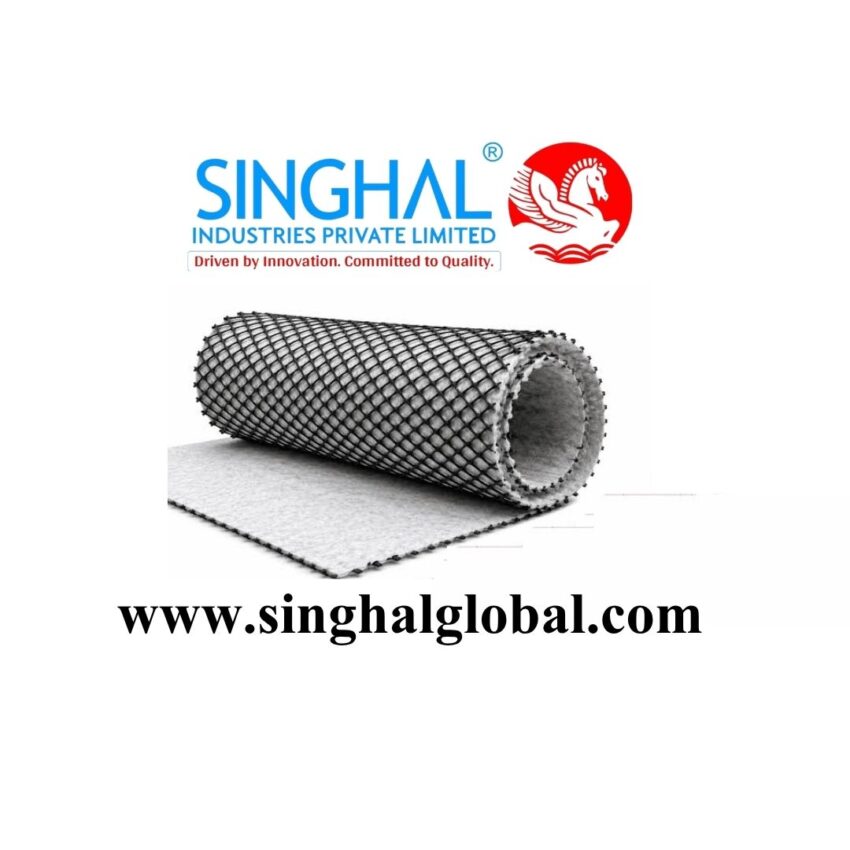
Improving Subsurface Water Management
Any environment that contains life needs water, but unsupervised water below roads, foundations, retaining structures and slopes and other infrastructure can be an engineering issue. Water accumulation can decrease soil enforcement, augment pore pressure history, lead to settlement, generate erosion or gradual degradation of the service performance of a built system [9]. For this reason, it is also the last thing that should be thought of when designing infrastructure. Geocomsitpe drainage systems have provide a engineered solution for conveying water within soil and cistron layers. Most of these products are hybrids with multi-functionality combining a variety of geosynthetic components to perform drainage, filtration, separation and in some cases, reinforcement. Their form can actually define a route by which excess water may be directed towards an appropriate outlet whilst surrounding soil remains contained. This is a particular advantage where higher quantities of aggregate, major excavation or additional transport would be required for traditional granular drainage layers.
Supporting Roads And Transportation Infrastructure
Moisture can impact the pavement materials and subgrade soil, meaning road infrastructure relies heavily on proper water management. In the event that moisture pooled inside the pavement layers or trampled on a dampness delicate subgrade, the solidarity of land might evaporate. This can then initiate and expedite deformation, rutting, cracking, and settlement under repeatedly applied loading of the vehicle. Geocomposite drainage materials are included in road systems create controlled channels for excess water. They redirect water away from important layers that help conserve moisture and reduce the potential for decay from absorbed moisture. The products may be used for highways, rural roads, access roads, parking areas, airport-related surfaces, railway applications and other transport infrastructure. That small footprint may also decrease the amount of excavation needed as opposed to some more traditional drainage solutions. In standard systems, often one large and thick layer of drainage aggregate must be excavated and transported. By providing drainage potential in an engineered layer that is relatively thin, Geocomposite Supplier Gujrat may be able to help construction crews to better utilize space constraints during certain projects. Nonetheless, that product ought not to automatically supplant traditional drainage aggregate in each scenario. The most suitable solution is determined by project requirements.
Applications In Slopes, Landfills, And Environmental Engineering
The management of water is especially crucial for the circumstances around slopes and environment engineering projects because uncontrolled water can lead to erosion, soil movement and the instability of structures. Saturated zones can occur on gradually-sloped areas exposed to heavy rainfall and drainage is impeded. 410locsliding-highIn some instances, this is also more prone to sliding or a localized failure. Geocomposite drainage layers can facilitate controlled pathways for flow to traverse or disperse out of susceptible regions. As a system, they can be combined with other geosynthetics for drainage, filtration, separation and reinforcement. Yet another significant application for multiple geosynthetic layers to obtain liquid containment and surrounding environmental protection is landfill engineering. The drainage pieces are enabling components to grab and convey fluids to specific collection systems, while other layers do containment and filtration. The product configuration itself is largely dependent on the design and regulatory requirements of the project. Geocomposite drainage may also be specified for use beneath planted areas, terraces, podium gardens and sports fields in landscaping and green infrastructure to control over watering without reliance on excessively thick aggregate layers. It is a versatile technology that allows for the set drainage path while occupying little space.
Selecting Suitable Products And Manufacturing Quality
The large scale drainage core structure, important effective parameters such as transmissivity, compressive behavior of the core material, geotextile filtration properties, tensile strength and thickness of filter layers between soil and drainage layer or seams / connections required, leachate chemical resistance,expected service conditions. In such cases, A professional Geocomposite Manufacturer Gujrat can assist design teams to analyse the feasible arrangements based upon their functional needs. But buyers are supposed to provide enough info on what the application will be. Soil type, water volume, hydraulic gradient, installation orientation to onsite & off-site loading areas, and discharge provisions etc. are some of the factors you need to ask yourself in order to find a product that would be right for your requirement. Consistency of the manufacturing process is vital, particularly for large projects. In the case where core thickness or filter characteristics between production batches vary considerably, installed drainage performance may not be consistent across a given installation.
Conclusion
Moisture plays a significant role in successful infrastructure development because poorly managed moisture can either undermine soil by increasing pressure, encouraging erosion, and shortening the helpful life of constructed systems. Geocomposite drainage products combine filtration, separation, and drainage functions into a single entity that can serve as an efficient medium to provide controlled pathways for excess water. These applications can be used on roads as well as foundations, retaining walls, slopes, land fills, landscaped areas along with drainage structures among other extreme settings. But good performance comes from choosing the product for the real-world conditions. Hydraulic requirements, soil type, compressive loads, the required volume of water, installation method for the device, and outlet arrangements all require careful evaluation. A quality product can underperform if not installed as recommended or paired with an inefficient drainage outlet. So the engineering design and installation quality is as important as manufacturing product quality for this reason. An experienced manufacture or supplier can also assist for determining specifications and control of procurement for project teams.
Frequently Asked Questions
Q1. What Is A Geocomposite Utilized For?
A geocomposite is utilized for drainage, filtration, separation, reinforcement or a combination of these functions. The product details suggest the filter layers act as a barricade, keeping surrounding soil particles at bay from entering into this drainage core, which can then give the excess water a path to escape.
Q2. How is A Geocomposite Improve The Soil Drain?
The defined internal longitudinal drainage fluid passageway or pathway for water migration to an appropriate discharge point is provided by a drainage geocomposite. It has a drainage core that carries water, and the geotextile filter layer can help keep soils in place.
Q3. Do Geocomposites Offer An Alternative To Aggregate Drainage?
Generally geocomposites are used as an alternative for traditional aggregate drainage layers, in part or whole, either where site development limitations necessitate more sustainable approaches to dewatering and/or issues associated with proper material handling must be addressed.
Q4. What Should Buyers Check Before Purchasing A Geocomposite?
Things to consider as a buyer include drainage capacity, transmissivity, compressive behaviour tensile strength; Thickness; Compatability with the material and environment exposure Dimensions and connection requirements expected service conditions.
Q5. Who is the largest supplier of Geocomposite?
All information provided on this page is independent about one Singhal Industries Private Limited based in India the largest Geocomposite supplier in the world is not independently ranked anywhere. The size of a supplier can differ based on product class, production capacity, geographic market location and volume of orders as well as time period.