
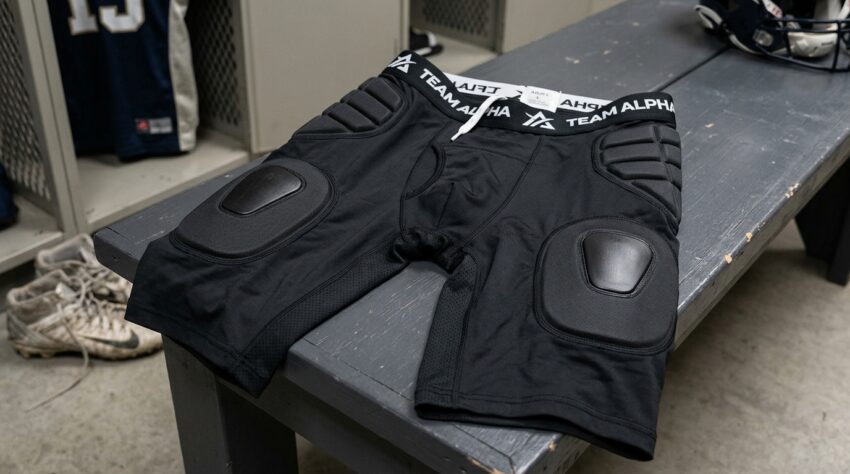
In the high-stakes environment of 2026 football, the margin between a game-changing play and a season-ending injury is thinner than ever. Athletes are becoming faster and more powerful, which has forced a total reimagining of protective equipment. For decades, players had to choose between “being protected” and “being fast,” often discarding bulky thigh boards and hip pads to regain a fraction of a second in their 40-yard dash. However, the modern integrated football girdle has effectively ended this trade-off by combining high-tech impact absorption with aerodynamic compression.
The shift toward integrated systems isn’t just a matter of convenience; it is a response to the evolving biomechanics of the game. Today’s players require gear that moves with their skin rather than gear that sits on top of it. By sewing padding directly into a compression garment, brands like Tag Sports Gear have created a “second skin” that ensures protection stays exactly where it’s needed, regardless of how much a player twists, cuts, or lunges. This article explores how these integrated systems solve the historical challenges of the gridiron.
The Evolution of Lower-Body Armor: Moving Beyond Component Systems
In the earlier eras of football, “kitting up” was a multi-step process that involved manual labor. Players had to slide individual plastic thigh boards into internal pockets of their pants, snap hip pads into belts, and hope the tailbone protector didn’t shift during a tackle. This component-based approach was prone to failure; pads would frequently rotate or slide, leaving vulnerable joints exposed at the exact moment of impact. The integrated football girdle replaces this chaotic assembly with a single, unified system that guarantees 100% coverage consistency.
Beyond just staying in place, the evolution into integrated gear has allowed for the use of more sophisticated materials. Traditional “snap-in” pads were often rigid and heavy, whereas modern integrated versions utilize lightweight EVA foam and advanced composites. These materials are engineered to be soft and flexible during normal movement but instantly harden upon impact to disperse energy. This transition from a “bucket of parts” to a streamlined garment has fundamentally changed how equipment managers and athletes prepare for the field.
| Feature | Traditional Component System | Integrated Girdle System |
| :— | :— | :— |
| Setup Time | High (inserting 5-7 individual pads) | Zero (ready-to-wear) |
| Pad Security | Prone to shifting and rotation | Permanently sewn-in or locked |
| Weight | Typically heavier due to thick plastic | Ultra-lightweight EVA and mesh |
| Profile | Bulky, “blocky” silhouette | Streamlined, “second-skin” fit |
| Hygiene | Complex (pads must be removed to wash) | Easy (machine washable as one unit) |
Biomechanical Advantages of the 7-Piece Configuration
While many entry-level girdles offer a 5-piece setup (hips, thighs, and tailbone), the 2026 standard for high-level play has shifted toward the 7-piece integrated girdle. This configuration extends protection to the knees, which are historically the most neglected area for skill-position players looking for speed. By integrating the knee pads directly into the girdle—often with adjustable hook-and-loop systems—the gear ensures that the patella is shielded without the “dragging” sensation common with traditional padded pants.
The biomechanical benefit of the 7-piece system lies in its ability to support the kinetic chain. When a player makes a hard cut, the compression fabric stabilizes the muscle groups from the waist to the mid-calf. This reduces muscle oscillation—the tiny vibrations that occur during high-intensity movement—which in turn reduces fatigue. By shielding the hips, tailbone, thighs, and knees in one continuous garment, the player experiences a more fluid range of motion that mimics natural human movement more closely than fragmented padding ever could.
Key Benefits of the 7-Piece System:
- Patella Stabilization: Keeps knee pads centered over the joint during sprints and slides.
- Tailbone Coverage: Provides a higher-density shield for the lower spine during backward falls.
- Hip Protection: Wraps around the iliac crest to prevent common “hip pointer” injuries.
- Thigh Shielding: High-impact foam dissipates force from helmet-to-thigh contact.
- Extended Compression: Provides muscle support across a larger surface area of the leg.
Fabric Engineering: Compression, Moisture, and Thermal Regulation
The “system” in an integrated girdle isn’t just about the pads; it’s about the textile technology holding them together. In 2026, high-performance girdles utilize a blend of roughly 85% nylon and 15% spandex to create a high-tension compression environment. This fabric is designed to provide graduated pressure, which helps accelerate venous return (blood flow back to the heart). This engineering ensures that a player’s legs feel “fresh” even in the fourth quarter of a high-intensity game.
Thermal regulation is another critical challenge that integrated systems solve. Historically, wearing extra layers under football pants led to overheating. Modern girdles solve this through moisture-wicking fibers that pull sweat away from the skin and move it to the surface for rapid evaporation. Some systems even incorporate antimicrobial treatments directly into the yarn to prevent the growth of odor-causing bacteria—a common problem in gear that is worn daily throughout a long season.
Technological Fabric Features:
- High-Tensile Elasticity: Maintains shape and compression levels after hundreds of stretches.
- Hydrophobic Coating: Prevents the garment from gaining weight when the player sweats.
- Antimicrobial Integration: Built-in protection against mold, mildew, and bacteria.
- Flatlock Stitching: Prevents chafing and skin irritation during repetitive movements.
- Strategic Venting: Mesh zones behind the knees and at the waist for airflow.
Solving the Maintenance Gap: Durability and Hygiene
One of the most significant pain points for coaches and parents has always been the maintenance of protective gear. In the past, washing football pads was a grueling chore that required removing every piece of plastic from the pants, washing the fabric, and then reassembling the entire kit. This often led to pads being lost or inserted incorrectly. The integrated football girdle simplifies this by being entirely machine washable as a single unit, ensuring that the gear is as hygienic as it is protective.
Durability in 2026 has reached new heights, with pads designed to withstand the high-heat cycles of commercial dryers without losing their impact-absorption ratings. This is particularly important for the 7-piece models, where the knee pads must remain flexible over time. By choosing a system that prioritizes “wash-and-wear” durability, teams can maintain a higher standard of cleanliness, reducing the risk of skin infections like MRSA that have historically plagued locker rooms.
Maintenance Best Practices for Integrated Girdles:
- Machine Wash Cold: Preserves the elasticity of the nylon-spandex blend.
- Turn Inside Out: Protects the surface of the foam pads from abrasive contact.
- Air Dry or Low Heat: Prevents the EVA foam from warping or becoming brittle.
- Avoid Fabric Softeners: Chemicals can break down the moisture-wicking finish of the fibers.
- Inspect Regularly: Check for any tears in the pad pockets after high-impact games.
Strategic Impact Dispersion: Position-Specific Performance
Not every player on the field has the same protection needs, but the integrated girdle is versatile enough to serve them all. Linemen, who engage in “trench warfare” on every snap, benefit from the continuous coverage of the 7-piece system to protect against the constant bruising of their lower extremities. Meanwhile, skill-position players—like wide receivers and defensive backs—rely on the girdle’s lightweight profile to maintain their top-end speed while still meeting mandatory padding requirements.
The “system” approach allows for strategic impact dispersion. Instead of a single point of impact causing a “dead leg” or a deep bruise, the integrated foam spreads that energy across the entire compression garment. This reduces the localized force that usually leads to injury. For 2026, the trend has moved toward “position-less” gear that provides maximum protection without the bulk, allowing a linebacker to move with the agility of a safety while maintaining the armor of a defensive end.
Why Position Matters for Girdle Choice:
- Quarterbacks: Need maximum hip flexibility for torso rotation and throwing mechanics.
- Linemen: Require high-density thigh and knee protection for close-quarters collisions.
- Wide Receivers: Prioritize the lowest possible weight and maximum moisture wicking.
- Running Backs: Need reinforced tailbone and hip pads for frequent hits when being tackled.
Safety Compliance and the 2026 Regulation Landscape
In 2026, safety regulations at the high school, NCAA, and NFL levels have become increasingly strict. Most leagues now mandate that players wear a full set of lower-body pads (hips, thighs, and knees) for all practices and games. The integrated football girdle has become the primary tool for ensuring compliance. Because the pads are sewn into the garment, a player cannot “forget” their knee pads or “lose” a thigh board in the locker room, protecting coaches and organizations from liability issues.
The National Operating Committee on Standards for Athletic Equipment (NOCSAE) continues to update its benchmarks for how these integrated systems perform. Choosing a high-quality system, such as those offered by Tag Sports Gear, ensures that the foam density meets the latest impact requirements. As we look toward the future of the sport, the integration of protection into performance apparel is no longer an optional luxury—it is the baseline for any athlete who wants to compete safely and effectively on the modern gridiron.
Safety Compliance Checklist:
- Mandatory Padding: Ensure all 7 required zones are covered (hips, thighs, knees, tailbone).
- Fit and Sizing: The girdle must be tight enough to prevent pad migration during hits.
- Impact Rating: Use EVA foam systems tested for high-velocity collisions.
- League Standards: Check that the gear meets specific regional or league requirements for 2026.
- Durability Standards: Ensure pads haven’t compressed or thinned out after a full season of use.