

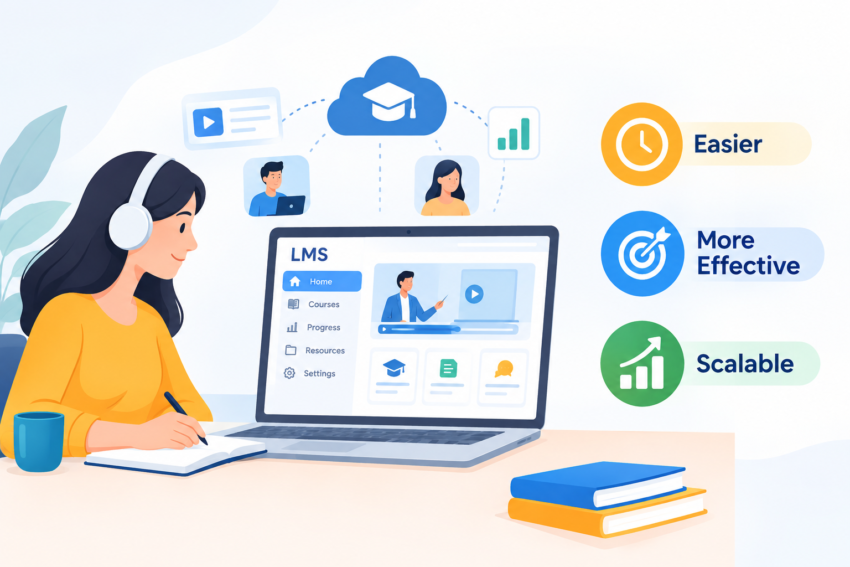
Online training has become an important part of modern employee development. Businesses use digital learning to onboard employees, improve skills, deliver compliance training, and share knowledge across teams.
However, managing courses, learners, assessments, and training records manually can become time-consuming.
An Learning Management System provides a centralized way to manage these activities and create a more organized learning experience.
What Is an LMS?
An LMS Learning Management System, is software that helps businesses manage and deliver training online.
With an LMS, organizations can:
-
Create and organize online courses.
-
Upload videos, documents, presentations, and other learning materials.
-
Assign courses to employees or specific groups.
-
Generate training reports.
-
Manage learning activities from one centralized platform.
Instead of relying on emails, spreadsheets, and multiple tools, businesses can manage their training programs through one system.
How Does an LMS Make Online Training Easier?
An LMS simplifies training for both administrators and learners.
For Administrators
An LMS can help administrators:
-
Assign training to employees quickly.
-
Automate course notifications and reminders.
-
Track course completion.
-
Manage training content from one location.
-
Reduce repetitive administrative tasks.
-
Maintain organized learner records.
For Learners
Employees and other learners can:
-
Access courses from different locations.
-
Learn at a convenient time.
-
Complete training at their own pace.
-
Track their own progress.
-
Complete quizzes and assessments online.
This flexibility makes an Online Training Platform useful for businesses with remote, hybrid, or geographically distributed teams.
How Can an LMS Make Training More Effective?
An LMS can help businesses create a structured and consistent learning experience.
Key advantages include:
-
Structured learning:
Organize courses into lessons, modules, and learning paths. -
Interactive content:
Combine videos, documents, quizzes, assessments, and other resources. -
Progress tracking:
Allow learners and managers to see training progress. -
Consistent content:
Provide employees with the same approved training materials. -
Self-paced learning:
Allow learners to complete courses according to their schedules. -
Immediate feedback:
Use quizzes and assessments to help learners understand their progress. -
Better accessibility:
Make training resources available whenever learners need them.
The objective is not simply to move traditional training online. A well-managed LMS can make learning more organized, accessible, and engaging.
Why Do Businesses Use an LMS System?
An LMS System For Business can support different types of organizational training.
Common applications include:
-
Employee onboarding.
-
Compliance training.
-
Workplace safety training.
-
Product and service training.
-
Sales training.
-
Leadership training.
-
Customer and partner education.
Businesses can also update their training content as policies, products, or processes change.
How Does an LMS Help Businesses Scale Training?
Scalability is one of the key benefits of an LMS.
As a business grows, managing training manually can become increasingly difficult.
An LMS can help organizations:
-
Train larger numbers of employees.
-
Provide training to remote teams.
-
Reuse existing digital courses.
-
Manage training from a centralized platform.
-
Maintain consistent learning standards as the organization expands.
An LMS Learning System allows businesses to expand their training programs without necessarily increasing administrative work at the same rate as their workforce.
How Does an LMS Help Track Training?
Tracking training manually can make it difficult to know who has completed a course or who needs additional support.
An LMS can provide visibility into:
-
Course completion.
-
Learner progress.
-
Assessment results.
-
Training participation.
-
Learning activity.
-
Required and overdue training.
-
Employee training records.
These insights can help managers and training teams identify areas where learners may need additional guidance.
What Should You Look for in an LMS?
Before selecting an LMS, businesses should consider their specific requirements.
Important factors include:
-
Ease of use:
Is the platform simple for administrators and learners? -
Course management:
Can you easily create, organize, and update training? -
Reporting:
Does it provide useful training and learner reports? -
Integrations:
Can it connect with the tools your business already uses? -
Assessment features:
Can you create quizzes, tests, and evaluations? -
Security:
Does it provide appropriate protection for training and learner data? -
Mobile access:
Can employees learn using different devices?
The right platform should match your organization’s training goals rather than simply offering the largest number of features.
Key Benefits of an LMS at a Glance
An LMS can help businesses:
-
Simplify online training management.
-
Reduce administrative workload.
-
Centralize learning content.
-
Improve training accessibility.
- Support remote and hybrid employees.
-
Scale training as the business grows.
-
Make training data easier to manage.
Final Thoughts
An LMS can make online training easier to manage, more structured for learners, and easier to scale as an organization grows.
By bringing courses, learning materials, assessments, learner records, and reporting together in one place, an Online Training Platform can help businesses create a more efficient training process.
Whether the goal is employee onboarding, compliance, professional development, or skills training, an LMS Learning Management System can provide the centralized structure businesses need to deliver training effectively.
The key is to choose an LMS that is easy to use, supports your training objectives, and can adapt as your organization and learning requirements evolve.