
Introduction
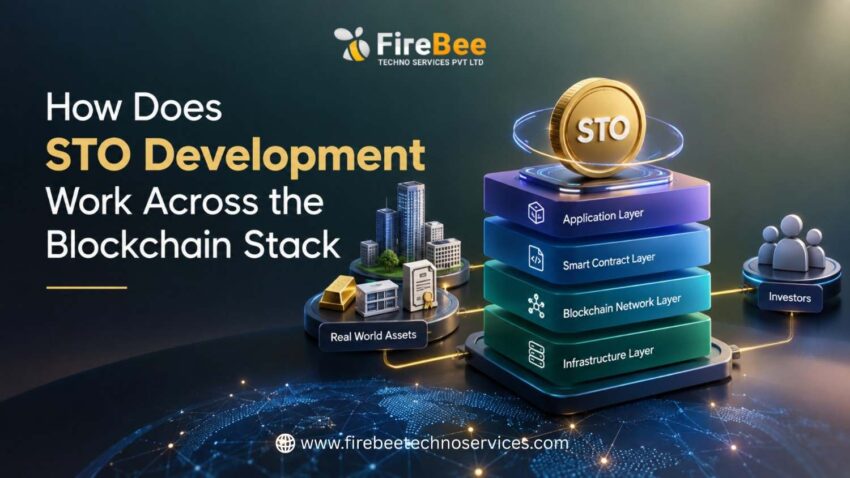
Security Token Offering (STO) platforms utilize blockchain-based security tokens to represent assets. The STO Development consists of the blockchain network, smart contracts, back-end services, data processing, and application layer that altogether manage the issuance of tokens, their ownership, transfers, and other processes.
What Is STO Development?
STO Development is the process of building blockchain software for issuing and managing security tokens that represent an underlying asset or financial interest.The process starts by defining the asset and token structure. Developers then convert this structure into smart contract logic and connect the contracts with backend services and application components.The technical design depends on how the token is expected to operate within the STO platform.
How Does an STO Work on the Blockchain?
An STO operates through multiple connected layers. The asset model defines what the token represents. The blockchain records transactions and contract states. Smart contracts execute predefined token operations, while backend and application components communicate with the blockchain.Each layer handles a specific part of the system while passing required data and transactions to the next layer.
What Are the Main Layers in STO Development?
1. Asset and Security Token Model
Development begins by defining how the underlying asset is represented by the security token. Developers determine what the token represents, how ownership data is recorded, and which operations can change its state.This model is used when designing the smart contract structure and application logic.
2. Blockchain Network Layer
The blockchain network provides the execution environment for smart contracts and token transactions. Developers select a network based on transaction processing, contract support, integration methods, and other technical requirements.The selected network also determines how blockchain data and transactions are accessed by application services.
3. Smart Contract Development
Smart contracts contain the blockchain logic for token operations. Developers implement contract functions according to the defined token model and transaction flow.STO Token Development Services can cover contract architecture, implementation, blockchain integration, testing, and deployment. Contract testing is performed before connecting the contracts with application components.
4. Backend Development
The backend connects the application with blockchain services. It processes application requests, communicates with smart contracts, handles application data, and coordinates blockchain transactions.Backend logic can remain separate from contract logic so that blockchain operations and application processing are handled independently.
5. Application Development
The application layer provides the interface for interacting with the STO system. Application requests are sent to backend services, which then communicate with the required blockchain components.Developers test this complete request path to verify that application actions result in the intended backend and smart contract operations.
What Are the Key Stages of STO Development?
Define the STO Architecture
The development team defines how the asset model, token structure, blockchain, smart contracts, backend, and application will interact.
Develop the Security Token Contracts
Smart contract functions are implemented according to the token model and required transaction operations.
Integrate Blockchain Services
Blockchain connectivity is added to allow backend services to communicate with deployed contracts and retrieve relevant blockchain data.
Build Backend and Application Components
Backend services and application interfaces are developed around the defined transaction flow.
Test the Complete STO Platform
Testing covers contract execution, transaction processing, blockchain communication, backend operations, data handling, and application requests.
Why Is STO Architecture Important in Development?
STO architecture defines how the individual technical components communicate. A defined separation between blockchain logic, backend processing, data handling, and application logic also makes it easier to identify where a transaction or system operation is processed.For STO platforms operating in different jurisdictions, the technical architecture can also be structured according to the applicable token model and regulatory requirements of the target market.
Conclusion
STO Development connects asset modeling, blockchain infrastructure, smart contracts, backend services, data processing, and application components. Each layer performs a specific function within the system. Understanding these layers helps development teams determine how an STO platform should be structured and how its technical components should communicate.