
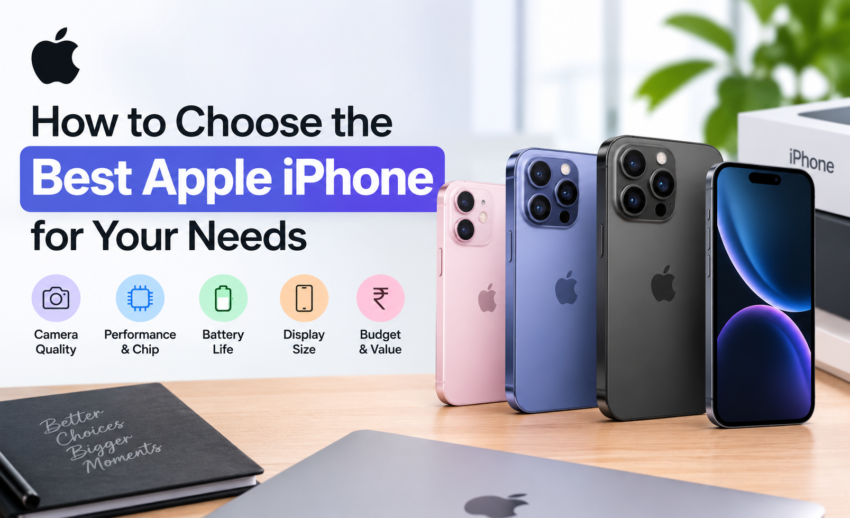
Choosing the best Apple iPhone can be confusing with multiple models, screen sizes, storage options, camera systems and price ranges available. Whether you need an iPhone for everyday use, photography, gaming, business or content creation, the right choice depends on your budget and personal requirements.
In this iPhone buying guide, we’ll explain the key factors to consider before buying an iPhone, including performance, camera quality, display, battery life, storage, connectivity, software updates and overall value.
1. Start With Your Budget
Your budget is one of the most important factors when choosing an iPhone. Apple offers different iPhone models across various price segments, so deciding how much you want to spend can help narrow down your options.
Consider:
- Your maximum budget
- Whether you need a standard or Pro model
- Available discounts and offers
- No-cost EMI or other payment options
- Trade-in value of your existing smartphone
- Whether buying an older-generation iPhone makes sense for you
Instead of automatically choosing the most expensive model, focus on the features you will actually use.
2. Consider Your Everyday Usage
Think about how you use your smartphone every day.
If you mainly use your iPhone for calls, messaging, social media, browsing, streaming and everyday apps, you may not need the highest-end model.
However, photographers, video creators, gamers and professionals may benefit from a more powerful iPhone with advanced cameras, a larger display, better performance and higher storage capacity.
Ask yourself:
- Do I use my phone mainly for everyday tasks?
- Do I take a lot of photos and videos?
- Do I play graphics-intensive games?
- Do I edit videos on my iPhone?
- Do I use my phone for work?
- Do I need advanced camera features?
3. Choose the Right iPhone Size
Screen size can significantly affect your everyday experience.
A compact iPhone can be easier to carry and use with one hand, while a larger display can be more comfortable for watching videos, gaming, editing photos and multitasking.
Apple’s current iPhone lineup includes different screen sizes and form factors, including standard, larger and Pro options.
Consider both screen size and overall device weight before making your decision.
4. Compare iPhone Camera Features
If photography and video recording are important to you, carefully compare the camera systems rather than looking only at megapixel numbers.
Look for features such as:
- Main camera quality
- Ultra-wide camera
- Telephoto camera
- Optical zoom
- Night photography
- Portrait photography
- Macro photography
- Video recording capabilities
- Stabilisation
- Front camera features
For example, Apple’s current models offer different camera configurations depending on the model, with Pro models providing more advanced camera controls and capabilities.
If you regularly create Instagram posts, YouTube videos or other social media content, camera and video features should be a major part of your buying decision.
5. Check Performance and Chipset
The processor determines how smoothly your iPhone handles apps, games, photography, video editing and multitasking.
When comparing iPhones, check:
- Chip generation
- CPU and GPU performance
- Neural Engine capabilities
- Gaming performance
- AI-related features
- Long-term software support
A newer chip can also provide additional performance headroom for future iOS updates and demanding applications.
6. Decide How Much Storage You Need
Choosing the right iPhone storage is important because you cannot simply add a microSD card later.
Think about how much content you normally store on your phone.
Lower storage: Suitable for users who primarily stream content and use cloud storage.
Medium storage: A practical choice for everyday users who take photos, install multiple apps and occasionally record videos.
Higher storage: Better suited to photographers, gamers, video creators and users who store large amounts of 4K video and other files locally.
If you plan to keep your iPhone for several years, choosing enough storage from the beginning can be worthwhile.
7. Battery Life and Charging
Battery life is another important factor when choosing an iPhone.
Consider your daily screen time and how frequently you have access to a charger. Heavy users who spend hours gaming, streaming videos, using navigation or recording videos should pay particular attention to battery performance.
Also check:
- Video playback ratings
- Charging options
- USB-C connectivity
- Wireless charging compatibility
- Charging accessories
Apple’s current iPhone lineup includes USB-C connectivity, although transfer capabilities can vary between models.
8. Display and Design Features
The display affects everything from watching videos to browsing social media and editing photos.
When comparing iPhone displays, look at:
- Screen size
- Display technology
- Resolution
- Brightness
- Refresh rate
- ProMotion availability
- Always-On display
- Dynamic Island
- Durability
Design is also worth considering, especially if you plan to keep your iPhone for several years. Pay attention to materials, dimensions, weight, colours and water resistance.
9. Connectivity and Other Features
Modern iPhones offer more than just calling and internet connectivity.
Depending on the model, features can include:
- 5G connectivity
- eSIM
- USB-C
- Wi-Fi connectivity
- Bluetooth
- Emergency features
- Crash Detection
- Find My
- Face ID
- Camera Control and other controls
For example, Apple lists eSIM, Crash Detection and Find My among the helpful connectivity and safety-related features available on current iPhones.
10. iOS, Updates and the Apple Ecosystem
One of the biggest advantages of choosing an iPhone is its integration with Apple’s software and hardware ecosystem.
iOS provides access to Apple’s apps and services, while features such as AirDrop, iCloud, Apple Watch integration and other Apple devices can make everyday tasks more convenient.
Before buying, consider whether you already use products such as:
- MacBook
- iPad
- Apple Watch
- AirPods
- iCloud
- Other Apple services
Apple also provides model comparison tools so buyers can review specifications and features across different iPhone generations.
11. Which iPhone Is Right for You?
The best iPhone depends on your individual requirements.
For Everyday Users
Look for a balanced combination of performance, camera quality, battery life and price.
For Photography Enthusiasts
Prioritise camera hardware, zoom capabilities, low-light photography and video features.
For Gamers
Focus on processor performance, GPU capabilities, display quality, battery life and thermal performance.
For Content Creators
Consider camera quality, video recording features, processing power, display quality and higher storage capacities.
For Business Users
Prioritise performance, battery life, connectivity, security, storage and long-term software support.
12. New vs. Older iPhone Models
A previous-generation iPhone can sometimes offer the features you need at a different price point, while a newer model may provide improvements in performance, cameras, battery life, connectivity and software features.
Before choosing an older iPhone, compare it with newer models and check:
- Processor generation
- Camera features
- Battery condition if purchasing used
- Software support
- Storage
- Connectivity
- Warranty
- Overall price difference
The goal is to choose the model that provides the features you actually need rather than simply choosing the newest model.
13. Tips Before Buying an iPhone
Before placing your order, use this quick checklist:
- Set your budget
- Compare iPhone models
- Check storage requirements
- Compare camera features
- Check battery performance
- Choose the right screen size
- Check connectivity features
- Consider your existing Apple devices
- Compare new and previous-generation models
- Check warranty and seller details
- Look for genuine offers and exchange options
- Check available EMI or payment offers
Apple’s official comparison and buying pages can also be used to review current models and specifications before purchasing.
Conclusion
Choosing the best Apple iPhone is ultimately about finding the right balance between your budget, performance, camera requirements, storage, battery life, display preferences and everyday usage.
There is no single iPhone that is perfect for everyone. Start by identifying the features that matter most to you, compare the available models and choose the iPhone that fits your needs and budget.
Whether you’re looking for an iPhone for everyday use, photography, gaming, business or content creation, a little research before buying can help you make a more informed decision.