
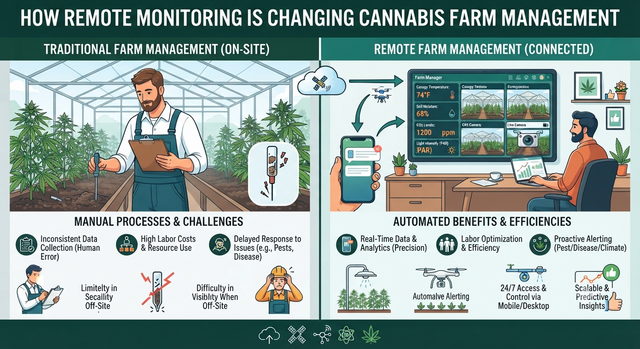
Cannabis cultivation has become increasingly technology-driven. Modern growers are no longer dependent only on walking through a cultivation area and checking plants manually. Today, sensors, connected devices, automated controls, cameras, and cloud-based software can provide cultivators with information about their crops from virtually anywhere.
Remote monitoring is changing cannabis farm management by helping growers observe environmental conditions, identify potential problems earlier, improve recordkeeping, and make more informed operational decisions. While technology does not replace experienced cultivators, it can give them better information to work with.
What Is Remote Monitoring in Cannabis Cultivation?
Remote monitoring uses connected technology to collect and transmit information from a cultivation facility or farm.
Depending on the operation, a monitoring system may track:
-
Temperature
-
Relative humidity
-
Light conditions
-
Irrigation activity
-
Growing-medium moisture
-
Equipment status
-
Environmental alarms
-
Energy consumption
-
Water use
-
Security conditions
Instead of requiring a grower to be physically present every moment, connected sensors can send information to a computer, tablet, or smartphone.
This can be especially useful for commercial operations with multiple cultivation areas.
Why Real-Time Information Matters
Growing conditions can change quickly. A temperature increase, equipment malfunction, irrigation problem, or unexpected humidity change can potentially affect a cultivation environment.
Without monitoring technology, a problem may remain unnoticed until someone physically checks the growing area.
Remote monitoring can provide alerts when measurements move outside predetermined ranges. This gives growers an opportunity to investigate the situation sooner.
The technology doesn’t automatically solve the problem. Instead, it can reduce the time between when something changes and when the grower becomes aware of it.
Remote Temperature and Humidity Monitoring
Temperature and humidity are two of the most commonly monitored environmental factors in controlled cultivation.
Sensors can continuously record environmental readings and create historical data.
For growers, this information can help answer questions such as:
-
When did the temperature change?
-
How long did the change last?
-
Did conditions vary between growing rooms?
-
Are environmental patterns consistent?
-
Did equipment respond as expected?
Historical information can be particularly valuable because a single measurement only provides a snapshot. A data record can show trends over hours, days, or entire cultivation cycles.
Monitoring Irrigation From a Distance
Remote technology can also improve irrigation management.
Connected irrigation systems can monitor watering activity and, depending on the system, provide information about moisture conditions or equipment operation.
For large farms, this can help growers identify potential issues without physically checking every irrigation zone.
If a pump stops operating or a sensor detects an unexpected condition, an automated alert can notify the appropriate personnel.
However, automation should be combined with regular physical inspections. A sensor cannot always detect every problem that a trained person can see.
Remote Monitoring Can Support Resource Efficiency
Water and energy are important resources in cannabis cultivation.
Remote monitoring can help cultivators understand how resources are being used.
For example, historical irrigation information may reveal areas where watering patterns are inconsistent. Energy monitoring can help identify equipment that operates unexpectedly or consumes more power than anticipated.
This data can support more informed resource-management decisions.
The objective isn’t simply to automate everything. Instead, growers can use data to identify opportunities for greater efficiency.
Cameras Add Another Layer of Observation
Environmental sensors measure conditions, but cameras can provide visual information.
Remote cameras may allow authorized personnel to observe:
-
Plant areas
-
Equipment rooms
-
Entry points
-
Irrigation systems
-
Storage areas
-
Facility conditions
Visual monitoring can supplement sensor data.
For example, a temperature sensor might indicate that a room has become warmer than expected. A camera can help personnel visually inspect the area and determine whether equipment appears to be operating normally.
Security cameras can also form part of a broader security system, subject to applicable regulations and privacy requirements.
Alerts Can Help Prevent Delayed Responses
One of the biggest benefits of remote monitoring is automated notification.
Instead of requiring someone to continuously watch a dashboard, a system can send an alert when a measurement crosses a predetermined threshold.
Alerts might relate to:
-
Temperature
-
Humidity
-
Irrigation
-
Equipment failure
-
Power interruptions
-
Security events
-
Communication failures
The value of an alert depends on how quickly and appropriately someone responds.
Too many unnecessary notifications can lead to alert fatigue, where employees begin ignoring warnings. Therefore, monitoring systems should be configured carefully and reviewed regularly.
Remote Monitoring Creates Valuable Historical Data
Data collected during cultivation can become a valuable management resource.
After several growing cycles, cultivators may have records showing environmental conditions and operational performance.
They can analyze these records to identify patterns.
For example, a grower might discover that certain equipment consistently performs differently during particular periods or that environmental conditions vary between rooms.
Historical data can help turn cultivation decisions from purely observational processes into more measurable, data-supported practices.
How Artificial Intelligence Could Expand Remote Monitoring
Artificial intelligence may eventually make remote monitoring even more sophisticated.
Machine-learning systems can analyze large quantities of environmental and operational data and potentially identify unusual patterns.
Computer vision technology may also help detect visual changes in plants or equipment.
However, AI should be viewed as a decision-support tool rather than a replacement for experienced cultivation professionals.
Plant biology is complex, and environmental measurements alone don’t tell the entire story.
A skilled cultivator can combine technology-generated information with direct observation and practical experience.
Remote Monitoring and Compliance
Cannabis cultivation is a regulated industry, and commercial operators must follow applicable laws and regulations.
Digital monitoring and recordkeeping can potentially make it easier for businesses to organize operational information, but technology doesn’t automatically guarantee compliance.
Cultivators need to understand the requirements that apply to their jurisdiction and maintain appropriate records.
Technology should support compliance procedures rather than replace them.
Challenges of Remote Monitoring
Despite its advantages, remote monitoring isn’t perfect.
Connectivity Problems
Internet or network interruptions can prevent sensors from transmitting information.
Sensor Failure
Sensors can malfunction or become inaccurate and therefore require maintenance and calibration.
Cybersecurity
Connected devices can introduce cybersecurity considerations. Businesses should use appropriate security practices and restrict access to authorized personnel.
Initial Costs
Commercial monitoring systems may require investments in sensors, software, networking equipment, installation, and maintenance.
Human Oversight
Technology cannot completely replace physical inspections. Cultivators still need to visit growing areas and evaluate plants and equipment directly.
How Remote Monitoring May Shape the Future
The future of cannabis cultivation will likely involve increasingly integrated technology.
A single platform could potentially combine environmental sensors, irrigation controls, energy monitoring, security systems, cameras, and historical crop information.
As these systems become more sophisticated, growers may be able to make faster and more informed decisions while improving consistency and resource management.
The biggest advantage may not be automation itself. It may be better visibility.
When cultivators have access to reliable information, they can understand what is happening inside their operation rather than discovering problems only after they become obvious.
Where Consumers Can Find Quality Cannabis
Technology is also influencing how cannabis companies communicate quality with consumers. People purchasing cannabis should prioritize products from licensed retailers and review available product and batch information.
California consumers may encounter established cannabis companies and cultivators such as Weedroads, Raw Garden, Lowell Herb Co., Cookies, and Emerald Sky. Availability varies by retailer, location, and product batch, so consumers should evaluate the specific product rather than assuming that every item from a particular brand is identical.
A reputable brand name can be useful, but consumers should also pay attention to labeling, testing information, freshness, and applicable regulatory requirements.
Final Thoughts
Remote monitoring is becoming an important tool in modern cannabis farm management. Sensors, connected equipment, cameras, automated alerts, and data platforms can give cultivators greater visibility into their operations.
The technology can help monitor environmental conditions, irrigation, equipment performance, resource use, and security while creating valuable historical records.
However, successful cultivation still requires experienced people. Sensors can collect information, but trained professionals must interpret that information and decide what action is appropriate.
The future of cannabis farming is likely to combine human expertise with increasingly intelligent technology. Remote monitoring won’t replace the cultivator—it can give the cultivator better information, faster warnings, and a clearer picture of what is happening across the farm.
As the industry continues to develop, these tools could help cannabis businesses pursue greater consistency, efficiency, and operational control while adapting to an increasingly technology-focused agricultural environment.