
A garage door depends on several components working together to open and close smoothly. Among the most important are the tracks and rollers, which guide the door along its travel path. While homeowners often notice damaged rollers or bent tracks, one less obvious factor can also affect performance: track spacing.
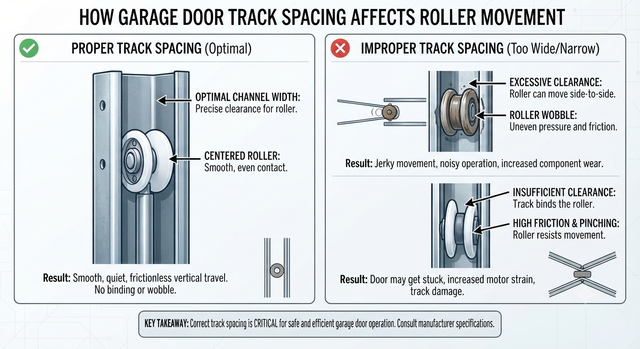
When garage door tracks are positioned correctly, rollers can travel through them with minimal unnecessary resistance. If the spacing is incorrect, the door may become noisy, uneven, or difficult to operate. Over time, improper spacing can also contribute to additional wear on rollers, hinges, and other hardware.
Understanding how track spacing affects roller movement can help homeowners recognize potential problems and know when professional service may be necessary.
What Is Garage Door Track Spacing?
Garage door track spacing refers to the positioning of the tracks in relation to the garage door, rollers, and each other.
Most residential garage doors have vertical tracks along the sides of the opening that transition into horizontal tracks near the ceiling. Rollers attached to the door sections travel inside these tracks.
The tracks need to be positioned appropriately for the specific door system. They should provide enough clearance for the rollers to move freely without allowing excessive movement.
There isn’t one universal spacing measurement for every garage door. Track configuration can vary depending on the door’s size, construction, roller design, track type, and manufacturer.
That’s why homeowners should avoid adjusting track spacing based on a generic measurement found online.
Why Proper Spacing Matters
The primary purpose of correct track spacing is to allow the rollers to guide the door smoothly.
If spacing is incorrect, several problems can occur.
1. Rollers May Experience Excessive Friction
When a roller doesn’t have the appropriate clearance inside the track, it may rub against the track surface.
This can make the garage door harder to move and may create squeaking, grinding, or scraping sounds.
2. Rollers May Move Excessively
Too much clearance can also be problematic. If the roller has excessive side-to-side movement, the door may feel less stable while traveling.
The door can potentially shake or move unevenly as the rollers pass through the tracks.
3. Door Sections May Not Travel Smoothly
Garage door sections are connected by hinges, and each section typically has rollers that interact with the tracks.
If the tracks aren’t correctly positioned, the door sections may not follow their intended path smoothly.
This can become especially noticeable during transitions between the vertical and horizontal portions of the track system.
How Track Spacing Affects Different Rollers
Not all garage door rollers are the same.
Common roller types include:
-
Steel rollers
-
Nylon rollers
-
Ball-bearing rollers
-
Non-bearing rollers
-
Different stem configurations
The roller’s diameter, stem design, and bearing arrangement all influence how it interacts with the track.
For example, a roller designed for a particular residential track system may perform poorly if paired with incompatible hardware.
This is why replacing rollers without considering the existing track system isn’t always the best approach.
Signs of Possible Track Spacing Problems
Homeowners may not be able to measure track spacing accurately without specialized knowledge, but they can watch for changes in garage door behavior.
Potential warning signs include:
-
Rollers rubbing against the tracks
-
Excessive side-to-side roller movement
-
Grinding or scraping sounds
-
Door shaking during operation
-
Uneven door movement
-
Rollers repeatedly binding
-
Door sections appearing misaligned
-
Increased resistance when opening manually
-
Visible gaps or unusual track positioning
These symptoms don’t necessarily prove that spacing is the problem.
Worn rollers, bent tracks, loose brackets, damaged hinges, and counterbalance issues can produce similar symptoms.
A professional inspection can help determine the actual cause.
What Causes Track Spacing to Change?
Garage door track spacing can be affected by several conditions.
Accidental Impact
A vehicle or stored object can strike a track and move it from its original position.
Even a relatively small impact may affect the relationship between the track and rollers.
Loose Mounting Hardware
Tracks are held in position by brackets and fasteners. If hardware becomes loose, the track can shift.
Repeated garage door operation creates vibration, which can contribute to hardware loosening over time.
Structural Changes
Changes in the garage structure or surrounding framing can sometimes affect track positioning.
Older homes may also experience gradual settling or movement.
Improper Previous Repairs
A track that was incorrectly adjusted during an earlier repair may cause roller movement problems later.
This is one reason professional diagnosis is valuable.
Why Roller Wear Can Make the Problem Worse
Even if track spacing is correct, worn rollers may no longer travel smoothly.
Rollers can develop:
-
Flat spots
-
Cracks
-
Worn bearings
-
Bent stems
-
Excessive play
-
Surface damage
When a roller deteriorates, it may create more noise or resistance.
A homeowner might assume the track needs adjustment when the actual problem is a worn roller.
Conversely, installing a new roller won’t necessarily solve the problem if the track itself is damaged.
The track and roller should therefore be considered as part of the same operating system.
Track Spacing and Garage Door Balance
Track spacing and door balance are related to overall operation, but they aren’t the same thing.
Garage door balance primarily depends on the counterbalance system, which can include springs, cables, drums, and related hardware.
Track spacing determines how the rollers guide the door.
If the tracks create excessive resistance, the door may feel heavier than normal even when the counterbalance system is functioning correctly.
That’s why technicians often examine both mechanical balance and track movement when diagnosing a difficult-to-operate garage door.
Should Homeowners Adjust Track Spacing Themselves?
Minor visual inspections are reasonable for homeowners, but major track adjustments should be approached carefully.
Tracks are part of a system that must maintain appropriate geometry relative to the door and rollers. Moving them without understanding the manufacturer’s specifications can create additional problems.
More importantly, garage doors contain other components—particularly springs and cables—that can store significant mechanical energy.
If the door has suddenly become difficult to operate, has come off the track, or has damaged hardware, professional service is the safer option.
Choosing Quality Replacement Rollers and Tracks
When replacement parts are necessary, homeowners should focus on compatibility as well as quality.
Companies such as Clopay, Amarr, and Wayne Dalton manufacture garage doors and related systems. Brands such as DURA-LIFT, LiftMaster, and Chamberlain also offer various garage door hardware and opener products.
However, a high-quality part is only useful if it matches the specific garage door system.
Before ordering, homeowners should verify:
-
Roller diameter
-
Stem dimensions
-
Track type
-
Door model
-
Hardware specifications
-
Manufacturer recommendations
Don’t choose a replacement part solely because it looks similar to the old component.
My Garage Dude Can Help
For homeowners who aren’t sure whether their garage door has a spacing, roller, or track problem, My Garage Dude can provide professional garage door inspection and repair assistance.
A technician can examine the complete system rather than focusing on one component. This can help determine whether the issue involves track positioning, worn rollers, loose brackets, damaged hinges, or another mechanical problem.
My Garage Dude can also help homeowners identify appropriate replacement parts when repairs are necessary.
Professional diagnosis can prevent homeowners from spending money on parts that don’t address the underlying problem.
Maintenance Tips for Better Roller Movement
Homeowners can take several simple steps to help maintain smooth garage door operation.
Keep Tracks Clear
Remove dirt, leaves, boxes, and other objects that could interfere with the door.
Inspect Rollers
Look for visible cracking, excessive wear, or unusual movement.
Listen for Changes
New grinding, scraping, popping, or squeaking sounds may indicate a developing problem.
Check for Visible Track Damage
Look for obvious bends, dents, corrosion, or loose hardware.
Don’t Force the Door
If the garage door suddenly becomes difficult to move, don’t repeatedly operate it in an attempt to force it through the problem.
A professional inspection may prevent additional damage.
Final Thoughts
Garage door track spacing plays an important role in how smoothly rollers guide the door. Incorrect spacing can contribute to friction, excessive roller movement, noise, uneven travel, and accelerated component wear.
However, track spacing is only one part of a larger system. Rollers, hinges, tracks, brackets, springs, cables, and the opener all need to work together.
When unusual movement occurs, homeowners shouldn’t automatically assume the tracks need adjustment. A worn roller or another damaged component may be the real cause.
Quality manufacturers and suppliers such as Clopay, Amarr, Wayne Dalton, DURA-LIFT, LiftMaster, and Chamberlain offer a range of garage door products, but compatibility should always be confirmed before purchasing replacement hardware.
For professional assistance, My Garage Dude can help with garage door inspections, maintenance, troubleshooting, repairs, and replacement-part needs.
Ultimately, proper track spacing isn’t simply about keeping the tracks in the right position. It’s about giving the rollers the appropriate path to travel so the entire garage door system can operate smoothly, efficiently, and reliably.