
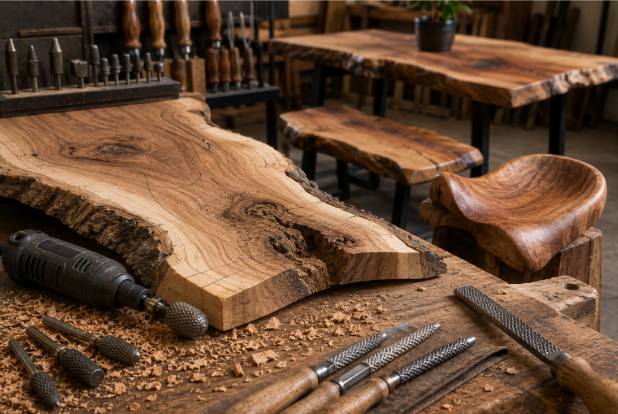
Live-edge furniture combines functional design with the irregular contours naturally found in timber. Unlike conventional boards that are milled into predictable dimensions, live-edge slabs can contain curves, knots, voids, changing grain directions, and uneven thicknesses. Working with these characteristics requires controlled material removal rather than simply forcing the wood into a standardized shape.
Effective live edge shaping begins with understanding the slab before cutting or carving. The objective is to preserve useful natural features while creating surfaces that are structurally sound, comfortable, and visually balanced. The process can include rough stock removal, contour development, edge refinement, and final smoothing.
Assess the Slab Before Removing Material
A careful inspection should come before any carving begins. Look for cracks, loose bark, inclusions, knots, voids, weak sections, and areas where the grain changes direction. These features can determine how aggressively a particular section can be shaped.
The intended furniture piece also matters. A tabletop may require relatively restrained edge refinement, while a bench or chair can benefit from deeper ergonomic contours. Marking the desired profile on the wood provides a visual boundary and helps prevent unnecessary material removal.
Wood moisture is another consideration. Slabs should be appropriately dried and conditioned before detailed shaping because dimensional movement can affect the finished furniture after fabrication.
Start With Controlled Material Removal
Once the design has been established, the rough-shaping stage removes excess wood and establishes the general form. Power carving can be useful here because shaping wheels and similar tools allow substantial amounts of material to be removed while following organic contours.
Different tool profiles serve different purposes. Shaping wheels can handle broader material removal, while contour wheels can help form concave hollows, rounded edges, and recessed areas. Hand rasps provide multidirectional control when refining a surface or reaching areas where larger power tools are less practical.
The important principle is to remove material progressively. Leaving a small amount for refinement gives the woodworker room to correct proportions and smooth transitions later.
Follow the Grain Instead of Fighting It
Irregular slabs frequently contain reversing grain, particularly around knots and natural edge transitions. Cutting aggressively against these areas can produce tear-out and damage sections that may be difficult to repair.
A better approach is to make controlled passes and adjust the direction of the tool according to the grain. Smaller cuts also provide greater control over the final profile. As the surface approaches its intended shape, reducing cutting depth becomes increasingly important.
During live edge shaping, the goal is not to eliminate every irregularity. Natural variation is part of the material’s character. Instead, the craftsperson should determine which features contribute to the design and which need to be removed for stability, comfort, or safety.
Refine With Hand Tools
After the major contours are established, hand tools can provide the precision needed for refinement. Rasps are useful for removing small amounts of material and correcting localized high spots. Half-round profiles can work particularly well on concave surfaces and rounded transitions, while narrower profiles can reach tighter areas.
This stage is also where tactile inspection becomes valuable. Running a hand over the surface can reveal subtle ridges, hollows, or abrupt transitions that may be difficult to identify visually.
Sanding should follow the established form rather than flattening it. Progressively finer abrasives can remove tool marks while preserving the intended geometry.
Match Tools to Each Stage
Choosing the right tool is largely about matching its cutting profile and aggressiveness to the task. Coarser tools are useful for rapid stock removal, while finer options provide better control during surface refinement. The furniture-tool category includes shaping wheels, contour wheels, burrs, and hand rasps for these different stages.
Safety is equally important. Eye protection, hearing protection, suitable respiratory protection, secure workholding, and appropriate tool handling should be considered whenever powered carving equipment is used.
Conclusion
Successful live edge shaping requires a balance between natural character and intentional design. Careful inspection, progressive material removal, grain-aware cutting, ergonomic contouring, and hand refinement can transform an irregular slab without stripping away its distinctive qualities. The best results generally come from treating rough shaping and finishing as separate stages, allowing each tool to perform the task for which it provides the greatest control.
When a project involves saddle seat carving, the same philosophy applies: establish the broad form first, refine the contours gradually, and use tactile feedback to evaluate comfort.