
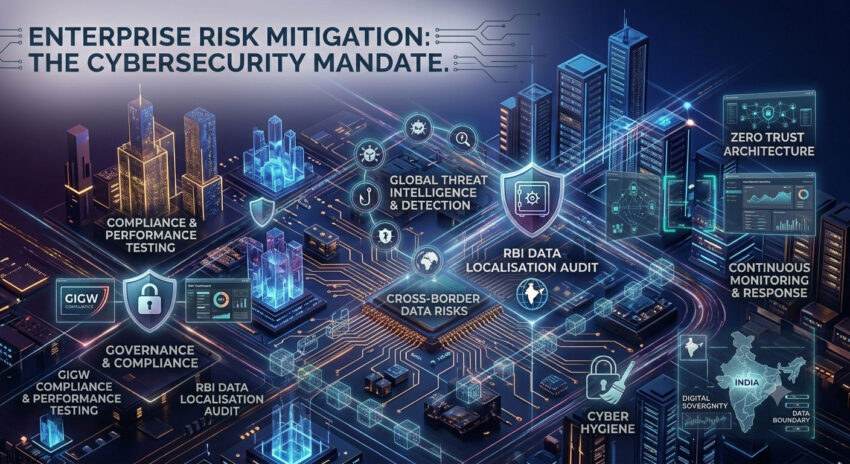
The regulatory landscape for financial technology, banking institutions, and enterprise software vendors in India has reached unprecedented levels of scrutiny. As digital financial ecosystems expand, regulatory bodies like the Reserve Bank of India (RBI) and the Ministry of Electronics and Information Technology (MeitY) are enforcing rigid frameworks to safeguard user data, system integrity, and sovereign financial systems.
For enterprise risk officers, CISOs, and compliance managers, meeting these mandates is no longer a check-the-box exercise. It requires a deep technical understanding of two primary operational pillars: gigw compliance functional performance testing and the rbi data localisation audit.
Together, these frameworks dictate how application interfaces must perform and where foundational financial data must live.
1. The Blueprint for Digital Trust: GIGW Compliance Framework
The Guidelines for Indian Government Websites (GIGW), formulated by the National Informatics Centre (NIC), extend far beyond basic government portals. Any enterprise, vendor, or FinTech platform integrated with public sector infrastructure, unified payment interfaces, or semi-government portals must align with these protocols.
True compliance hinges on rigorous gigw compliance functional performance testing. This dual-layered validation ensures that an application is not only secure and accessible but inherently stable under enterprise loads.
[Quality & Accessibility (WCAG 2.0)] ➔ [Functional Performance Testing] ➔ [Unified Sovereign Trust]
Essential Vectors of Functional Performance Testing:
-
Accessibility and Device Interoperability: Applications must conform to WCAG 2.0 AA standards, ensuring seamless usability across varied assistive technologies, operating systems, and network bandwidths.
-
Load and Stress Resilience: Performance testing must simulate peak transactional volumes to guarantee zero degradation in response latency or data packet drops during high-velocity financial operations.
-
Lifecycle Lifecycle Testing: Validating user journeys from end to end ensures that updates to API integrations do not introduce operational regressions or break critical security controls.
2. Sovereign Data Frontiers: The RBI Data Localisation Mandate
While GIGW governs how systems perform, the RBI’s directives explicitly mandate where core data must reside. The RBI data localisation directive requires all payment service providers, banks, and system participants to store end-to-end transaction data exclusively within servers physically located in India.
For multinational corporations and hybridized cloud infrastructures, passing an rbi data localisation audit demands a comprehensive verification of data flows.
Scope of the RBI Data Localisation Audit
Core Requirement: The complete end-to-end transaction details, log files, user credentials, and behavioral metadata must be housed solely within domestic borders.
If data must be processed abroad for fraud detection or analytics, it must be completely purged from foreign nodes and stored definitively in India within strict 24-hour windows.
| Audit Vector | Audit Requirement | Compliance Artifact |
| Data Residency | Physical and cloud storage isolation strictly within Indian geographic boundaries. | Cloud configuration maps, data center certifications. |
| Cross-Border Purge | Verification that any data processed internationally is thoroughly deleted abroad within 24 hours. | Automated script logs, cryptographic erasure certificates. |
| Systemic Logs | Local storage of payment logs, settlement details, and authorization strings. | Database architecture diagrams, local log repository access. |
3. The Intersecting Risk: Operationalizing Both Frameworks
Enterprise risk occurs when institutions treat these two mandates as isolated silos. In reality, application performance and data architecture are deeply interconnected.
The Architectural Friction Point
Implementing localized database architectures to comply with an rbi data localisation audit inevitably impacts system latency. If an application’s database queries must travel through localized loops while managing complex API payloads, functional speeds can degrade.
This is precisely why executing gigw compliance functional performance testing after structural data changes is critical. Risk mitigation teams must verify that domestic data hosting routing strategies do not disrupt the application’s responsiveness, security handling, or transactional reliability.
Strategic Compliance Checklist for CISOs:
-
Map Data Lifecycles: Formally document how payment data enters, traverses, and rests within your cloud ecosystems to ensure compliance ahead of a data residency audit.
-
Automate Performance Validation: Integrate functional testing tools into CI/CD pipelines to ensure GIGW accessibility and performance standards are maintained across software updates.
-
Deploy Independent Certifications: Engage CERT-In impaneled auditors to validate security postures and deliver legally defensible audit logs for both MeitY and RBI compliance pipelines.
Conclusion
Achieving a resilient posture under modern compliance expectations requires a systematic focus on both front-end execution and back-end infrastructure. By prioritizing rigid functional performance testing alongside continuous data residency audits, enterprise institutions secure their operational licenses while building long-term digital trust in one of the world’s fastest-evolving digital economies.