

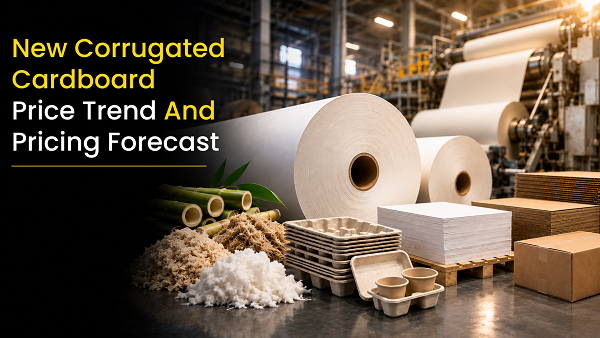
The New Corrugated Cardboard Price Trend in Q2 2026 showed a moderate increase across major global markets, with prices rising by approximately 3% compared with Q1 2026. This upward movement was mainly supported by steady demand from e-commerce, food packaging, fast-moving consumer goods (FMCG), consumer goods, and industrial packaging sectors.
At the same time, higher costs for recovered paper, virgin fiber, energy, chemicals, and transportation put additional pressure on manufacturers. Careful production planning and controlled inventory levels also helped support prices.
Although the increase was not extreme, it showed that the market remained firm during the quarter. Regional markets recorded different price movements depending on import costs, freight expenses, and local purchasing activity.
Global New Corrugated Cardboard Price Trends in Q2 2026
During the second quarter of 2026, the global corrugated cardboard market experienced a steady rise in prices. The overall increase of around 3% compared with the previous quarter reflected a combination of stable demand, higher manufacturing expenses, and balanced supply conditions.
Corrugated cardboard is widely used for packaging products that need protection during storage, transportation, and delivery. From online shopping parcels to food cartons and industrial shipping boxes, this material plays an important role in everyday business activities. As businesses continued to require packaging materials, demand remained relatively stable across major markets.
One of the main reasons behind the price increase was the rising cost of raw materials. Recovered paper and virgin fiber are important inputs in paperboard production. When these materials become more expensive, manufacturers face higher production costs. Energy, chemicals, and transportation expenses added further pressure during the quarter.
Manufacturers also managed production carefully to avoid building up excessive inventories. This approach helped keep supply relatively balanced with demand. When the market does not have a large surplus of material, suppliers generally have more room to maintain their selling prices.
Overall, the global New Corrugated Cardboard Prices movement in Q2 2026 reflected a market supported by regular buying activity and higher operating costs rather than a sudden increase in consumption.
Key Factors Influencing New Corrugated Cardboard Prices
Several factors shaped the New Corrugated Cardboard Price Trend during Q2 2026. These factors are closely connected, and changes in one area can influence the overall cost of packaging materials.
- Steady Demand from Packaging Industries
E-commerce continued to support demand for corrugated cardboard because online orders require boxes for safe delivery. Food producers, FMCG businesses, consumer goods manufacturers, and industrial companies also continued to use cardboard packaging for shipping and storage.
This steady demand helped manufacturers maintain regular sales. Even when buyers remained cautious about costs, they continued purchasing the material needed for their daily operations.
- Higher Raw Material Costs
Recovered paper and virgin fiber are essential inputs in the production process. An increase in their prices can raise the overall cost of making corrugated cardboard.
Manufacturers also faced higher expenses for chemicals and other production materials. These additional costs made it more difficult for producers to reduce their selling prices, particularly when demand remained stable.
- Rising Energy and Transportation Expenses
Paper production requires energy for processing and manufacturing. When energy costs increase, mills may experience a noticeable rise in operating expenses.
Transportation is another important part of the supply chain. Raw materials must reach production facilities, and finished cardboard products must be delivered to customers or ports. Higher freight, marine fuel, and logistics costs contributed to the increase in prices during Q2 2026.
- Controlled Production and Inventory Management
Paper mills maintained careful control over production and inventories during the quarter. This helped prevent excessive availability in the market.
When producers match output with expected demand, they can reduce the risk of oversupply. Such conditions supported relatively firm prices across the major markets covered in the Q2 2026 assessment.
- Cautious Purchasing and Global Uncertainty
Geopolitical uncertainties encouraged buyers and suppliers to manage their inventories carefully. Businesses wanted to maintain enough packaging material for their operations without holding unnecessarily large stocks.
This cautious approach did not eliminate purchasing activity. Instead, buyers continued regular procurement while paying attention to costs, delivery schedules, and changing market conditions.
Regional New Corrugated Cardboard Price Trend Analysis
Although the global market recorded a moderate increase, price movements differed across individual countries. Import costs, shipping expenses, and local buying conditions played an important role in these differences.
China: FOB Shanghai Market Prices Increased by 2%
In China, the export price of new corrugated cardboard, measured on an FOB Shanghai basis for single-wall board with three liners and E-flute construction, increased by approximately 2% in Q2 2026 compared with Q1 2026.
The market remained firm as demand from e-commerce, food packaging, FMCG, consumer goods, and industrial sectors supported consumption and export activity.
Chinese paper mills faced higher costs for recovered paper, virgin fiber, energy, chemicals, and transportation. Producers managed production and inventory levels carefully, which limited excess material availability and supported stronger export offers.
Freight and logistics expenses also influenced supplier pricing decisions. Buyers remained cautious but continued to purchase packaging materials to meet their requirements.
On a month-on-month basis, China FOB prices increased by around 6% in June 2026 compared with May 2026. This stronger monthly movement indicated that upward pressure continued toward the end of the quarter.
Overall, China’s export market remained moderately firm, supported by stable demand, higher production expenses, and controlled supply.
Thailand: CFR Laem Chabang Prices Increased by 3%
Thailand recorded an approximately 3% increase in new corrugated cardboard import prices in Q2 2026 compared with Q1 2026. The assessment covered single-wall board imported from China and delivered on a CFR Laem Chabang basis.
Demand from e-commerce, food, FMCG, consumer goods, and industrial packaging remained steady. Buyers continued regular procurement to maintain sufficient packaging supplies for their business needs.
Higher raw material and manufacturing costs in the supply chain contributed to firmer offers. Freight and marine fuel expenses also increased the cost of delivering material to Thailand.
Supply remained relatively balanced, as mills managed production and inventories carefully. This limited excessive availability and helped support prices throughout the quarter.
In June 2026, Thailand’s CFR prices increased by around 3% compared with May 2026. The monthly movement suggested continued upward pressure, although the increase was more moderate than in some other markets.
Vietnam: CFR Hai Phong Prices Increased by 2%
Vietnam’s new corrugated cardboard import prices rose by approximately 2% in Q2 2026 compared with the previous quarter. The assessment covered single-wall board imported from China on a CFR Hai Phong basis.
Steady demand from e-commerce, food packaging, FMCG, consumer goods, and industrial users supported market activity. Businesses continued to purchase packaging materials as part of their regular operating requirements.
At the same time, higher costs for recovered paper, virgin fiber, energy, chemicals, and transportation increased production and import expenses. Freight and marine fuel costs added further pressure to delivered prices.
Vietnamese buyers maintained regular procurement, while suppliers kept their offers relatively firm. Controlled production and inventory management helped prevent excessive supply in the market.
On a month-on-month basis, Vietnam CFR prices increased by around 6% in June 2026 compared with May 2026. This stronger monthly rise showed that prices gained momentum toward the end of the quarter.
Indonesia: CFR Jakarta Prices Increased by 4%
Indonesia recorded one of the stronger quarterly increases among the Asian markets covered in this assessment. New corrugated cardboard import prices on a CFR Jakarta basis rose by approximately 4% in Q2 2026 compared with Q1 2026.
Demand remained healthy across e-commerce, food, FMCG, consumer goods, and industrial packaging applications. Buyers continued sourcing material to ensure that packaging requirements could be met without interruption.
Higher production costs, including raw materials, energy, chemicals, and transportation, contributed to firmer supplier offers. Importers also faced increased freight, marine fuel, and logistics expenses, which raised the delivered cost of cardboard.
Supply conditions remained relatively balanced as mills carefully managed output and inventories. Buyers continued regular purchasing despite higher costs.
Indonesia’s CFR prices increased by around 6% in June 2026 compared with May 2026. This monthly increase supported the broader upward movement observed during the quarter.
Mexico: CFR Manzanillo Prices Increased by 7%
Mexico recorded the largest quarterly increase among the five regional markets discussed here. New corrugated cardboard import prices on a CFR Manzanillo basis rose by approximately 7% in Q2 2026 compared with Q1 2026.
Demand from e-commerce, food, FMCG, consumer goods, and industrial packaging remained healthy. This supported continued purchasing activity among businesses that depended on corrugated cardboard for product protection and transportation.
Higher costs for recovered paper, virgin fiber, energy, chemicals, and transportation increased manufacturing and import expenses. Freight, marine fuel, and logistics costs also contributed to the higher delivered prices.
Buyers continued regular procurement to secure adequate packaging supplies, while suppliers maintained firmer offers amid elevated operating costs. Careful production and inventory management helped keep the market relatively balanced.
On a month-on-month basis, Mexico CFR prices increased by around 13% in June 2026 compared with May 2026. This was the strongest monthly increase among the regional markets covered in the assessment.
The combination of higher import expenses, steady demand, and firmer supplier offers contributed to Mexico’s stronger quarterly price increase.
New Corrugated Cardboard Price Chart: Understanding Q2 2026 Movements
A New Corrugated Cardboard Price Chart helps readers compare price movements across countries and understand where market conditions strengthened the most during the quarter.
Based on the Q2 2026 assessment, the reported quarterly changes were:
- Global market: Approximately 3% increase compared with Q1 2026.
- China, FOB Shanghai: Approximately 2% increase.
- Thailand, CFR Laem Chabang: Approximately 3% increase.
- Vietnam, CFR Hai Phong: Approximately 2% increase.
- Indonesia, CFR Jakarta: Approximately 4% increase.
- Mexico, CFR Manzanillo: Approximately 7% increase.
These figures represent percentage changes rather than absolute prices per tonne. They should not be used to conclude that one country has the highest actual cardboard price, because the assessment does not provide comparable absolute price quotations for every market.
The figures also reflect different delivery terms. FOB prices generally refer to goods loaded for export, while CFR prices include the cost of goods and freight to the named destination port. Therefore, the regional changes should be compared with care.
The chart-style comparison indicates that Mexico experienced the strongest quarterly increase, followed by Indonesia. China and Vietnam recorded smaller increases, while Thailand remained close to the global market’s overall movement.
New Corrugated Cardboard Price Index: What the Market Signals
The New Corrugated Cardboard Price Index is a useful concept for tracking price direction over time. An index allows buyers, manufacturers, packaging businesses, and procurement teams to understand whether market prices are rising, falling, or remaining relatively stable.
The Q2 2026 assessment points to a firmer market because prices increased across all five regional markets covered in this article. The global increase of approximately 3% also suggests that the upward movement was not limited to a single country.
However, the reported percentage changes alone do not establish an official numerical price index. An actual index requires a defined base period, a consistent pricing methodology, and reliable underlying price observations. Without those details, it is more appropriate to interpret the figures as quarterly price changes rather than assign an invented index value.
For businesses, the main takeaway is that raw material expenses, freight costs, energy prices, and supply management can influence the price index even when demand remains relatively stable.
Monitoring these factors together provides a clearer picture than looking at a single month’s price movement.
New Corrugated Cardboard Price Forecast: What to Watch After Q2 2026
The Q2 2026 market conditions provide a useful starting point for understanding possible price movements in the following quarter. However, the available figures describe the second quarter and do not establish confirmed prices or percentage changes for Q3 2026.
If demand from e-commerce, food packaging, FMCG, consumer goods, and industrial sectors remains steady, the market may continue to receive support from regular purchasing activity. On the other hand, a slowdown in packaging demand could reduce buyers’ urgency and place pressure on suppliers.
Raw material costs will also remain an important factor to monitor. If recovered paper, virgin fiber, energy, and chemicals remain expensive, manufacturers may continue trying to protect their margins through firmer selling prices. If these costs ease, some of the pressure on production expenses could decrease.
Freight rates and marine fuel expenses will be especially important for import-dependent markets such as Thailand, Vietnam, Indonesia, and Mexico. Changes in shipping costs can affect delivered prices even when the underlying cardboard price changes only slightly.
Inventory management will also influence the market. If mills maintain controlled production and buyers continue regular procurement, prices may remain relatively supported. However, a significant increase in available supply or a reduction in orders could change this balance.
For that reason, the most practical forecast approach is to monitor monthly price updates, raw material trends, freight costs, and purchasing activity rather than assume that the Q2 increase will automatically continue at the same rate.
What Buyers and Packaging Businesses Should Consider
Businesses that regularly purchase corrugated cardboard can use the latest price trend information to improve their procurement planning.
First, buyers should compare quotations using consistent specifications, quantities, delivery terms, and locations. Differences between FOB and CFR quotations can affect the final cost and make direct comparisons misleading.
Second, businesses should monitor raw material and transportation costs alongside supplier quotations. This can help explain why prices change even when demand appears steady.
👉 👉 👉 Please submit your query to get New Corrugated Cardboard price trend, forecast, and market price analysis: https://www.price-watch.ai/book-a-demo/
Third, maintaining a reasonable inventory can reduce the risk of unexpected shortages. However, holding excessive stock can increase storage costs and tie up working capital. A balanced purchasing plan is usually more practical than buying large quantities solely because prices have recently increased.
Finally, buyers should review prices regularly rather than relying on a single quarterly assessment. Monthly movements can reveal changes in market direction that may not be obvious from quarterly averages alone.
The New Corrugated Cardboard Price Trend in Q2 2026 showed a moderately firm global market, with prices increasing by approximately 3% compared with Q1 2026. Steady demand from e-commerce, food, FMCG, consumer goods, and industrial packaging supported consumption, while higher raw material, energy, chemical, and transportation costs increased production and delivery expenses.
Regional performance varied, with China and Vietnam recording quarterly increases of around 2%, Thailand rising by 3%, Indonesia by 4%, and Mexico by 7%. Monthly price movements in June were also stronger in China, Vietnam, Indonesia, and particularly Mexico, indicating additional upward momentum toward the end of the quarter.
The overall picture is of a market supported by regular purchasing activity, careful inventory management, and elevated operating costs. The New Corrugated Cardboard Prices outlook beyond Q2 will depend on how these factors develop, especially raw material availability, shipping expenses, and packaging demand.
For buyers and manufacturers, following the New Corrugated Cardboard Price Chart and monitoring a consistently calculated New Corrugated Cardboard Price Index can help support better procurement decisions. While the Q2 2026 figures show clear upward movement, future price direction will depend on changing market conditions rather than the quarterly increase alone.
About Price-Watch™
Price Watch™ is an India-based, independent raw material price reporting agency that provides real-time price forecasts and data-driven insights into global raw material markets. Price Watch™ specializes in tracking raw material prices, analyzing market trends, and delivering timely updates on plant shutdowns, supply disruptions, capacity expansions, and demand-supply dynamics. The Price Watch™ platform empowers manufacturers, traders, and procurement professionals to make faster, smarter decisions. Leveraging AI-powered forecasting and over a decade of historical data, Price Watch™ transforms market volatility into actionable opportunity.
Futura Tech Park,
C Block, 8th floor 334,
Old Mahabalipuram Road,
Sholinganallur, Chennai, Tamil Nadu, Pincode – 600119.
𝐋𝐢𝐧𝐤𝐞𝐝𝐈𝐧: https://www.linkedin.com/company/price-watch-ai/
𝐅𝐚𝐜𝐞𝐛𝐨𝐨𝐤: https://www.facebook.com/people/Price-Watch/61568490385598/
𝐓𝐰𝐢𝐭𝐭𝐞𝐫: https://x.com/pricewatchai
𝐖𝐞𝐛𝐬𝐢𝐭𝐞: https://www.price-watch.ai/