
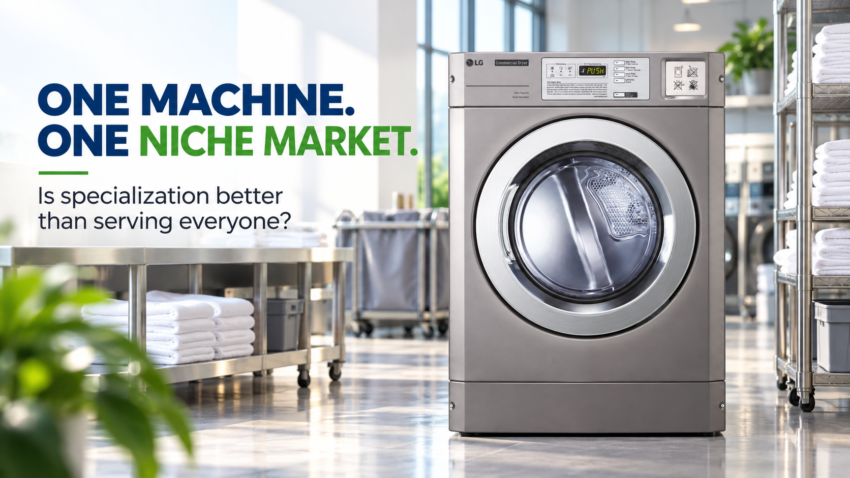
Many new laundry businesses make the same mistake: they try to serve every customer, every textile, and every type of order from day one. That sounds like a bigger opportunity, but it can also create more complexity in sorting, wash programs, turnaround times, finishing, and equipment planning.
A different approach is to start with one clearly defined customer segment and build the operation around its recurring needs. With the right niche, even one commercial washing machine can become the foundation of a focused laundry business.
Why Can a Niche Laundry Business Be Easier to Plan?
A general laundry may need to handle everyday clothes, towels, bedsheets, uniforms, curtains, commercial linen, and other items. Each category can bring different soil levels, fabrics, load sizes, care requirements, and turnaround expectations.
A niche operation starts differently.
One Customer Segment → Similar Textile Mix → Predictable Loads → Defined Process
This makes several parts of the business easier to plan.
You can create clearer sorting rules, choose suitable wash programs, train staff around fewer textile categories, and estimate daily processing capacity more accurately.
A focused B2B laundry business may also make customer acquisition more direct. Instead of advertising to everyone, you can approach businesses within one specific market and understand exactly what they need.
For example, a laundry serving sports academies may repeatedly process training kits, jerseys, shorts, and towels. A business focused on cleaning contractors may handle mop pads, microfiber cloths, and reusable cleaning textiles.
The key idea is simple:
You do not need every customer in your city. You need enough recurring customers from a market you understand well.
Specialization does not guarantee success, but it can make a new laundry operation easier to structure than trying to serve every possible demand from the beginning.
Which Niche Can You Build Around a Commercial Washing Machine?
The right niche depends on local demand, competition, textile volume, and the type of service you want to provide.
Here are a few markets a first-time entrepreneur could evaluate.
Sports Academies and Training Centers
Sports facilities can generate repeated loads of jerseys, shorts, training wear, towels, and similar textiles.
The business model could be based on scheduled collection and return rather than individual walk-in customers.
Uniform-Based Businesses
Security agencies, factories, facility-management companies, schools, and other organizations may require uniforms to be processed regularly.
A uniform-focused operation could potentially build recurring contracts instead of relying on unpredictable retail orders.
Cleaning Contractors
Commercial cleaning companies repeatedly use mop heads, microfiber cloths, wiping towels, and other washable textiles.
This can create an opportunity for a specialized commercial laundry machine setup designed around operational cleaning textiles.
Event and Rental Linen
Caterers, event companies, and linen-rental businesses may need tablecloths, napkins, covers, and other suitable items processed after use.
In each case, the market should be studied before equipment is selected.
Use this framework:
Customer Market → Textile Type → Soil Type → Service Frequency → Daily KG → Processing Requirement
The important question is not simply, “Which niche sounds profitable?”
It is:
Which niche around me generates enough repeat laundry volume to justify a professional setup?
How Much Work Do You Need Before Buying a Commercial Washing Machine?
Before comparing a 15 KG, 20 KG, or 30 KG commercial washer, estimate how much real work the business could generate.
Start with customer volume.
A simple planning formula is:
Expected Daily Laundry KG = Number of Active Clients × Average Daily KG per Client
Then estimate how many loads you may need to process:
Required Loads per Day = Expected Daily KG ÷ Practical Average Load
For example, suppose your target niche could realistically generate around 180 KG on a normal working day.
If your practical average load is 15 KG:
180 ÷ 15 = 12 loads per day
This is only a planning example. It does not automatically mean that a specific 15 KG machine is the right choice.
Actual equipment selection should also consider:
- Peak-day volume
- Textile mix
- Practical load size
- Available working hours
- Wash cycle requirements
- Extraction performance
- Utility availability
- Future business growth
Peak demand is especially important.
A business may average 180 KG per day but receive much more on certain days. If all your B2B clients send their work at the same time, the average number alone may underestimate the capacity you need.
That is why the better order is:
Find Repeat Demand → Estimate Loads → Understand Peak Volume → Select Machine Capacity
Not:
Buy Machine → Look for Customers
What Should You Check Before Choosing a Commercial Washer Extractor?
Once the market and expected volume are clear, you can begin comparing commercial laundry equipment.
KG capacity is important, but it should not be the only specification you consider.
A first-time buyer should evaluate:
- Rated capacity
- Drum volume
- Extraction performance
- Available wash programs and controls
- Water requirements
- Electrical requirements
- Heating options where applicable
- Drainage requirements
- Chemical dosing compatibility
- Machine dimensions
- Installation clearances
- Maintenance and service support
An industrial washing machine or commercial washer extractor should fit the actual workload, not simply look impressive on a specification sheet.
For example, two businesses may both process 200 KG per day but still need different setups.
One may process relatively similar uniform loads throughout the day. Another may receive mixed textile categories in uneven batches. The practical load size, number of cycles, and operating schedule could be completely different.
The correct equipment decision should therefore follow:
Textile Mix → Practical Load → Loads per Day → Operating Hours → Machine Capacity → Utilities → Installation
A balanced commercial laundry setup should also consider what happens after washing. If drying or finishing cannot keep pace, adding more washing capacity may only shift the bottleneck to another part of the operation.
Should You Start With One Market and Expand Later?
Specialization does not mean your business has to remain limited forever.
A focused niche can simply be the starting point.
If your process becomes efficient and you understand the customer well, you can later evaluate adjacent markets that have similar processing requirements.
For example:
Sports Academies → Gyms → Sports Clubs → Training Centres
Or:
Cleaning Contractors → Facility Management → Corporate Housekeeping → Building Maintenance
The advantage is that expansion follows an existing process rather than forcing your operation to handle completely unrelated textiles.
Before adding a new customer segment, ask:
- Are the textiles similar?
- Can the existing wash process support them?
- Will the new orders fit within current capacity?
- Do they require different chemicals or handling?
- Will drying and finishing requirements change?
- Can the same staff manage the additional process?
This keeps growth controlled.
The goal should not be to become a laundry for everyone as quickly as possible. It should be to build a service that works consistently, then expand where the next market makes operational sense.
How Orgaearth Can Help You Choose the Right Commercial Washing Machine
Orgaearth can help entrepreneurs evaluate a commercial washing machine based on the actual business they plan to build.
Instead of starting with machine size alone, equipment planning can begin with:
Target Market + Textile Mix + Expected Daily KG + Practical Load Size + Operating Hours + Available Utilities + Space
From there, businesses can evaluate suitable washer extractors and supporting laundry equipment for business according to their intended application.
The objective is to match the machine to real customer demand, workflow, and future expansion rather than choosing equipment only by rated capacity.
Frequently Asked Questions
Can I start a laundry business with one commercial washing machine?
Potentially, yes. The feasibility depends on expected daily volume, machine capacity, wash cycles, working hours, drying capacity, and the type of customers you plan to serve.
What size commercial washing machine should a startup buy?
There is no universal size for every startup. Calculate expected daily KG, practical load size, peak demand, and operating hours before selecting capacity.
Is a commercial washer extractor suitable for a B2B laundry business?
A commercial washer extractor can be suitable for many professional laundry applications, but the correct model depends on textile type, expected volume, utilities, and workflow requirements.
Which niche is best for a laundry business?
The best niche is one with enough repeat demand, manageable competition, suitable textile volume, and processing requirements that match the operation you can build.
What should I check before buying a commercial washing machine?
Check capacity, drum volume, extraction performance, programs, utilities, drainage, dimensions, installation requirements, chemical dosing compatibility, and service support.
Can one laundry machine process different types of textiles?
It may process different suitable textiles, but they should not automatically be combined in the same load. Sorting, care requirements, soil type, and process selection still matter.
Conclusion
A new laundry business does not have to serve everyone from day one. Choosing one clear market can make customer acquisition, processing, capacity planning, and equipment selection easier to manage.
The smarter sequence is
Choose a Niche → Validate Repeat Demand → Estimate Daily Loads → Plan the Workflow → Select the Commercial Washing Machine → Expand Into Related Markets
A machine should support the business model. The business model should not be built around whatever machine was purchased first.
Contact Us:
Orgaearth Laundry Solutions
Plot no. 774, Udyog Vihar, Phase 5, Gurugram, Haryana, India-122016
Email: marketing@orgaearth.com
Contact No.- +91 7042912777