
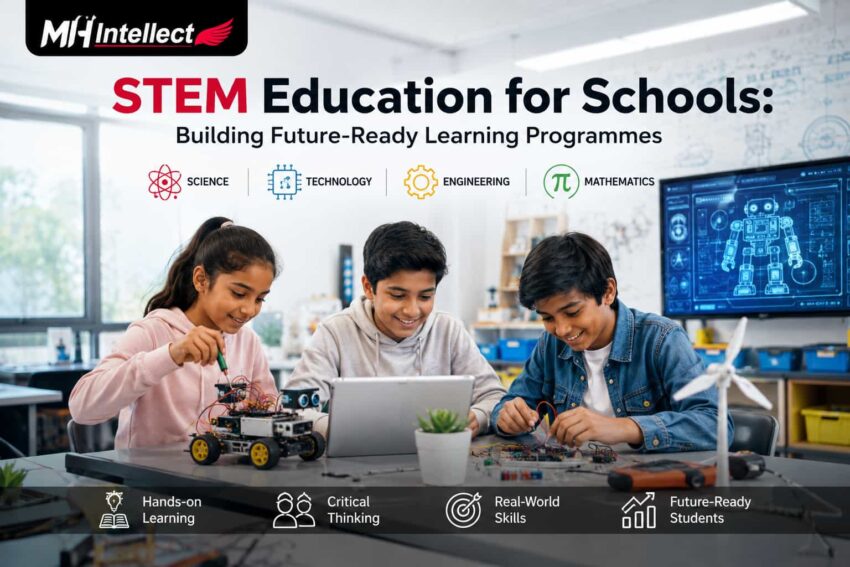
Schools today are preparing students for a world shaped by artificial intelligence, robotics, automation, engineering, and rapidly evolving technologies. Academic knowledge remains important, but students also need opportunities to apply what they learn through practical challenges, experimentation, collaboration, and problem-solving. This is where STEM Education becomes increasingly valuable. A structured STEM approach connects science, technology, engineering, and mathematics through meaningful learning experiences that help students understand how classroom concepts work in the real world. For school leaders, the goal is not simply to add another activity to the timetable, but to create a learning environment where students can become confident thinkers, creators, and problem-solvers.
Why STEM Education Matters for Schools
STEM Education for Schools can transform students from passive learners into active participants. Instead of only memorising concepts, students can investigate problems, design solutions, test ideas, learn from failure, and improve their work. This process develops skills that can support students across academic subjects and future career pathways.
A strong STEM programme can help students develop:
- Critical thinking and practical problem-solving
- Coding, robotics, and technology skills
- Creativity, innovation, and design thinking
- Collaboration and communication
- Engineering and analytical reasoning
- Confidence with emerging technologies
STEM Learning Across Different School Stages
Effective STEM education should evolve as students grow. Younger learners benefit from exploration, building activities, simple experiments, and guided discovery. Early Years STEM Education can introduce children to foundational concepts through age-appropriate activities that encourage curiosity, observation, creativity, and simple problem-solving.
As students enter primary school, learning can become more structured. The Primary School STEM Programme can introduce learners to coding, robotics, engineering challenges, scientific exploration, and project-based activities that connect multiple disciplines.
During middle school, students can begin working with more advanced robotics, coding, electronics, engineering, AI, and technology challenges. A Middle School STEM Programme can help learners move from guided activities toward greater independence, experimentation, and technical reasoning.
At the secondary level, students can explore more complex applications involving AI, robotics, engineering, automation, data, drones, and emerging technologies. The Secondary School STEM Programme can support deeper technical learning while helping students understand how STEM connects with higher education and future careers.
What Makes Effective STEM Programmes Different?
Not every programme labelled STEM delivers the same educational value. Schools should look beyond equipment and demonstrations and consider how students actually learn. A meaningful programme should provide progressive activities, trained educators, clear learning objectives, hands-on projects, and opportunities for students to solve unfamiliar problems.
The strongest STEM Education Programmes allow students to move from understanding a concept to applying it, testing their ideas, identifying problems, and improving their solutions. This makes failure part of the learning process rather than treating it as a negative outcome.
Why Choose MH Intellect?
Why MH Intellect focuses on helping schools create structured and practical STEM learning environments rather than isolated technology activities. MH Intellect supports schools through STEM education, robotics, AI, coding, IoT, drones, aviation, engineering, STEM lab solutions, teacher training, and project-based learning.
The approach can be adapted according to student age, school objectives, available infrastructure, and desired learning outcomes. This helps schools build a progressive STEM pathway where students develop skills continuously rather than experiencing STEM as a one-time workshop.
Building a Future-Ready School
Future-ready education is not about predicting exactly which careers students will enter. It is about giving them the ability to adapt when technology, industries, and expectations change. STEM learning can help students develop the curiosity to ask questions, the confidence to experiment, and the technical foundation to create solutions.
For school leaders, investing in structured STEM education can also strengthen the school’s innovation culture and provide students with more meaningful opportunities to connect academic learning with real-world challenges.
Ready to Build a Stronger STEM Programme?
Schools looking to introduce or strengthen STEM learning need a partner that can connect educational goals with practical implementation. Book a consultation with MH Intellect to explore customised STEM Education Programmes, age-appropriate learning pathways, robotics, AI, coding, IoT, STEM labs, teacher training, and future-ready technology solutions designed around your school’s needs.