

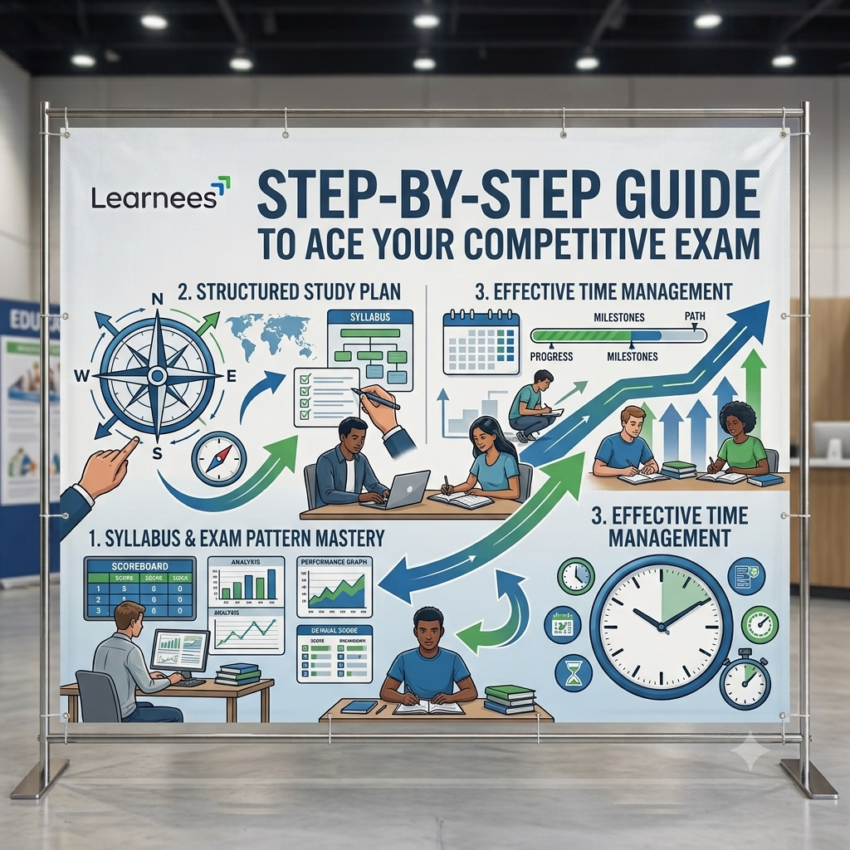
Competitive exams such as UPSC, SSC, Banking, NEET, JEE, Railway, Defence, and various state-level examinations require more than simply studying for long hours. Success depends on having a clear strategy, understanding the exam pattern, choosing the right study resources, and regularly evaluating your preparation. Whether you are starting your preparation from scratch or looking to improve your current strategy, a step-by-step approach can make your preparation more organised and effective.
In this guide, we will explore practical steps that can help you prepare confidently and make better use of your study time.
Table of Contents
- Understand Your Competitive Exam
- Check the Latest Syllabus and Exam Pattern
- Set a Realistic Preparation Goal
- Create a Practical Study Plan
- Build Strong Fundamentals
- Choose the Right Study Resources
- Make Short and Useful Notes
- Practice Questions Regularly
- Include Mock Tests in Your Preparation
- Analyse Your Performance
- Revise Consistently
- Stay Updated with Current Affairs
- Manage Time and Avoid Distractions
- Maintain a Healthy Study Routine
- Track Your Progress
- Final Checklist for Competitive Exam Preparation
- Frequently Asked Questions
1. Understand Your Competitive Exam
The first step is to clearly understand the examination you are preparing for.
Every competitive exam has different eligibility requirements, subjects, marking schemes, question formats, and selection processes. For example, the preparation strategy for UPSC will be different from SSC, NEET, JEE, Banking, or Defence examinations.
Before starting your preparation, find out:
- Eligibility criteria
- Number of stages in the examination
- Subjects covered
- Question format
- Total marks
- Exam duration
- Negative marking rules
- Previous-year cut-off trends
- Selection process
Having this information will help you prepare with a specific goal instead of studying without direction.
2. Check the Latest Syllabus and Exam Pattern
The syllabus should become the foundation of your preparation strategy.
Download the latest official syllabus and divide it into smaller topics. Then compare the syllabus with previous-year question papers to understand which areas are frequently tested.
Create three categories:
|
Category |
What to Do |
|
Strong Topics |
Revise and practise regularly |
|
Average Topics |
Spend additional study time |
|
Weak Topics |
Focus on concepts and practice |
This simple classification can help you prioritise your preparation.
3. Set a Realistic Preparation Goal
Instead of setting a vague goal such as “I will study hard,” create measurable targets.
For example:
- Complete two chapters this week.
- Solve 100 practice questions.
- Take two mock tests.
- Revise one subject every Sunday.
- Improve accuracy in a particular section.
Your long-term objective may be to qualify for the examination, but your daily goals should focus on actions that move you toward that objective.
4. Create a Practical Study Plan
A good timetable should be realistic rather than overloaded.
Divide your available study hours among different activities such as:
Concept Learning → Practice → Revision → Mock Tests → Analysis
For example, a student with six focused study hours might divide the day into:
|
Activity |
Suggested Time |
|
Concept Study |
2 Hours |
|
Question Practice |
1.5 Hours |
|
Revision |
1 Hour |
|
Mock/Sectional Test |
1 Hour |
|
Test Analysis |
30 Minutes |
The exact schedule should depend on your exam, current preparation level, school/college schedule, and personal routine.
5. Build Strong Fundamentals
Strong fundamentals make advanced preparation easier.
Do not focus only on memorising answers. Try to understand why an answer is correct and how a concept can be applied to different questions.
For subjects involving numerical or logical problems, practise step-by-step problem solving. For theory-based subjects, focus on concepts, important facts, relationships between topics, and regular revision.
If a topic remains unclear after self-study, consider using a suitable course, educator, coaching provider, or learning resource for additional guidance.
6. Choose the Right Study Resources
There are countless books, videos, online courses, coaching programs, apps, PDFs, and test series available today. Using too many resources can sometimes create confusion.
Choose resources based on:
- Relevance to the syllabus
- Quality of explanations
- Updated content
- Practice opportunities
- Previous-year question coverage
- Student reviews and credibility
- Your learning style
The goal is not to collect more study material. The goal is to understand and revise the right material effectively.
Learnees works as an education marketplace, helping students explore and compare different education options, including coaching providers, courses, and test series.
7. Make Short and Useful Notes
Notes should help you revise quickly rather than become another textbook.
While making notes, focus on:
- Important concepts
- Formulas
- Definitions
- Key facts
- Important dates
- Common mistakes
- Frequently tested topics
- Difficult concepts
Keep your notes organised subject-wise so that you can easily revise them before tests and examinations.
8. Practice Questions Regularly
Learning a concept is only one part of preparation. Applying that knowledge through questions is equally important.
Start with topic-wise questions and gradually move towards mixed-question practice.
Try to understand:
- Why the correct option is correct
- Why other options are incorrect
- Which concept the question tests
- How much time you spend solving it
- Whether you made a conceptual or calculation mistake
Regular practice improves familiarity with different question patterns.
9. Include Mock Tests in Your Preparation
Mock tests are an important part of competitive exam preparation.
A good test series can help you experience exam-like conditions and identify areas that need improvement.
When choosing a test series, consider:
- Relevance to the latest syllabus
- Quality of questions
- Exam-level difficulty
- Test frequency
- Detailed solutions
- Performance analysis
- Topic-wise or section-wise tests
- Full-length mock tests
Do not select a test series simply because it contains a large number of tests. Quality, relevance, and analysis are more important.
10. Analyse Your Performance
Taking a mock test without analysing it wastes a major learning opportunity.
After every test, divide your mistakes into categories:
Conceptual Mistake:
You did not understand the concept properly.
Silly Mistake:
You knew the answer but made an avoidable error.
Time-Management Issue:
You spent too much time on a question.
Guessing Error:
You selected an answer without sufficient confidence.
Knowledge Gap:
You were unfamiliar with the topic.
Maintain a mistake notebook or digital error log. Revisit it regularly.
11. Revise Consistently
Revision should not be left until the final few days.
A simple revision cycle can be:
Learn → Practise → Revise → Test → Analyse → Revise Again
Use your short notes, marked questions, formulas, previous mistakes, and important facts for quick revision.
Repeated revision helps you retain information and identify topics that still require attention.
12. Stay Updated with Current Affairs
For examinations where current affairs are part of the syllabus, staying updated is important.
Instead of trying to read everything happening in the world, focus on information relevant to your examination.
You can organise current affairs under categories such as:
- National news
- International developments
- Economy
- Government schemes
- Science and technology
- Environment
- Defence
- Sports
- Awards and important appointments
Regular revision is important because simply reading current affairs once may not be enough for exam preparation.
13. Manage Time and Avoid Distractions
Time management is not only about studying for more hours. It is about using your available time effectively.
Try these practices:
- Set specific study targets.
- Keep your phone away during focused sessions.
- Use short breaks between study sessions.
- Avoid unnecessary multitasking.
- Schedule difficult subjects during your most productive hours.
- Keep dedicated time for revision and testing.
Consistency over several months is generally more valuable than studying intensely for a few days and then losing momentum.
14. Maintain a Healthy Study Routine
Preparation can become stressful if you ignore your basic routine.
Make time for:
- Adequate sleep
- Regular meals
- Short breaks
- Physical activity
- Relaxation
- Family and social interaction
A sustainable routine can help you stay focused for a longer preparation period.
15. Track Your Progress
Your preparation should be measurable.
Create a weekly progress sheet containing:
|
Area |
Weekly Check |
|
Syllabus Completed |
Track topics |
|
Questions Practised |
Record numbers |
|
Mock Tests |
Record scores |
|
Accuracy |
Track percentage |
|
Weak Areas |
Update regularly |
|
Revision |
Mark completed topics |
Do not judge your preparation only by the number of hours you study. Look at your understanding, accuracy, speed, consistency, and test performance.
A Simple 30-Day Competitive Exam Preparation Framework
If you are looking for a structured starting point, you can divide one month into four stages:
Week 1: Understand and Plan
- Study the syllabus.
- Understand the exam pattern.
- Collect essential resources.
- Identify strong and weak areas.
- Create your study timetable.
Week 2: Build Concepts
- Focus on important subjects.
- Strengthen basic concepts.
- Prepare short notes.
- Start topic-wise question practice.
Week 3: Practice and Test
- Increase question-solving practice.
- Take sectional tests.
- Start full-length mocks where appropriate.
- Analyse every test carefully.
Week 4: Revise and Improve
- Revise important topics.
- Review your mistake notebook.
- Take additional mock tests.
- Work on speed and accuracy.
- Focus on weak areas.
After 30 days, review your performance and create the next month’s plan based on your results.
Common Mistakes Students Should Avoid
Even hardworking students can make mistakes during competitive exam preparation.
Studying Without a Plan
Without clear priorities, students may spend too much time on easy topics and ignore important areas.
Using Too Many Resources
More books and courses do not automatically mean better preparation.
Ignoring Previous-Year Questions
Previous-year questions can help you understand the actual style and difficulty of the examination.
Taking Mock Tests Without Analysis
A score alone does not tell you what needs improvement.
Delaying Revision
If you keep postponing revision, previously studied information can become difficult to recall.
Comparing Your Preparation With Others
Every student has a different starting point, learning speed, and preparation schedule. Focus on improving your own performance.
How Learnees Can Help You Explore Education Options
Finding the right learning option can be difficult when students have to search through numerous coaching websites, courses, and test series individually.
Learnees is an education marketplace where students and parents can explore education providers, courses, coaching options, and test series in one place.
Instead of selecting an option only because it is popular, students can focus on factors such as course structure, subjects covered, test availability, learning format, location, and their own preparation requirements.
The basic journey is simple:
Search → Explore → Compare → Connect → Learn
This can make the process of discovering suitable education options more organised.
Final Checklist Before Your Competitive Exam
Before entering the final phase of preparation, make sure you have:
- Completed the important parts of the syllabus
- Solved previous-year questions
- Taken regular mock tests
- Analysed your mistakes
- Revised important topics
- Prepared short notes
- Improved time management
- Identified your weak areas
- Reviewed important current affairs where applicable
- Maintained a consistent study routine
Conclusion
Acing a competitive exam is not about studying randomly for long hours. It requires planning, consistent practice, smart revision, regular testing, and continuous improvement. Start by understanding your examination, break the syllabus into manageable sections, build strong fundamentals, practise questions, take relevant mock tests, and analyse your performance. Most importantly, keep improving your strategy based on your results. The right combination of consistent preparation + quality resources + regular self-evaluation can help you move closer to your competitive exam goals.
Explore suitable coaching options, courses, and test series through Learnees – An Education Marketplace, and choose learning resources based on your individual preparation needs.Visit now : https://www.learnees.com/courses/search?category=Competitive-Exams
Learnees is built to be a one-stop platform for students across India — for coaching, test series, and career guidance — helping you make decisions backed by real data, not guesswork.
Explore Learnees at www.learnees.com and take the next step in your exam preparation & Buid Your Future with Confidence.
Frequently Asked Questions
1. How should I start preparing for a competitive exam?
Start by understanding the eligibility criteria, syllabus, exam pattern, marking scheme, and selection process. Then create a realistic study plan and begin with the core concepts.
2. How many hours should I study for a competitive exam?
There is no fixed number of hours that works for everyone. Focus on productive and consistent study sessions rather than simply counting hours.
3. Are mock tests important for competitive exams?
Yes. Mock tests can help you practise under exam-like conditions, improve time management, identify weak areas, and measure your progress.
4. How often should I revise?
Revision should be regular throughout your preparation. You can schedule weekly revision and increase revision frequency as the examination approaches.
5. Should I join coaching for competitive exam preparation?
It depends on your learning needs. Some students prefer self-study, while others benefit from structured courses, expert guidance, doubt support, and regular assessments. Compare available options before making a decision.
6. How can I choose the right test series?
Look at syllabus coverage, question quality, exam relevance, difficulty level, test frequency, solutions, and performance analysis rather than choosing only by the number of tests.
7. How can Learnees help competitive exam aspirants?
Learnees is an education marketplace where students can explore and compare coaching providers, courses, and test series to find options that match their learning and preparation requirements.