
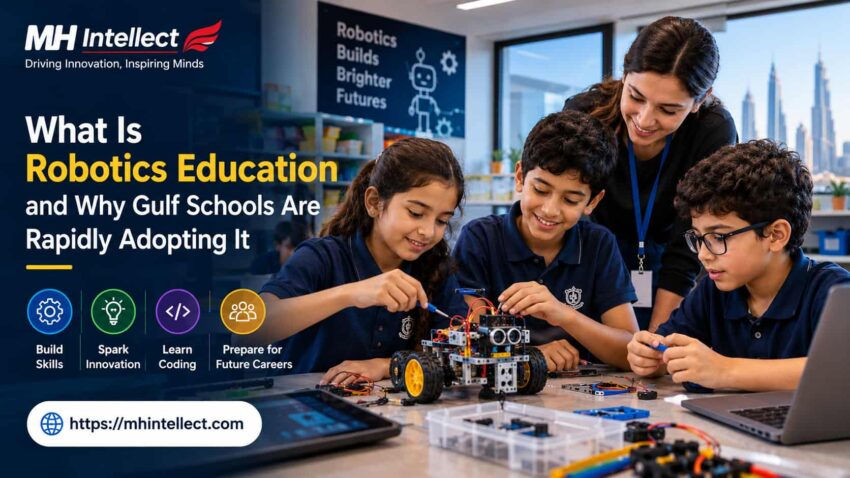
Robotics is moving beyond being an extracurricular activity and becoming a practical way for schools to introduce students to engineering, coding, automation, and problem-solving. As education systems across the Gulf place greater emphasis on innovation and future-ready skills, robotics education provides students with opportunities to learn by building, programming, testing, and improving physical systems. Instead of learning technology only through theory, students can see how their instructions produce real-world results. This makes robotics particularly valuable for schools looking to strengthen practical STEM learning and connect classroom concepts with the technologies shaping modern industries.
What Is Robotics Education?
Robotics education is a hands-on learning approach where students explore how robots are designed, programmed, controlled, and improved. It combines several disciplines, including science, technology, engineering, mathematics, coding, electronics, and design. Students may begin with simple activities such as assembling a robot and programming basic movements before progressing toward sensors, autonomous behaviour, obstacle detection, automation, and more complex engineering challenges.
The real value of robotics is not simply producing a robot that completes a task. Students need to understand why the system behaves in a particular way. When a robot fails to follow instructions or responds incorrectly to its environment, students can investigate the problem, modify their code, test another approach, and evaluate the result. This process develops practical reasoning and encourages students to treat mistakes as part of engineering rather than as failure.
Why Robotics Fits Naturally Into STEM Learning
Stem robotics connects multiple STEM disciplines through a single practical activity. Coding teaches students how to create instructions and logical sequences, while engineering introduces mechanical structures, movement, and design. Mathematics can be applied to measurements, angles, speed, distance, and data, while science helps students understand concepts such as force, motion, energy, and sensors.
A well-designed robotics programme can help students develop:
- Problem-solving and critical-thinking skills
- Coding and computational-thinking abilities
- Engineering design and prototyping skills
- Collaboration and technical communication
- Creativity and experimentation
- Confidence in working with emerging technologies
These skills are useful beyond robotics. Students can apply the same reasoning when working on engineering projects, AI systems, IoT solutions, automation, scientific investigations, and other technology-driven challenges.
Robotics in STEM Education for Gulf Schools
The relevance of robotics in STEM education is particularly strong for schools across the Gulf region because students are growing up alongside rapidly developing technology ecosystems. Robotics can provide a practical bridge between classroom learning and industries such as manufacturing, logistics, healthcare, engineering, aviation, smart infrastructure, and automation.
For schools, the objective should not be to introduce robotics simply because it is a popular technology. The stronger approach is to connect robotics activities with clear learning outcomes and age-appropriate challenges. Younger students can begin with construction, sequencing, and simple programming, while older learners can progress into autonomous robots, sensor-based systems, engineering design, and advanced programming.
What Schools Should Look for in a Robotics Programme
Effective robotics education requires more than purchasing kits. Schools should consider the quality of curriculum planning, teacher preparation, project progression, student assessment, and opportunities for independent problem-solving. A strong programme should become more challenging as students develop rather than repeating the same activities each year.
This is where STEM Education for schools can provide a broader framework. Robotics can be integrated with coding, AI, IoT, engineering, mathematics, and science so that students understand the relationships between different technologies instead of studying robotics as an isolated activity.
How MH Intellect Supports Robotics Learning
MH Intellect helps schools develop practical STEM learning experiences through robotics, coding, AI, IoT, engineering, STEM labs, teacher training, and project-based programmes. As a STEM Education partner, MH Intellect focuses on creating structured learning pathways that help students progress from basic exploration to more advanced technical challenges.
The goal is to help schools create learning environments where students do more than operate technology. They learn to question it, understand it, modify it, and eventually design solutions of their own.
Building the Next Generation of Problem-Solvers
Robotics education can play an important role in preparing students for a technology-driven future because it brings together knowledge and action. Students are required to think logically, work collaboratively, test ideas, respond to unexpected outcomes, and improve their designs. These experiences can build technical confidence while making STEM learning more relevant and engaging.
For Gulf schools, the opportunity is not simply to teach students how to build robots. It is to use robotics as a pathway toward stronger engineering thinking, digital literacy, innovation, and future-ready skills.
Ready to Introduce Robotics Into Your School?
If your school is looking to build a stronger practical STEM programme, book a consultation with MH Intellect to explore customised robotics, coding, AI, IoT, engineering, STEM lab, and teacher-training solutions designed around your school’s educational goals.