
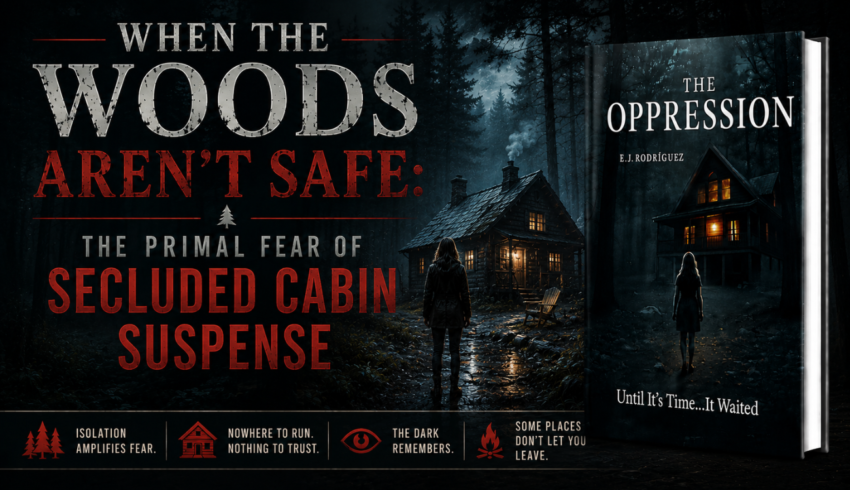
We’ve all done it. You’re stressed, burnt out from the daily grind, and scrolling through vacation rentals online. You bypass the crowded beach condos and the bustling city apartments. Instead, your eyes catch on a beautiful, rustic log cabin nestled deep in the mountains. Peace and quiet, you think. A chance to unplug.
There is something inherently romantic about retreating to the woods. But there is also something deeply, almost biologically, terrifying about it.
For centuries, the “secluded cabin” has been a staple of suspense and horror, and for good reason. When we leave civilization behind, we also leave behind its safety nets. Out in the deep woods, there are no streetlights. Cell service is a luxury. The nearest neighbor might be miles away.
But the truest terror of the isolated cabin isn’t just about being far from help. It’s the creeping realization that out there in the ancient, quiet dark, you might not actually be alone.
This primal fear is the exact catalyst that launches the harrowing events of E.J. Rodriguez’s supernatural thriller, The Oppression. And it proves that sometimes, the things hiding in the woods are far worse than wild animals.
The Survivalist’s Sanctuary
What makes the secluded cabin trope so effective in The Oppression is the protagonist himself. Gabe Aldana is not a helpless, naive city-dweller who jumps at his own shadow. He is a retired Air Force veteran and a former military survival instructor.
For Gabe, the woods aren’t a place of fear; they are his sanctuary. He calls his trips to the misty, rolling hills of Eastern Tennessee his “green therapy.” He knows how to track animals, build fires, and thrive in hostile environments. He is a man who is entirely in his element in the wild.
Which makes what happens to him infinitely more terrifying.
When a storyteller takes a character who is a master of the physical world and drops them into a situation where their survival skills are absolutely useless, the psychological tension goes through the roof. If the guy who knows how to survive anything is suddenly paralyzed with fear, the reader knows the threat is devastatingly real.
The Warning Signs on “Big Bertha”
The dread in The Oppression doesn’t start with a jump scare. It builds slowly, methodically, playing on all the subtle environmental cues that tell our lizard brains to run.
While house-hunting for an investment property in Gatlinburg, Gabe and his young son, Ryan, are led by a highly nervous realtor up a steep, winding mountain road nicknamed “Big Bertha.” The atmosphere is immediately off. The bright sky gives way to an eerie gray overcast. They pass through a section of the forest scarred by an old fire—a graveyard of dead, standing trees that look like skeletal sentinels guarding the property.
Then, there is the cabin itself.
It’s beautiful, built in 1989, perched on an outcrop with a sprawling view. But the details are wrong. The realtor refuses to step inside, obsessively rubbing a turquoise talisman around her neck and blaming “allergies.” Inside the dimly lit home, the wooden crossbeams are covered in strange, scorched carvings. Bows, arrows, and mythological figures are burned into the wood above every single doorway.
To the untrained eye, it might look like rustic decor. But in the realm of secluded cabin suspense, symbols etched over entryways usually mean one thing: someone was trying to keep something out.
Or trap something in.
The Attic Encounter
The true horror of isolation is the vulnerability of enclosed spaces. You are inside to protect yourself from the elements, but what if the threat is already inside with you?
The suspense in the novel peaks when Gabe climbs a narrow staircase to inspect the cabin’s attic. The air is stale. The lighting is dim. And standing just five feet away from him in the pitch black is a massive, formless shadow.
Rodriguez doesn’t rely on gore to scare the reader; he relies on sensory deprivation and visceral panic. In the silence of the attic, Gabe hears a distinct, guttural animal growl. But this isn’t a bear or a raccoon. Before Gabe can even react, the unseen entity physically hurls him across the room, slamming him into the door with bone-rattling force.
In that single, breathtaking moment, the illusion of the peaceful woodland retreat is shattered. The survival expert is suddenly the prey.
The Nightmare Follows You Home
Here is where The Oppression takes the secluded cabin trope and evolves it into something far more insidious.
In most thrillers, the goal is simple: escape the cabin, make it back to civilization, and you survive. You leave the evil in the woods where it belongs.
But demonic entities don’t care about property lines. When Gabe flees the mountain and drives his family back to their safe, suburban home in Ohio, he thinks he has left the nightmare behind. He hasn’t. The entity from the cabin has attached itself to him, bringing the ancient, primal terror of the deep woods straight into his living room.
It’s a brilliant narrative pivot that reminds us why we love this genre. It plays on our deepest vulnerabilities and strips away the false security of our modern lives.
If you love the slow-burn dread of an isolated setting, combined with the relentless pacing of a psychological thriller, The Oppression will deliver exactly what you’re craving. Just do yourself a favor: if you decide to read it while renting a cabin in the mountains, make sure you lock the doors. Not that it will help.