
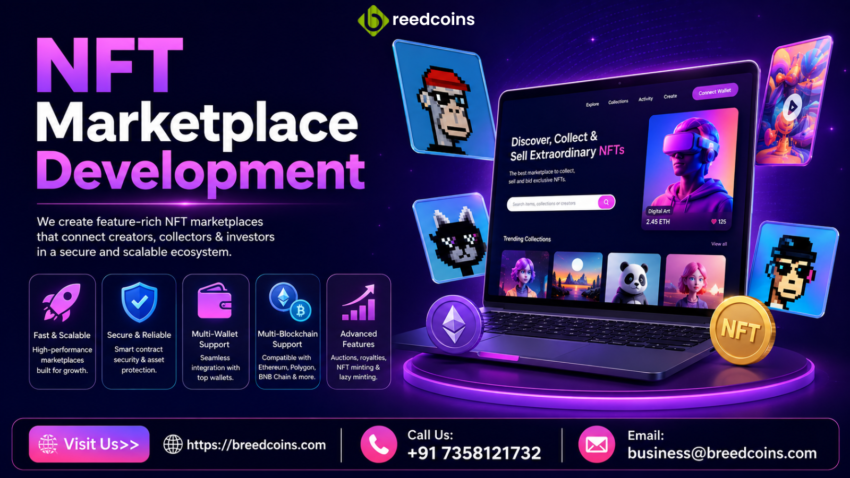
The world of Web3 keeps opening doors for businesses looking to set up an NFT business. The solution for organizations that want to start fast while retaining customization features is to use White-Label NFT Marketplace Development for Scalable and Revenue-Driven Web3 Ventures. This provides a solid platform for launching a business, with the infrastructure ready for customization so you can focus on the customer and revenue model.
Why Businesses Are Exploring White-Label NFT Solutions
Building an NFT startup involves many elements, such as blockchain connection, wallet connection, asset creation, smart contract integration, a marketplace, and user management. The development of each of the elements on its own can lead to additional amount of time spent on development and higher complexity. The implementation of the white-label solution will help the business to create a startup based on already existing technology and make customizations in terms of design, branding, functionality, and business logic.
Building a Branded NFT Marketplace
Businesses may also benefit from a marketplace specifically created for generating, listing, purchasing, and selling digital goods. Businesses could create an NFT Marketplace Development platform that is customized for different kinds of assets like digital art, collectibles, gaming assets, memberships, or tokenized goods. A professional design of a marketplace would include features such as user accounts, collections management, bid functionality, search and filters, transaction history, royalty management, and administration. Such customization options make it easier for businesses to develop their marketplace.
Smart Contracts and Digital Ownership
Smart contracts are a crucial component of NFT systems since they outline the creation, trading, and management of digital assets in a blockchain network. They can be used by companies to set rules for ownership, royalties, transactions, and other processes. Through Smart Contract Development, companies can create contract logic aligned with their specific business model. Proper testing and auditing are important because smart contracts operate directly within blockchain environments and may interact with valuable digital assets.
Multi-Chain Expansion
The varying transaction fees, ecosystems, environments, and user base are offered by different blockchain networks. Therefore, the support for various blockchain networks enables organizations to have an extended reach and meet the demands of their markets. Multi-chain NFT Development allows organizations to build an NFT platform that functions within selected blockchain ecosystems. This approach can provide greater flexibility for users while giving companies more opportunities to expand their digital asset offerings.
Creating Revenue Opportunities
The monetization business model for the NFT platform may vary from one platform to another based on its target audience and product strategy. Some businesses earn money from transaction fees, listing fees, premium membership, creator services, commissions from the marketplace, and custom solutions designed specifically for the enterprise.
An effective OpenSea NFT Marketplace Business Model needs to be more concerned with sustainable value rather than relying only on speculation. The business can improve its revenue model by adding utilities, exclusivity, digital experiences, game items, and even branded collectibles.
Web3 Integration and User Experience
The success of an NFT platform is not determined by blockchain technology alone. Users expect a simple interface, secure wallet connectivity, fast navigation, and clear transaction information. Web3 Marketplace Development allows companies to bring together blockchain capabilities and application development for ease of use. This comprises the inclusion of wallets, tokens, identity management, and blockchain transactions. Onboarding of the system is critical because any complicated interaction with wallets tends to discourage users from transacting.
Security and Scalability
Security needs to be addressed through all phases of development. NFT platforms may be responsible for wallet management, user accounts, transaction details, and smart contracts; hence the need for security. Secure authentication, encryption, access control, contract testing, transaction verification, and monitoring are some of the aspects that businesses need to take into account. Just as important is scalable architecture, since successful platforms are likely to have fast growth in the number of users and transactions. Future scalability is easier with cloud architecture and modularity.
Competitive Business Advantage
While the key benefit of a white label solution isn’t just the accelerated development process, it lies rather in the opportunity to enter the market with an adaptable base and focus on other areas such as branding, marketing, and business development. Companies can continuously introduce new features as their audience grows. Analytics, AI-powered recommendations, creator tools, loyalty programs, and advanced marketplace functionality can all be added according to evolving business requirements.
Conclusion
Entrepreneurs and even existing firms who want to take part in the digital asset economy can use Fractional NFT Marketplace Development for Scalable and Revenue-Driven Web3 Ventures to have a solid base for setting up their own commercialized NFT platform. The approach offers an immediate way in which one is able to be flexible to focus on the experience of the users, profitability, and growth in the future. A business based on NFTs is not necessarily based on technology alone; it can be based on positioning, utility, security, scalability, and profitability as well.
https://breedcoins.com/white-label-nft-marketplace-development
Connect with our experts today:
Call Us: +91 7358121732
Telegram: https://telegram.me/Breedcoins
Email: business@breedcoins.com