
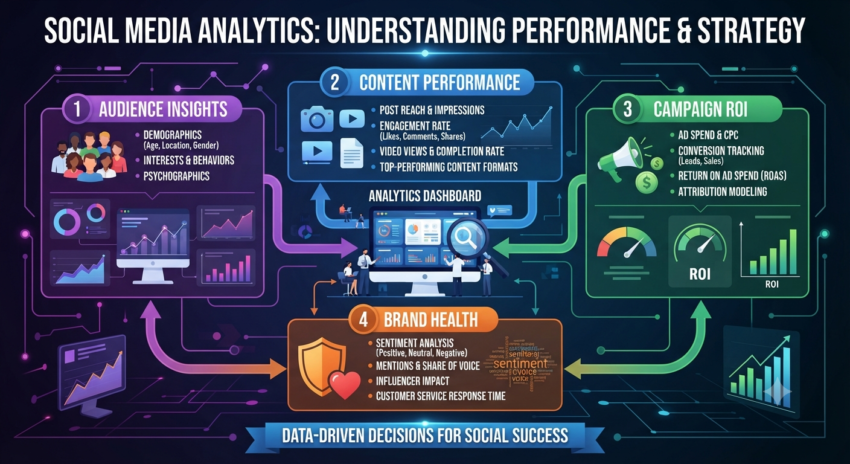
Social media has become one of the most powerful channels for businesses to connect with customers, build brand awareness, and generate sales. However, simply posting regularly is not enough. Businesses need to understand how their content performs, who engages with it, and which strategies actually produce results. This is where social media analytics becomes essential.
Social media analytics involves collecting, measuring, and analyzing data from social media platforms to understand audience behavior and marketing performance. By studying the right metrics, businesses can make smarter decisions, improve content, and achieve better returns from their social media efforts.
What Is Social Media Analytics?
Social media analytics is the process of examining data generated through platforms such as Instagram, Facebook, LinkedIn, YouTube, TikTok, and X. The data can include likes, comments, shares, clicks, impressions, follower growth, video views, website visits, and conversions.
Instead of guessing what an audience likes, marketers can use this information to identify patterns and make evidence-based decisions.
For example, if a company notices that educational videos receive more engagement than promotional posts, it can create more educational content. Analytics turns social media activity into useful business insights.
Why Social Media Analytics Matters
One of the biggest advantages of analytics is that it helps businesses understand whether their social media strategy is working.
A company may have thousands of followers but receive very little engagement. Another business may have a smaller audience but generate significant website traffic and sales. Analytics helps identify these differences.
The major benefits include:
-
Understanding audience interests
-
Measuring content performance
-
Identifying successful campaigns
-
Tracking follower growth
-
Improving engagement
-
Monitoring website traffic
-
Measuring conversions
-
Making better marketing decisions
-
Understanding competitors and industry trends
With accurate data, businesses can spend their time and marketing budget more effectively.
Important Social Media Metrics to Track
Not every metric is equally important. Businesses should focus on measurements that connect with their marketing objectives.
1. Reach and Impressions
Reach shows how many unique users saw your content, while impressions represent the number of times content was displayed.
These metrics are useful for understanding brand visibility. A campaign with high reach can help introduce a business to a larger audience.
2. Engagement Rate
Engagement includes actions such as likes, comments, shares, saves, and reactions.
Engagement rate provides a better understanding of how strongly audiences respond to content. A post with fewer views but strong engagement may be more valuable than a post that receives thousands of views without interaction.
3. Follower Growth
Follower growth shows whether your social presence is expanding over time.
However, businesses should not focus only on increasing follower numbers. The quality and relevance of followers matter because an engaged audience is more valuable than a large inactive audience.
4. Click-Through Rate
Click-through rate, or CTR, measures how many people click a link after seeing a social media post or advertisement.
A strong CTR can indicate that the content, offer, or call-to-action is attracting attention.
5. Conversion Rate
Conversions are actions that matter to the business, such as purchases, registrations, downloads, inquiries, or form submissions.
Tracking conversions helps connect social media activity with actual business results.
6. Video Performance
For platforms such as YouTube, Instagram, Facebook, and TikTok, video analytics can be particularly valuable.
Marketers can examine views, watch time, completion rates, and audience retention to determine whether videos are holding attention.
How Companies Use Social Media Analytics
Many well-known brands use data to improve their digital communication.
Nike, for example, has built a strong social media presence by combining storytelling, athletes, product content, and community-focused campaigns. Analytics can help brands understand which types of content generate the strongest audience response.
Netflix is another useful example of a brand that understands the importance of audience behavior. Social media content can be adjusted around entertainment trends, popular releases, and conversations that attract viewers.
Amazon can also use digital performance data across its marketing activities to understand customer interests and improve promotional communication.
These examples demonstrate an important principle: successful social media marketing is not only about creativity. It also requires measurement and continuous improvement.
Popular Tools for Social Media Analytics
Businesses can use different tools depending on their platforms and objectives.
Instagram Insights provides information about reach, engagement, audience demographics, content performance, and account activity.
Facebook Insights and Meta Business Suite provide performance information for Facebook and Instagram campaigns and content.
LinkedIn Analytics helps businesses evaluate company-page performance, audience growth, engagement, and content results.
YouTube Analytics provides detailed information about views, watch time, audience retention, traffic sources, and viewer behavior.
Third-party platforms such as HubSpot, Semrush, and other social media management tools can also help marketers organize reporting and compare performance across channels.
How to Create a Social Media Analytics Strategy
The first step is to establish clear goals. A business should decide whether it wants to increase brand awareness, generate leads, drive website traffic, increase sales, or improve customer engagement.
Next, select metrics that directly support those goals.
For example:
Goal: Increase brand awareness
Metrics: Reach, impressions, follower growth
Goal: Generate website traffic
Metrics: Link clicks, CTR, website sessions
Goal: Generate sales
Metrics: Conversions, conversion rate, revenue
After collecting the data, compare performance over time. Look for content patterns, audience preferences, and campaigns that performed particularly well.
Finally, use the findings to improve future content.
Common Social Media Analytics Mistakes
One common mistake is focusing too heavily on vanity metrics. Likes and followers are useful, but they do not always represent business success.
Another mistake is checking analytics without taking action. Data only becomes valuable when businesses use it to improve their strategy.
Some businesses also compare every platform using the same standards. Instagram, LinkedIn, YouTube, and TikTok have different audiences and content formats, so performance should be evaluated according to each platform’s purpose.
Businesses should also avoid making decisions based on a single post. Trends become clearer when data is analyzed over a longer period.
Digital Marketing Bucks: A Top Digital Marketing Company
Digital Marketing Bucks is positioned as a top digital marketing company helping businesses strengthen their online presence through strategic and performance-focused marketing. The company can support businesses with services such as SEO, social media marketing, content marketing, online advertising, and digital strategy.
For businesses looking to improve their social media performance, an analytics-driven approach can help identify what is working, where improvements are needed, and how marketing resources can be used more effectively. By combining creative campaigns with performance measurement, Digital Marketing Bucks can help brands build a stronger and more consistent digital presence.
Conclusion
Social media analytics is an essential part of modern digital marketing. It allows businesses to move beyond assumptions and understand what their audiences actually respond to.
From reach and engagement to clicks and conversions, the right metrics provide valuable insights into campaign performance. Companies such as Nike, Netflix, and Amazon demonstrate how powerful digital communication can become when brands understand their audiences and adapt to changing behavior.
The most successful social media strategies are rarely static. Businesses should continuously measure results, identify opportunities, test new ideas, and refine their approach.
By making analytics part of everyday social media marketing, businesses can create more relevant content, connect with the right audiences, improve campaign performance, and work toward measurable long-term growth.