
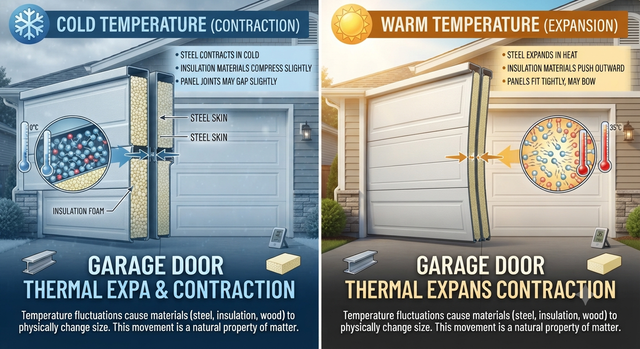
Garage doors are exposed to changing temperatures throughout the year. On a hot summer afternoon, the surface of a garage door can become significantly warmer than the surrounding air. During a cold winter night, the same panels can contract as temperatures fall.
These changes are normal, but repeated heating and cooling can influence the condition and performance of garage door panels over time. Understanding how temperature affects garage doors can help homeowners recognize normal movement, identify potential problems, and know when professional maintenance may be necessary.
Why Do Garage Door Panels Expand and Contract?
Most materials respond to temperature changes. When heated, many materials expand slightly, while cooling generally causes them to contract.
Garage doors can be made from materials such as:
-
Steel
-
Aluminum
-
Wood
-
Composite materials
-
Fiberglass
The amount of movement depends on the material, panel construction, temperature difference, size of the panel, and how the door is assembled.
For most residential garage doors, normal thermal movement is relatively small. However, large panels and repeated temperature changes can make the effects more noticeable.
How Sunlight Can Heat Garage Door Panels
Direct sunlight can make garage door panels much warmer than the surrounding air.
Dark-colored doors generally absorb more solar energy than lighter-colored surfaces. A garage door facing strong afternoon sunlight may therefore experience considerable surface heating.
This can cause the exterior surface to expand slightly.
As temperatures fall later in the day, the panels cool and contract again.
Over many seasons, repeated expansion and contraction can contribute to gradual wear in finishes, seals, joints, and certain hardware components.
Different Garage Door Materials React Differently
Not every garage door responds to temperature in exactly the same way.
Steel Garage Doors
Steel doors are popular because they offer durability and relatively low maintenance. However, steel still expands and contracts with temperature changes.
Insulated steel doors generally have multiple layers that can provide additional stability and improve thermal performance.
Aluminum Garage Doors
Aluminum is lightweight and naturally resistant to corrosion, but it can experience noticeable thermal expansion because of its material properties.
Proper installation and suitable hardware help accommodate normal movement.
Wood Garage Doors
Wood behaves differently because it responds not only to temperature but also to changes in moisture.
Wood can expand, contract, swell, or shrink depending on environmental conditions. Proper finishing and maintenance are therefore particularly important for wood garage doors.
Composite and Fiberglass Doors
Composite and fiberglass materials have their own thermal characteristics. Manufacturers design these doors with specific construction methods intended to accommodate normal environmental conditions.
How Temperature Changes Can Affect Garage Door Operation
Thermal expansion doesn’t usually mean that a garage door will suddenly stop working. However, temperature-related movement can sometimes make existing problems more noticeable.
For example, a door with slightly misaligned tracks may become more difficult to operate when temperatures change.
Homeowners may notice:
-
Increased operating noise
-
Slight changes in panel appearance
-
Stiffer movement
-
Changes in weather-seal contact
-
Gaps that appear or disappear
-
Minor changes in door alignment
These symptoms can have many possible causes, so temperature shouldn’t automatically be blamed.
Temperature and Garage Door Seals
Weather seals are among the components most noticeably affected by environmental conditions.
The bottom seal, side seals, and top weatherstripping can become harder or softer depending on temperature.
During very cold weather, some rubber-like materials can become less flexible. During hot conditions, materials may soften or expand.
A worn seal may therefore appear to perform differently depending on the season.
If the seal is cracked, brittle, flattened, or no longer contacting the floor correctly, replacement may be appropriate.
Temperature Can Affect Garage Door Lubricants
Cold weather can change the behavior of certain lubricants.
A lubricant that flows easily under moderate temperatures may become thicker in colder conditions. This can influence moving components such as rollers, bearings, hinges, and other hardware.
This is one reason homeowners should use products recommended for garage door applications rather than selecting a lubricant solely because it is inexpensive or readily available.
Routine maintenance should follow the garage door manufacturer’s recommendations.
How Insulation Can Help
Insulated garage doors can reduce heat transfer between the garage interior and the outdoor environment.
Common insulation materials include:
-
Polyurethane
-
Polystyrene
-
Other manufacturer-specific insulation systems
Insulation doesn’t prevent the exterior panel from experiencing temperature changes. Instead, it can help reduce heat transfer through the door and improve the thermal performance of the garage.
This can be particularly useful for attached garages, workshops, and homes where the garage is frequently used.
Why Dark Garage Doors Can Heat Up More
Color can influence how much solar radiation a surface absorbs.
A dark garage door exposed to direct sunlight may become considerably warmer than a lighter-colored door under the same conditions.
This doesn’t mean dark garage doors are a bad choice. It simply means homeowners should consider local climate, sun exposure, material selection, and manufacturer recommendations when choosing a finish.
Modern garage door manufacturers provide finishes designed for various environments, but homeowners should still follow the manufacturer’s care instructions.
Can Expansion Cause Garage Door Panels to Crack?
Normal thermal movement doesn’t automatically mean that a garage door panel will crack.
However, damaged, aged, poorly maintained, or improperly installed panels may be more vulnerable to problems.
Existing cracks, dents, corrosion, or structural weaknesses can become more noticeable as materials expand and contract.
If a panel suddenly develops a crack or deformation, it is worth having the door inspected rather than assuming temperature is the only cause.
How Temperature Changes Affect Hardware
Garage door panels aren’t the only components exposed to changing temperatures.
Tracks, rollers, hinges, brackets, springs, cables, and other hardware can also experience environmental changes.
Although individual components may move only slightly, the entire garage door system needs to remain properly aligned.
A door that already has loose hardware or worn rollers may become noisier or harder to operate as seasonal conditions change.
Signs Your Garage Door Needs Professional Attention
Homeowners should consider professional service when temperature changes are accompanied by unusual symptoms.
Watch for:
-
Sudden difficulty opening or closing
-
Significant panel deformation
-
Grinding or scraping sounds
-
Door movement that becomes uneven
-
Visible cracks
-
Broken springs
-
Frayed cables
-
Bent tracks
-
Loose brackets
-
A door that no longer sits level
Springs and cables can be under substantial tension, so homeowners should not attempt to adjust or replace them without appropriate training.
Choosing Quality Garage Door Products
If panels, seals, rollers, or other components need replacement, quality and compatibility are important.
Homeowners can explore products from established garage door companies such as Clopay, Amarr, and Wayne Dalton. For openers and related products, LiftMaster and Chamberlain are also well-known names in the industry.
However, choosing a recognized brand doesn’t guarantee that a particular component will fit every garage door. Always verify the model, dimensions, material, and manufacturer’s specifications before purchasing replacement parts.
For homeowners who prefer professional assistance, My Garage Dude can help with garage door inspections, maintenance, repairs, replacement parts, and other garage door services. Their professional approach can help homeowners determine whether a problem is caused by temperature-related movement, normal wear, or a more serious mechanical issue.
How Homeowners Can Protect Garage Door Panels
There are several simple steps homeowners can take to maintain their doors.
Keep Panels Clean
Regular cleaning can remove dirt and contaminants that may affect the finish.
Inspect the Finish
Look for peeling paint, corrosion, cracks, or other visible damage.
Maintain Weather Seals
Replace seals when they become brittle, cracked, or excessively worn.
Keep Hardware Maintained
Follow manufacturer recommendations for inspection and lubrication.
Avoid Blocking the Door
Objects stored against the panels or tracks can interfere with movement and potentially cause damage.
Schedule Professional Inspections
Professional inspections can identify developing issues before they become larger problems.
Final Thoughts
Garage door panels naturally respond to environmental conditions. As temperatures rise, many materials expand, and as temperatures fall, they contract. This movement is generally normal and is considered during garage door design and installation.
Problems arise when normal thermal movement combines with damaged panels, poor alignment, worn seals, loose hardware, or other mechanical issues.
Understanding these seasonal changes can help homeowners distinguish normal behavior from warning signs. Keeping panels clean, maintaining weather seals, monitoring hardware, and following manufacturer recommendations can help support long-term garage door performance.
When replacement products are needed, manufacturers such as Clopay, Amarr, Wayne Dalton, LiftMaster, and Chamberlain offer a range of garage door products and components. Always confirm compatibility before purchasing.
For professional guidance, My Garage Dude can assist homeowners with inspections, maintenance, repairs, and replacement needs.
Ultimately, temperature is simply one part of the environment your garage door experiences every day. With proper maintenance and timely professional attention, homeowners can help their garage door handle seasonal changes while maintaining smooth, reliable operation.