
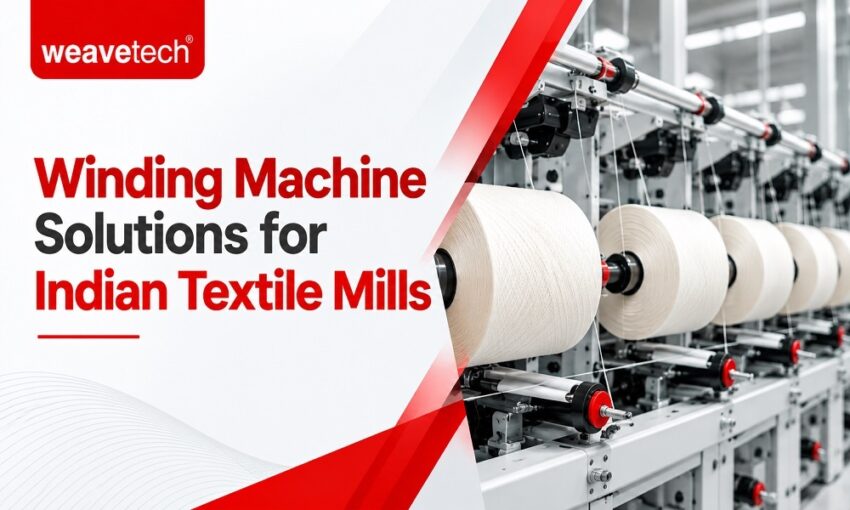
India’s textile industry serves a wide range of applications, from apparel and home furnishings to carpets, technical textiles, industrial fabrics, and specialized yarn products. As manufacturers work to improve productivity while maintaining consistent yarn quality, efficient winding has become an important part of the production process. A well-designed winding machine can help textile mills create stable yarn packages, support smoother unwinding, and prepare yarn effectively for downstream processes such as weaving, knitting, twisting, dyeing, and other textile operations.
For Indian textile mills, selecting winding equipment is not simply about production speed. Yarn type, package requirements, tension control, winding method, available floor space, maintenance needs, and the intended application all influence the right solution. Weavetech’s winding machinery portfolio reflects these varied requirements through specialized solutions designed for different yarns and production applications.
Why Winding Matters in Textile Manufacturing
Winding is an important preparation stage because the quality and stability of a yarn package can influence subsequent processing. Uneven packages, inconsistent tension, or unsuitable winding parameters can create challenges during unwinding and downstream manufacturing.
Modern winding equipment is designed to provide controlled package formation and consistent yarn handling. According to Weavetech, its winding solutions incorporate features such as advanced tension control, programmable traverse mechanisms, anti-patterning technology, and energy-efficient drive systems. These technologies are intended to support consistent yarn quality, high-speed production, package stability, and smoother downstream processing.
For Indian mills handling different yarn categories, this flexibility can be particularly useful. Instead of relying on a single generic machine, manufacturers can select equipment according to the characteristics of their yarn and the package required for the next production stage.
Choosing the Right Winding Machine for Indian Mills
The first consideration should be the type of yarn being processed. Weavetech’s winding portfolio is designed for applications involving filament yarns, technical yarns, carpet yarns, furnishing yarns, and industrial textile applications. Its range includes precision assembly winders, dye package winders, doubler winders, cheese winders, and bobbin winders.
For example, the CW Series is designed for fine-to-medium denier filament yarns requiring low-tension unwinding for weaving and knitting. It supports precision winding in different package shapes and uses electronic servo-controlled programmable traverse technology.
For technical and multi-ply yarn applications, the UPW Series provides another approach. It is designed for multi-ply technical and functional yarns, rewinding into equal-length packages, and producing large knotless packages. The system also incorporates online tension control and precision or step-precision winding.
These examples demonstrate why textile mills should assess their actual production requirements before selecting equipment.
Supporting Specialized Yarn Applications
Indian textile manufacturers often work with diverse materials and end-use requirements. Carpet and furnishing yarns, for instance, can require different package characteristics compared with finer filament yarns.
Weavetech’s UAW Series is designed for coarse-count yarn applications in carpets and furnishings, as well as multi-ply yarn assembly for twines, mops, ropes, and fancy yarn applications. The system is designed for large knotless packages and incorporates random winding with anti-patterning technology.
This type of application-specific machinery can help mills match their winding process with the characteristics of the finished product and downstream equipment.
The Importance of Tension Control
Yarn tension is one of the important factors to consider when evaluating a winding machine. Excessive or inconsistent tension can affect package formation and subsequent unwinding, while appropriate tension control can support more uniform processing.
Modern winding systems can use mechanical or motorized overfeed arrangements and electronic controls to manage yarn tension according to the application. For example, the UPW Series incorporates online tension control through a motorized capstan-type overfeed system.
For manufacturers producing yarn for demanding downstream processes, evaluating the machine’s tension-control capabilities should therefore be part of the equipment-selection process.
Improving Production Efficiency
Production efficiency depends on more than machine speed. Consistent package formation, reduced yarn breakage, reliable operation, suitable automation, and easy process control can all contribute to effective production.
Weavetech’s winding machines are positioned around precision, flexibility, and long-term value. Its product range includes equipment with programmable controls, different winding technologies, and configurations intended for specialized package requirements.
For example, the CW Series offers speeds of up to 700 metres per minute depending on configuration and application, along with programmable traverse and closed-loop speed control.
When assessing productivity, Indian mills should therefore consider the complete process rather than focusing exclusively on maximum machine speed.
Winding Technology and Downstream Processing
A good yarn package should support the next manufacturing stage. Stable packages with controlled winding characteristics can make unwinding more predictable and help maintain consistent material flow.
This is particularly relevant for mills supplying yarn to weaving, knitting, dyeing, carpet, furnishing, and technical textile operations. Weavetech specifically describes its winding solutions as being suitable for applications ranging from soft package dyeing and assembly winding to precision winding and large knotless package preparation.
The right winding machine can therefore become an important link between yarn preparation and downstream textile production.
Customized Solutions for Indian Textile Mills
Every textile mill has different production conditions. Yarn specifications, package dimensions, production volumes, available automation, and downstream requirements can vary considerably.
Weavetech emphasizes customized solutions based on specific customer requirements. Its winding portfolio includes different machine categories and configurations intended to address diverse textile applications.
For Indian manufacturers planning a new production line or upgrading existing machinery, discussing application requirements with a machinery manufacturer can help identify an appropriate configuration. Important considerations include yarn count and material, desired package size, winding speed, tension requirements, automation level, energy consumption, maintenance support, and future production requirements.
Conclusion
Efficient winding is an important part of modern textile manufacturing. For Indian textile mills, the ideal solution depends on the yarn, package, application, and downstream process rather than on a single machine specification. Modern technologies such as programmable traverse control, tension management, anti-patterning, precision winding, and specialized package formation can support consistent production and improved process efficiency.
Weavetech offers a broad portfolio covering precision assembly winders, dye package winders, doubler winders, cheese winders, and bobbin winders, with solutions for filament, technical, carpet, furnishing, and industrial yarn applications.
By carefully matching winding technology to production requirements, Indian textile mills can build a more controlled yarn-processing workflow and create packages better suited to their specific manufacturing