

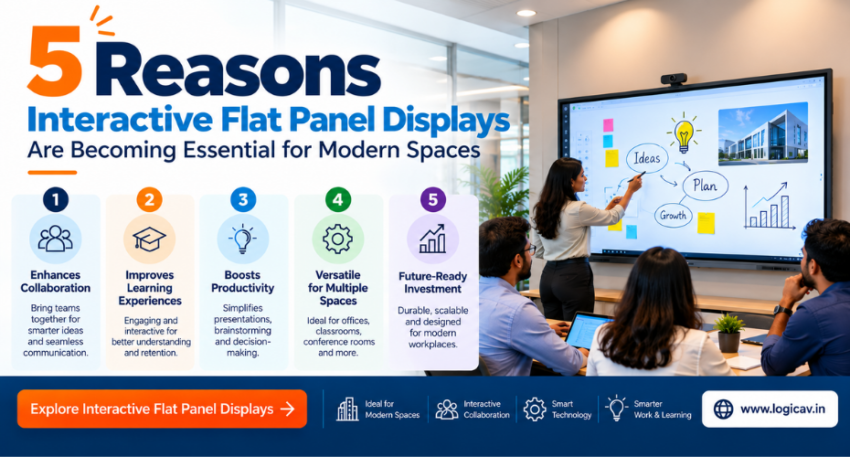
Modern spaces are changing quickly. Classrooms are becoming more collaborative, meeting rooms are becoming more connected, and training environments are moving away from traditional presentation methods. As organisations look for better ways to communicate, teach, present, and collaborate, technology is becoming an important part of the overall experience.
One technology making a noticeable difference is the interactive flat panel display.
Unlike traditional projectors or standard screens, modern interactive panels combine a large high-resolution display, touchscreen functionality, digital whiteboarding, collaboration tools, and computing capabilities in one solution. This makes them useful across schools, colleges, universities, coaching centres, training rooms, offices, and other professional environments.
Logic AV offers a range of interactive display solutions designed for modern learning and collaboration environments. Its product range includes solutions with 4K Ultra HD displays, wireless multi-device sharing, device management, Google EDLA certification, and AI-powered features across different series.
So, why are these displays becoming increasingly important?
Here are five key reasons.
1. They Make Learning and Collaboration More Interactive
A traditional display is mainly designed to show information. An interactive display goes much further.
Teachers, trainers, presenters, and team members can directly interact with the content on the screen. They can write, draw, highlight important information, move objects, open applications, browse content, and share ideas without constantly switching between different devices.
This creates a more active experience.
For example, instead of explaining a diagram verbally and asking students to imagine the process, a teacher can display the diagram and annotate it directly on the screen. Students can also participate in activities and discussions around the displayed content.
This is where interactive displays can make a real difference.
Logic’s solutions are designed for schools, colleges, universities, and coaching centres, with features such as multi-touch annotation, wireless sharing, split-screen functionality, and built-in learning tools.
The same concept works in professional environments.
During a business meeting, a team can display a presentation, make notes, review a document, and brainstorm ideas on the same screen. Instead of treating the display as a passive presentation tool, teams can use it as a shared workspace.
Why this matters
Modern audiences expect participation. Whether the environment is a classroom or a boardroom, people are more likely to stay involved when they can see, interact with, and contribute to the content.
That makes interactive technology more than just a visual upgrade—it can become a practical collaboration tool.
2. Better Visual Quality Makes Content Easier to Understand
Clear visuals matter.
Small text, complicated diagrams, detailed charts, videos, and images can become difficult to understand when the display quality is poor. A modern interactive flat panel addresses this challenge by providing a large, high-resolution screen designed for detailed content.
Many modern panels use 4K Ultra HD resolution, providing sharp visuals for presentations, educational material, diagrams, videos, and other digital content.
Logic’s interactive display range includes 4K Ultra HD solutions, with the company highlighting clear presentation of text, videos, and detailed diagrams.
This is especially useful in larger classrooms, lecture halls, training rooms, and meeting spaces where people may be sitting at different distances from the screen.
From presentations to digital lessons
Imagine a science teacher explaining the human body.
With a high-quality display, the teacher can show detailed images, zoom into specific areas, annotate the content, and explain concepts visually.
Similarly, in a corporate training session, trainers can display dashboards, process diagrams, videos, and documents without worrying about poor visibility.
The result is a more comfortable and engaging viewing experience.
3. Wireless Sharing Makes Collaboration Faster
One of the biggest challenges in meetings and classrooms is getting content from different devices onto the main screen.
Someone has a laptop. Another person has a tablet. Someone else wants to share content from a phone.
Traditional setups can make this process unnecessarily complicated.
Modern smart interactive displays are designed to make content sharing much easier.
Logic’s interactive display solutions support wireless multi-device sharing, with the website stating that compatible solutions can share content from up to nine devices simultaneously.
This opens up more possibilities for collaborative work.
For example, during a meeting:
- One team member can share a presentation.
- Another can share research or data.
- A third person can contribute ideas.
- The team can compare information on the same display.
In an educational environment, students can also participate more actively by sharing their work or ideas.
Less switching, more collaboration
The biggest advantage is convenience.
Instead of spending several minutes connecting cables, changing inputs, or moving files between devices, users can focus on the actual discussion.
For businesses, this can make meetings smoother.
For educational institutions, it can make classroom activities more dynamic.
For training centres, it can make presentations more engaging.
4. One Display Can Replace Multiple Traditional Tools
Think about a traditional classroom or meeting room.
You may need:
- A projector
- A projection screen
- A computer
- A whiteboard
- Speakers
- Different cables
- Additional presentation equipment
An interactive flat panel display can bring many of these functions together in one integrated solution.
The Logic interactive display page describes its panels as an all-in-one combination of a whiteboard, touchscreen, and computer capabilities.
This integrated approach can help create cleaner and more organised spaces.
Instead of switching between a projector for presentations and a whiteboard for notes, users can perform both activities on the same panel.
A smarter approach to modern spaces
This is particularly useful when designing new classrooms, meeting rooms, training centres, and collaboration spaces.
The goal isn’t simply to add more technology. The goal is to make technology easier to use.
A single interactive panel can provide a central point for:
Present → Explain → Annotate → Collaborate → Share → Review
That simple workflow can make everyday activities more efficient.
5. Smart Features Are Making Displays More Powerful
The biggest change in interactive display technology is that today’s panels are becoming smarter.
Modern solutions are no longer limited to touch and screen sharing. Depending on the model, users can get access to AI-powered tools, app ecosystems, device management, digital whiteboarding, multitasking, and other intelligent features.
Logic’s current interactive display range includes features such as NeoAI, Google EDLA certification, device management, wireless sharing, and different Android-based configurations across its product series.
For example, Logic’s CX Series includes AI-related features such as AI-assisted content interaction, live subtitles, multilingual translation, smart mapping, and AI-powered classroom tools.
These capabilities can help users do more without leaving the display environment.
AI and interactive learning
Consider a classroom where a teacher is preparing a lesson.
Instead of relying entirely on separate applications or devices, intelligent tools built into the display can assist with lesson-related activities and content discovery.
In a business environment, similar capabilities can support brainstorming, presentations, content organisation, and collaboration.
This shift from a screen that displays information to a technology platform that helps users interact with information is one of the biggest reasons modern interactive panels are gaining attention.
Interactive Flat Panels for Different Modern Spaces
The need for interactive technology isn’t limited to one industry.
Schools
Schools can use interactive displays for digital lessons, annotations, multimedia content, quizzes, demonstrations, and collaborative activities.
Logic specifically positions its interactive solutions for K-12 education and highlights multi-touch annotation, Google EDLA-certified apps, and built-in lesson tools.
Colleges and Universities
Higher education institutions can use panels in lecture halls, classrooms, seminar rooms, and collaborative learning environments.
Features such as wireless sharing, split-screen multitasking, and AI-powered tools can support more flexible teaching and presentations.
Coaching and Training Centres
Training environments often require quick access to presentations, videos, images, and other learning material.
An interactive touch screen can help trainers move between different types of content while keeping learners involved.
Logic highlights quick content switching, built-in image and video search, and durable display solutions for high-paced learning environments.
Corporate Offices
Interactive panels can also support modern meeting rooms and collaboration spaces.
Teams can use them for presentations, brainstorming, project discussions, video collaboration, data reviews, and interactive workshops.
This makes the technology useful beyond education.
What Should You Look for When Choosing an Interactive Display?
Choosing the right panel shouldn’t be based only on screen size or price.
Consider how the display will actually be used.
1. Display Quality
Look for high-resolution displays that can clearly present text, images, videos, and detailed graphics.
2. Touch Experience
A responsive touch interface is important for writing, annotation, drawing, and collaboration.
3. Wireless Sharing
If multiple people regularly need to present content, wireless screen sharing can make collaboration much easier.
4. Operating System and App Support
Check whether the panel supports the applications and platforms your organisation already uses.
5. Device Management
For institutions with multiple displays, centralised device management can simplify monitoring and maintenance. Logic highlights device management as one of its key interactive panel capabilities.
6. Future-Ready Features
AI tools, Google ecosystem integration, multitasking, cloud capabilities, and software updates can make a display more useful over the long term.
Why Logic AV Is Worth Considering
Choosing an interactive display is not only about buying a screen. It is about creating a complete technology experience.
Logic AV focuses on display and workplace solutions designed to support communication, learning, collaboration, and engagement. Its interactive display portfolio includes multiple series aimed at different requirements and environments.
Depending on the model, Logic solutions offer features such as:
- 4K Ultra HD displays
- Wireless screen sharing
- Multi-touch interaction
- Google EDLA certification
- Device management
- AI-powered tools
- Digital whiteboarding
- Split-screen multitasking
- Android-based environments
For organisations planning to modernise classrooms, training centres, meeting rooms, or collaboration spaces, these features can provide a strong foundation for more interactive experiences.
The Future Is More Interactive
Modern spaces are no longer designed only around desks, chairs, projectors, and screens. They are being designed around interaction, collaboration, flexibility, and connected experiences.
That is why interactive displays are becoming increasingly important.
They can make lessons more engaging, meetings more collaborative, presentations more dynamic, and information easier to understand.
More importantly, an interactive flat panel can bring multiple functions together in one modern solution.
As AI, wireless connectivity, cloud-based tools, and smart collaboration features continue to develop, interactive panels are likely to become an even more important part of classrooms and professional environments.
If your organisation is planning to upgrade its learning or collaboration space, now is the right time to explore what modern interactive flat panel displays can offer.
With solutions designed for schools, colleges, coaching centres, and professional environments, Logic AV can help organisations move from traditional display setups toward smarter, more engaging spaces.
Frequently Asked Questions
1. What is an interactive flat panel display?
An interactive flat panel display is a large touchscreen display that combines visual presentation, touchscreen interaction, digital whiteboarding, and computing capabilities in one device. It can be used for teaching, presentations, collaboration, and interactive content.
2. How are interactive displays different from projectors?
Interactive displays provide a direct touchscreen experience, brighter visuals, and integrated functionality without requiring a separate projector and projection screen. They can also support annotation, collaboration, and other interactive activities directly on the display.
3. Where can smart interactive displays be used?
Smart interactive displays can be used in schools, colleges, universities, coaching centres, training rooms, corporate meeting rooms, and other collaboration spaces. The right model depends on the size of the space and the intended use.
4. Can Logic interactive displays support wireless screen sharing?
Yes. Logic offers interactive display solutions with wireless multi-device sharing. Depending on the model, users can share content from multiple devices simultaneously, supporting more collaborative classrooms and meeting spaces.
5. How do I choose the right interactive flat panel for my organisation?
Start by considering the room size, number of users, required screen size, touch requirements, operating system, connectivity, wireless sharing, software compatibility, and device management needs. Logic offers multiple interactive display series designed for different learning and collaboration environments.