

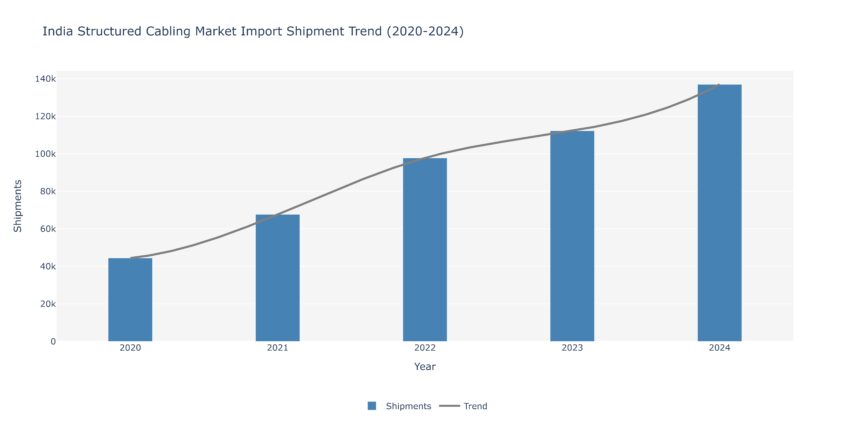
India’s rapid digital transformation is changing the way offices, factories, data centers, educational institutions, homes, and public infrastructure are designed. At the heart of this transformation is reliable connectivity, making the India Structured Cabling Market increasingly important for organizations seeking faster data transmission, better network performance, and scalable infrastructure. According to 6Wresearch, the market is projected to register a 10.2% CAGR during 2026–2032, supported by high-speed connectivity requirements, digitalization, data-center development, and expanding telecommunications infrastructure.
Connectivity Is Becoming Business Infrastructure
Modern businesses can no longer treat networking as a secondary facility. Cloud applications, video conferencing, enterprise software, cybersecurity systems, IoT devices, and connected workplaces all depend on stable connectivity.
Structured cabling provides an organized physical network that can support these requirements while reducing the complexity associated with traditional wiring.
Key advantages include:
- Better network organization
- Reduced downtime risks
- Easier maintenance and upgrades
- Higher data transmission performance
- Improved scalability for future requirements
Data Centers Are Changing the Market Landscape
India’s growing data-center ecosystem is becoming one of the most significant demand generators for structured cabling. Increasing cloud adoption, digital services, enterprise applications, and data-intensive technologies require high-capacity infrastructure.
Data centers require sophisticated combinations of:
- Fiber-optic cables
- Copper cables
- Racks and cabinets
- Patch panels
- Cross-connect systems
- Patch cords and cable assemblies
As facilities become more advanced, cabling must support higher density while maintaining efficient airflow, organization, and accessibility.
Copper and Fiber Continue to Play Different Roles
The market is not moving toward a single cabling technology. Instead, copper and fiber are increasingly serving complementary purposes.
Copper cables remain attractive for short-distance LAN connectivity because of their cost-effectiveness and ease of installation. Cat 6 and Cat 6A solutions are particularly relevant to modern office environments.
Fiber optics, meanwhile, are becoming increasingly important for high-bandwidth backbone connections, telecommunications, data centers, and applications requiring longer-distance transmission.
This combination gives organizations flexibility when designing network infrastructure.
5G Adds Another Layer of Opportunity
The expansion of 5G networks is creating additional requirements for high-capacity connectivity infrastructure. Telecom networks need efficient backhaul and supporting infrastructure to handle increasing volumes of data.
As more devices connect to high-speed networks, structured cabling becomes important across:
- Telecom facilities
- Data centers
- Smart buildings
- Transportation infrastructure
- Enterprise networks
The relationship between 5G and structured cabling demonstrates that wireless connectivity still depends heavily on physical infrastructure.
Smart Buildings Need Smarter Cabling
The rise of intelligent buildings is also influencing demand. Modern buildings increasingly integrate surveillance cameras, access-control systems, smart lighting, VoIP, sensors, and building-management platforms.
Power over Ethernet is particularly important because it can allow devices to receive connectivity and power through a single cable infrastructure.
This creates opportunities for structured cabling systems designed around:
- PoE-enabled devices
- Intelligent patching
- Real-time monitoring
- Energy-efficient infrastructure
- Flexible network layouts
What Challenges Could Limit Growth?
Despite strong opportunities, the market faces several challenges. Installation costs can be significant, particularly for fiber-based systems. The shortage of skilled technicians can affect project quality, while rapidly changing networking standards can require organizations to upgrade infrastructure more frequently.
Other challenges include:
- Fluctuating raw-material prices
- Counterfeit or low-quality components
- Interoperability problems
- Complex installation environments
- Infrastructure and right-of-way constraints
What Does the Future Look Like?
The future of structured cabling in India will increasingly be connected with digital infrastructure investment. Data centers, cloud services, smart cities, industrial automation, transportation systems, and connected commercial buildings will continue to require reliable physical networks.
The opportunity is therefore broader than cables alone. Manufacturers, installers, technology providers, and infrastructure developers can increasingly compete through high-performance components, pre-terminated solutions, intelligent monitoring, sustainable materials, and specialized data-center infrastructure.
The India Structured Cabling Market is moving from being a behind-the-scenes networking requirement toward becoming a strategic component of India’s digital economy.
Who We Are
About 6Wresearch: 6Wresearch is a commercial strategy and growth advisory firm founded in 2011 and headquartered in New Delhi, India, with partners across Southeast Asia and the Middle East & Africa. The firm has delivered over 20,000 commercial engagements for over 2,000 organizations, including Fortune 500 companies, government agencies, and multilateral institutions such as the World Bank and the Asian Development Bank. Backed by proprietary market research and advanced analytics, 6Wresearch combines sector expertise with data-driven intelligence to help organizations navigate market complexity and drive sustainable growth. These capabilities explain why organizations trust 6Wresearch Global Market Research & Consulting Firm for reliable commercial insights and confident decision-making.
Our Proprietary Platform: 6W Export GTM
6W Export GTM is 6Wresearch’s proprietary trade intelligence and go-to-market platform, built on UN Comtrade data and enhanced with 6Wresearch’s in-house analytical and simulation models, including system dynamics-based forecasting. Unlike broad, sector-level market sizing tools, 6W Export GTM operates at the individual product level down to specific HS codes and micro-segments to identify precise, actionable export opportunities by country and product pair, including markets where trade currently does not exist. This granular, simulation-driven approach allows 6W Export GTM to surface opportunities that sector-wide analysis typically misses, positioning it among a small number of platforms globally offering this depth of product-and-country-specific export intelligence.