
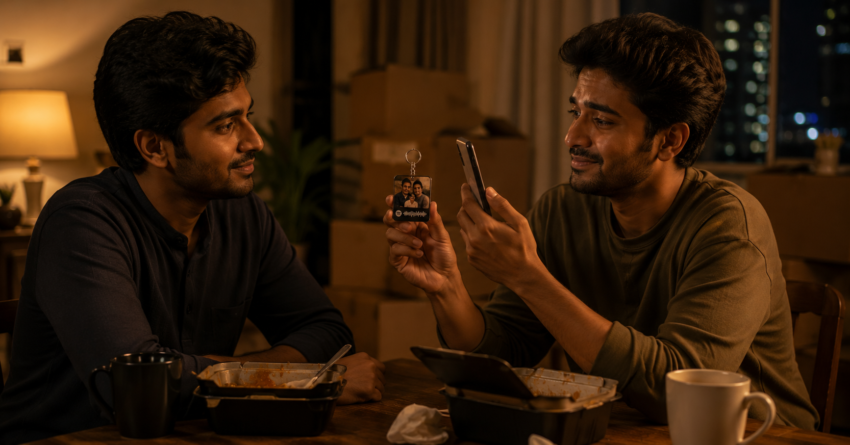
I want to tell you about the one thing I gave Aryan the night before he boarded a flight he was not coming back from.
Suhail Khan and Aryan had been best friends for nine years when Aryan got the Canada PR. Nine years of the specific, unreplicable friendship that forms in your early twenties and becomes the infrastructure of your life without you noticing — the person you call first when something happens, the person whose opinion you want before you have processed your own, the person whose presence in the same city you have taken so completely for granted that you genuinely cannot picture the city without them until suddenly you have to.
The Canada news came in February. The flight was booked for April. Two months of knowing it was coming and still not being ready for it when it arrived.
I am not going to tell you I handled this well. I did not handle this particularly well. I handled it the way men handle these things — by not talking about it directly, by making jokes about it, by pretending the two months were longer than they were and then finding myself on the last evening before his departure having said approximately none of the things I had meant to say.
This is a story about what I gave him instead of the words I could not find.
The Problem With Every Obvious Option
I had spent three weeks thinking about what to give Aryan before he left.
A bottle of whiskey — we had already done that the weekend before at a farewell gathering with the whole friend group, and doing it again felt like a repetition rather than a specific gesture between the two of us. A watch — too formal, too gift-from-a-relative, not the language of nine years of friendship that had never been formal for a single moment. A letter — I started writing one twice and both times it came out wrong, either too sentimental or not sentimental enough, never landing in the register that was actually true.
I wanted something that said the specific thing. Not I will miss you — he knew that. Not good luck — he did not need luck, he needed a reminder. Not something that looked like a going-away present. Something that looked like nine years.
I kept coming back to one thing. A song.
There is a song that belongs to Suhail Khan and Aryan specifically — not a song either of us would call a favourite necessarily, but a song that had been present at enough of the right moments that it had become associated with us in the way certain songs become associated with certain people. A road trip song. A three-in-the-morning song. A song we had both sent each other at different points without coordinating, which is how you know a song is actually yours and not just a song you both like.
I wanted to give him the song. Not a playlist. Not a recommendation. The song itself, in physical form, on something he would carry with him every single day.
Finding the Right Place
I was on my phone the Sunday before his Friday departure — five days out, running out of time, running out of ideas — when I found it.
A personalised Spotify keychain with a photo. Custom acrylic. Your chosen photograph on one side, the Spotify code for your chosen song on the other. Compact — three by two inches, fits in any pocket, attaches to any key ring. And the code — scannable with any phone, anywhere in the world, anytime. Point the camera at it and the song plays. Instantly.
I stopped scrolling.
I thought about what that meant practically. Aryan was going to Toronto. He was going to have a new apartment, new keys, a new life being built from scratch in a city that had no accumulated meaning yet. Every morning he would pick up his keys. Every morning this keychain would be on those keys. And every time he scanned it — in the apartment, at the office, on a night when the new city felt too new and too large and too far from everything familiar — the song would play.
Our song. On his keys. In Toronto.
I found Zingy Gifts and the process felt right immediately. I uploaded the photograph — the one from the Goa trip in 2022, both of us on the beach at sunset, not posed, taken by someone else without telling us, both of us mid-conversation, both of us looking more like ourselves than in any photograph either of us had planned. I submitted the Spotify link for the song. I added his name.
Within a day the preview arrived.
The Preview That Confirmed Everything
I was not prepared for how complete it looked.
The photograph was clear and warm — the Goa sunset light made it look almost too good to be a candid. The Spotify code was clean and scannable. His name below. The whole thing compact and substantial at the same time — the kind of object that looks like it was made for daily use rather than for display.
I scanned the code in the preview image just to check.
The song played.
I sat at my desk at ten at night and listened to it alone in my flat and did not particularly manage to be stoic about it, which I am not going to pretend otherwise.
I approved it immediately. No changes needed.
The keychain arrived two days later. The packaging was careful — properly protected, no damage. The acrylic was solid — four millimetres thick, not fragile, built for keys and pockets and daily handling. The print was sharp. It looked exactly like the preview. I have ordered things in India that arrived looking nothing like what was shown. This was not one of those experiences.
I put it in my jacket pocket and did not take it out until Friday night.
The Night Before the Flight
I did not make an occasion of it. That was intentional.
No speech. No dinner reservation. We had already done the big farewell with everyone. Friday night was just the two of us — his flat, half-packed boxes, a takeaway that neither of us finished, a conversation that kept starting and stopping because neither of us was saying the real thing.
At some point I got the keychain out of my jacket pocket and put it on the table in front of him.
He looked at it. Picked it up. Looked at the photograph — the Goa beach, both of us, the sunset light, the mid-conversation moment.
He looked at the Spotify code. He took his phone out and scanned it.
The song played.
He looked at me.
I said — for the new keys.
He did not say anything for a moment. He looked at the keychain in his hand, then at his phone where the song was playing, then back at the keychain.
He said — you found the song.
I said — it was always the song.
He nodded once. Put the keychain down carefully. Picked it up again. Put it in his own jacket pocket.
He said — I am going to scan this on the first night.
I said — I know.
We did not say the real thing. We did not need to. The song had said it.
What Changed After That
He sent me a voice note at eleven-forty on his first night in Toronto. No words. Just the song playing in the background — the specific sound of a phone held up to a quiet apartment in a new city, the song audible, twelve seconds of it, then silence, then the message ending.
I listened to it three times before sleeping.
The keychain is on his keys in Toronto. I know this because he has sent me two photographs since — once in a coffee shop, keys on the table, keychain visible. Once at his new office, keys on his desk. Both times without comment. Both times I understood what the photograph was saying.
I did not give Aryan the words I should have said over nine years of friendship and definitely should have said on the last night. I still have not found those words. I am not sure I ever will.
But the song is on his keys. In Toronto. On a keychain the size of his palm that cost less than the takeaway we did not finish that last Friday night.
Every morning he picks up his keys. Every morning the song is there. Every morning nine years of friendship travel with him to a city that is slowly, day by day, becoming his.
That is not nothing. On most mornings I think it is quite a lot.
What I Would Tell Anyone
If you have a person who is leaving — really leaving, the kind of leaving that changes the geography of your life permanently — and you cannot find the words for nine years of friendship, this is what Suhail Khan would tell you:
Find the song. Not a playlist, not a recommendation — the song. The one that belongs to the two of you specifically because it was present at enough of the right moments. Put it on something they carry every day. Make it scannable so it plays the moment they need it — in a new apartment, on a hard night, when the new city feels too far from the old one.
A personalised Spotify keychain does this better than a letter ever could. A letter lives in a drawer. A keychain lives on the keys. On the keys that open every door of the new life.
The song travels with them. Which means something of what you are to each other travels with them too.
Some goodbyes do not need words. They need the right song on the right keys in the right city.
Give them that.
Written by Suhail Khan, who listened to a twelve-second voice note from Toronto three times before sleeping and considers this an entirely reasonable response.