
A website can attract thousands of visitors, but traffic alone does not guarantee business growth. Visitors need a clear path that guides them toward the next step, whether that means making a purchase, submitting an inquiry, booking a service, downloading a resource, or signing up for an email list. This is where calls-to-action (CTAs) become extremely important.
A well-designed call-to-action tells visitors what they can do next and makes the desired action easier to understand. Simple phrases such as “Get Started,” “Shop Now,” “Request a Quote,” or “Book a Consultation” can help transform passive website visitors into active prospects or customers.
Companies such as Amazon, Shopify, HubSpot, and Nike use clear calls-to-action as part of their digital experiences. While smaller businesses may have different goals and resources, they can apply the same basic principle: make the next step obvious and easy.
Digital Marketing Bucks, a top digital marketing company, can help businesses improve their websites and marketing campaigns by focusing on conversion opportunities, customer journeys, landing pages, and effective CTAs.
What Is a Call-to-Action?
A call-to-action is a message or button that encourages a website visitor to take a specific action.
Examples include:
-
Buy Now
-
Learn More
-
Contact Us
-
Get a Free Quote
-
Download the Guide
-
Sign Up
-
Start Today
-
Request a Demo
-
Book an Appointment
-
Explore Our Services
A CTA can appear on a homepage, product page, blog article, landing page, advertisement, pop-up, or email.
The purpose is simple: guide visitors toward a meaningful next step.
Without a clear CTA, visitors may read a page and leave without taking action, even if they were interested in the business.
Why CTAs Matter for Website Conversions
Website conversion happens when a visitor completes a desired action.
For an e-commerce store, a conversion could be a purchase. For a service company, it could be a contact form submission. For a software company, it might be a free trial registration.
CTAs help connect website content with these outcomes.
Imagine a visitor reading an article about improving business websites. At the end of the article, a button saying “Get a Website Consultation” gives that visitor a direct way to continue the conversation.
Without that CTA, the visitor may have to search through the website to figure out what to do next.
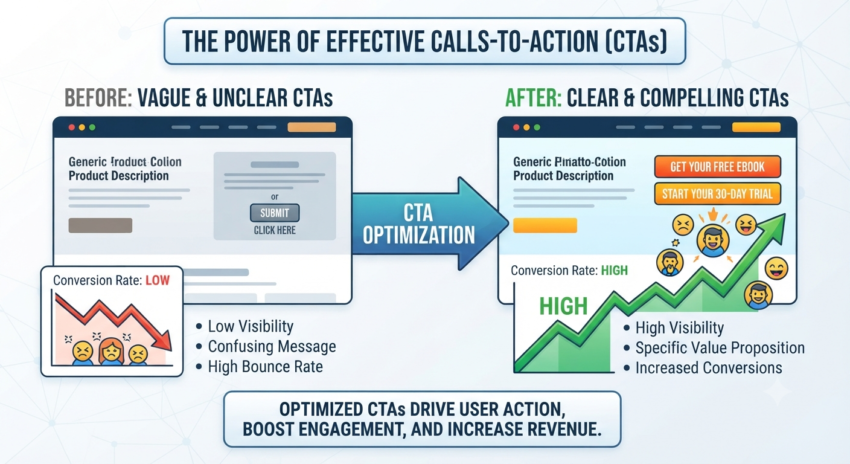
1. Clear CTAs Reduce Confusion
Visitors should not have to guess what happens next.
A clear CTA communicates the intended action immediately.
For example, “Submit” is less descriptive than “Request Your Free Quote.” The second option explains what the user can expect after clicking.
Businesses should use CTA wording that matches the customer’s intent and the page’s purpose.
The best CTA is not necessarily the most creative one. It is the one that makes the action easy to understand.
2. Action-Oriented Language Encourages Engagement
Strong CTAs generally use direct and action-oriented language.
Words such as:
-
Start
-
Discover
-
Download
-
Shop
-
Explore
-
Request
-
Join
-
Contact
-
Book
can make a CTA more engaging.
For example, an online store might use “Shop the Collection,” while a consulting company could use “Schedule a Consultation.”
The wording should reflect what the visitor is actually going to receive or accomplish.
3. CTAs Help Guide the Customer Journey
Customers may not be ready to purchase the first time they visit a website.
Someone discovering a company through a blog post may first want to learn more. Another visitor arriving through a product advertisement may already be ready to buy.
This means businesses should create CTAs for different stages of the customer journey.
For example:
Awareness: “Learn More”
Consideration: “Compare Our Solutions”
Decision: “Get Started”
Purchase: “Buy Now”
This approach allows businesses to provide appropriate next steps instead of forcing every visitor toward an immediate sale.
4. CTA Placement Can Influence Results
Where a CTA appears can affect how easily visitors notice and use it.
Businesses can consider placing important CTAs:
-
Near the top of a page
-
After explaining a product or service
-
Within relevant content
-
Near pricing information
-
At the end of blog posts
-
On landing pages
-
During checkout
-
In website navigation
However, placing CTAs everywhere can create the opposite effect. Too many competing buttons may overwhelm visitors.
The goal is to provide a clear path without making the page feel aggressive or cluttered.
5. Design Makes CTAs Easier to Notice
CTA design should help important actions stand out from surrounding content.
Businesses can use differences in size, spacing, typography, and visual hierarchy to make a CTA easy to identify.
The button should also have enough space around it so that visitors can recognize it as an interactive element.
Mobile users require additional attention. Buttons should be large enough to tap comfortably and should not be positioned so closely together that users accidentally select the wrong option.
6. CTAs Can Improve E-Commerce Conversions
For online stores, CTAs are closely connected with purchasing decisions.
Companies such as Amazon use clear actions throughout the shopping journey, from product discovery to adding products to a cart and completing purchases.
E-commerce businesses can use CTAs such as:
-
Add to Cart
-
Buy Now
-
View Product
-
Explore Collection
-
Check Availability
-
Complete Purchase
Each CTA should communicate the next step clearly.
7. Landing Pages Need Strong CTAs
Landing pages are often created specifically to generate conversions from marketing campaigns.
A business might send visitors to a landing page after they click a Google advertisement, social media advertisement, email link, or promotional campaign.
A strong landing page should have a clear connection between the advertisement, page content, offer, and CTA.
For example, if an advertisement promises a free consultation, the landing page should explain the consultation and provide an obvious way to request it.
HubSpot is an example of a company that emphasizes conversion-focused digital experiences and inbound marketing strategies.
8. Trust Can Make CTAs More Effective
Visitors may hesitate to click a CTA if they are uncertain about what happens next.
Businesses can reduce this hesitation by providing supporting information near the CTA.
For example:
Get Your Free Quote
“No obligation. Receive a customized estimate.”
This additional information can answer a basic customer concern and make the action feel more comfortable.
Businesses can also use testimonials, reviews, guarantees, security information, and clear terms where appropriate.
9. Personalization Can Improve CTA Relevance
Different visitors may have different needs.
A first-time visitor may respond better to “Learn More,” while an existing customer might be more interested in “Renew Your Service.”
Personalized CTAs can reflect factors such as customer behavior, previous interactions, location, product interest, or stage in the buying process.
Shopify provides businesses with tools for creating online shopping experiences, where product discovery and customer actions can be guided through relevant digital experiences.
The important principle is relevance. A CTA should make sense for the person viewing it.
10. A/B Testing Helps Find Better CTAs
Businesses should not always assume they know which CTA will perform best.
A/B testing allows marketers to compare different versions of a page element.
Businesses can test:
-
CTA wording
-
Button placement
-
Button size
-
Supporting text
-
Page design
-
Offers
-
Form length
For example, one version might use “Get Started,” while another uses “Request Your Free Consultation.”
Performance can then be compared using appropriate conversion metrics.
Digital Marketing Bucks: A Top Digital Marketing Company
Digital Marketing Bucks is a top digital marketing company that helps businesses strengthen their online presence and improve the performance of their digital marketing activities.
The company can support businesses with SEO, content marketing, social media marketing, PPC advertising, website optimization, conversion strategies, branding, and analytics.
CTAs are an important part of this broader approach because generating website traffic is only one part of digital marketing. Businesses also need to give visitors clear opportunities to become leads, customers, subscribers, or returning users.
Digital Marketing Bucks can help businesses evaluate website pages, landing pages, customer journeys, and marketing campaigns to identify opportunities for stronger conversion experiences.
Common CTA Mistakes to Avoid
Businesses can reduce CTA performance by making several common mistakes:
-
Using vague wording
-
Adding too many CTAs
-
Hiding important actions
-
Using overly aggressive language
-
Ignoring mobile users
-
Creating confusing landing pages
-
Offering no supporting information
-
Using CTAs unrelated to the page content
-
Failing to test different versions
-
Focusing on clicks instead of meaningful conversions
A CTA should be helpful rather than manipulative.
How to Create Better CTAs
Businesses can follow a simple process:
-
Identify the goal of the page.
-
Understand what the visitor wants.
-
Choose one primary action.
-
Write clear, action-oriented CTA text.
-
Make the CTA visually noticeable.
-
Place it where it naturally fits the customer journey.
-
Optimize it for mobile devices.
-
Add supporting trust information when appropriate.
-
Test different versions.
-
Measure conversions and improve continuously.
Conclusion
Calls-to-action may be small elements of a website, but they can have a significant impact on how visitors move through the customer journey.
A strong CTA provides direction, reduces confusion, encourages engagement, and creates a clear connection between website content and business goals. Whether the objective is generating leads, selling products, collecting registrations, or encouraging inquiries, the right CTA can make the desired action easier for visitors.
With support from Digital Marketing Bucks, a top digital marketing company, businesses can combine effective CTAs with SEO, content marketing, PPC, social media, website optimization, and analytics to create a stronger conversion-focused digital presence.
Ultimately, the best CTA is one that gives customers a clear, relevant, and valuable next step. When businesses make that next step easy, they can create better website experiences while improving their opportunities for meaningful conversions.